 en
en  Español

63L Round-Hole Vented Stackable and Nestable Crate with Attached Lid
Content
- 1 Introduction
- 2 Product Overview
- 3 Attached Lid Protection
- 4 Round-Hole Ventilation
- 5 Stackable and Nestable Construction
- 6 Advantages over Ordinary Plastic Crates
- 7 Reusable Packaging and Cost Efficiency
- 8 Applications in Warehousing and Distribution
- 9 Manufacturing Quality and Process Control
- 10 Advanced Production Capabilities
- 11 Warehouse Integration
- 12 Cleaning, Maintenance, and Service Life
- 13 Environmental and Operational Benefits
- 14 Advantages for International Buyers
- 15 Selection Guidance
- 16 Implementation in a Warehouse
- 17 Frequently Asked Questions
- 17.1 What is the capacity of the crate?
- 17.2 What are the external dimensions?
- 17.3 Does the crate have a lid?
- 17.4 Is the crate waterproof?
- 17.5 Can empty crates be nested?
- 17.6 Can loaded crates be stacked?
- 17.7 What material is used?
- 17.8 Is the crate suitable for food-related use?
- 17.9 How much does the crate weigh?
- 17.10 Can the color be customized?
- 17.11 What industries can use this product?
- 17.12 How should the crate be cleaned?
- 17.13 What should buyers confirm before ordering?
- 18 Conclusion
- 19 References
- 20 Product: 63L Round Hole Vented Stackable and Nestable Crate with Lid
Introduction
Efficient storage and transportation depend on more than simply placing goods inside a container. Modern warehouses, distribution centers, supermarkets, manufacturing plants, and e-commerce operations need storage products that protect contents, use available space efficiently, support repeated handling, and reduce operating costs. The 63L Round-Hole Vented Stackable and Nestable Crate with Attached Lid is designed to meet these requirements in one reusable logistics solution.
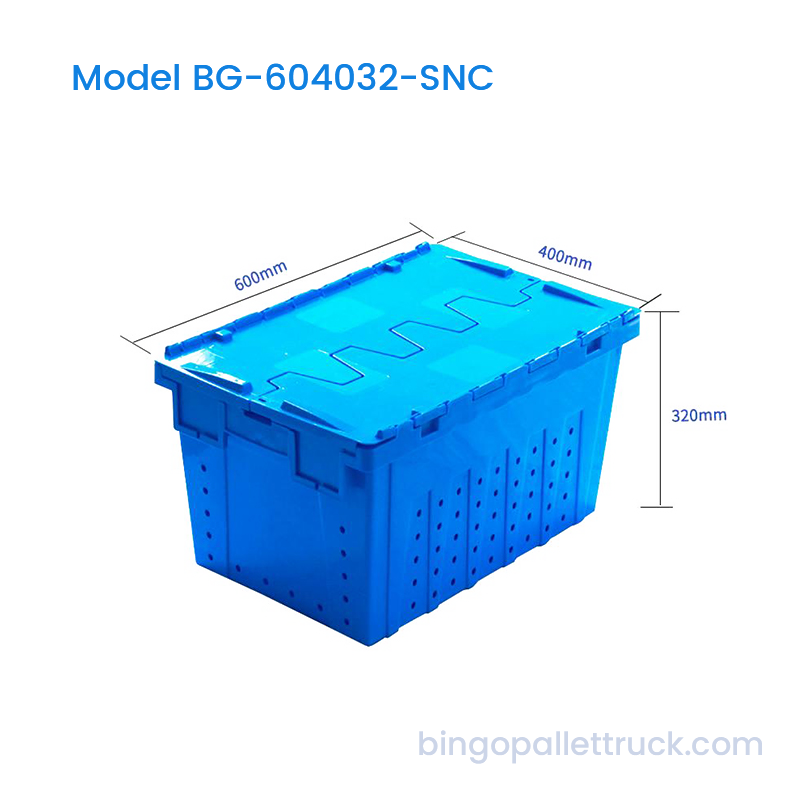
With external dimensions of 600×400×320mm, this crate follows a practical footprint widely used in warehouse and distribution environments. Its 63-liter capacity provides substantial working volume while maintaining compatibility with common storage layouts, pallets, shelving systems, conveyors, and transport vehicles. The internal dimensions of 560×375×300mm offer useful space for products, components, packaged goods, retail merchandise, agricultural items, and other materials that require organized movement.
The crate combines several features that are often purchased separately: a stackable body, a nestable structure, an attached lid, and round-hole ventilation. This combination gives the product a strong advantage over basic open crates, solid-wall totes, disposable cartons, and containers with loose lids. When closed, the attached lid helps protect goods from dust, accidental contact, and displacement. When empty, the nestable design allows the crates to be placed inside one another to reduce return-transport volume and save storage space.
Manufactured for repeated use, the crate is lightweight at approximately 2.8kg while providing the durable construction expected from a heavy-duty industrial container. It is intended for businesses seeking a dependable, reusable, and cost-conscious alternative to single-use packaging and inefficient storage methods.
63L Round Hole Vented Stackable and Nestable Crate with Lid
Product Overview
Model BG-604032-SNC is a round-hole vented plastic crate with an attached lid. The 600×400mm base footprint offers a balanced relationship between capacity, maneuverability, and space utilization. At 320mm high, the crate can hold a meaningful quantity of goods without becoming excessively difficult to lift, stack, or place on a shelf.
The 63-liter nominal capacity is suitable for many logistics applications. It can accommodate manufactured parts, tools, retail products, packaged food items, household goods, warehouse supplies, and components used in production. The exact usable capacity depends on the shape, density, and packaging of the goods being stored, but the internal dimensions provide a clear basis for evaluating compatibility before purchase.
| Product Attribute | Specification |
| Model | BG-604032-SNC |
| Product Type | Stackable and nestable plastic crate with attached lid |
| External Dimensions | 600×400×320mm |
| Internal Dimensions | 560×375×300mm |
| Nominal Capacity | 63L |
| Product Weight | Approximately 2.8kg |
| Material Information | High-density polyethylene is specified in the characteristics; production information also refers to virgin polymer material |
| Ventilation | Round-hole perforated walls |
| Lid | Integrated attached lid |
| Design Function | Stackable when loaded or closed; nestable when empty |
| Typical Applications | Warehousing, manufacturing, distribution, retail, e-commerce, and general logistics |
The combination of a standard footprint and a relatively deep interior allows the crate to work as part of a wider material-handling system. Businesses can organize multiple units on pallets, shelving, picking carts, delivery vehicles, or staging areas. Consistent external dimensions also make it easier to calculate storage density and plan warehouse zones.
One important point for technical purchasing is material verification. The product information identifies HDPE in the specification table, while other supplied descriptions refer to PP or virgin PP material. Buyers requiring a particular polymer, food-contact approval, temperature range, or regulatory certification should confirm the final resin specification and applicable compliance documents with the manufacturer before ordering. This verification does not change the crate’s overall design advantages, but it ensures that the selected version is appropriate for the intended operating environment.
Attached Lid Protection
A loose lid can be misplaced, separated from its container, or damaged during handling. The attached lid on this crate remains connected to the body, helping operators keep the complete container set together throughout storage, picking, transport, and return logistics. This is especially valuable in busy facilities where containers are frequently opened and closed by different employees.
When the lid is closed, it creates a practical barrier against dust, light debris, incidental contact, and product displacement. It also helps keep items contained when crates are moved on pallet trucks, carts, conveyors, or delivery vehicles. For operations that transfer goods between workstations, the lid reduces the need for additional wrapping or temporary covers.
The attached design can improve workplace organization as well. Employees do not need to search for a separate cover before closing a crate, and empty lids do not occupy independent storage space. In returnable packaging systems, keeping the lid permanently associated with the container simplifies counting, inspection, and circulation management.
The lid should not automatically be treated as a fully sealed, waterproof closure. The round-hole ventilation system is intentionally designed to permit airflow, and the product is not described as an airtight or liquid-tight container. Companies handling moisture-sensitive, hazardous, sterile, or liquid materials should evaluate the closure and ventilation characteristics against their specific requirements.
Round-Hole Ventilation
Ventilation is a major advantage when goods require air circulation during storage or transport. The round perforations allow air to move through the crate, helping reduce stagnant conditions. This can be useful for produce, packaged goods, components that need airflow, and products that may experience temperature variation between storage areas and vehicles.
Compared with a solid-wall container, a vented crate can support better circulation around the contents. The openings may also make it easier for operators to identify the general contents of a crate without completely opening it. In picking operations, this can improve speed when workers need to distinguish containers by visible product shape, color, or packaging.
The holes are also useful for cleaning and drainage in appropriate applications. Dust, small particles, and residual moisture may pass through the openings rather than remaining trapped against a solid base. However, the crate should be cleaned according to the nature of the stored material, and operators should make sure that the perforations are not obstructed if airflow is important.
Ventilation provides benefits, but it also means that very small loose items may require inner packaging or a liner. The crate is best used as an outer logistics container when products could pass through the holes, leak, or become contaminated by the surrounding environment. Proper application planning allows users to benefit from airflow without compromising product protection.
Stackable and Nestable Construction
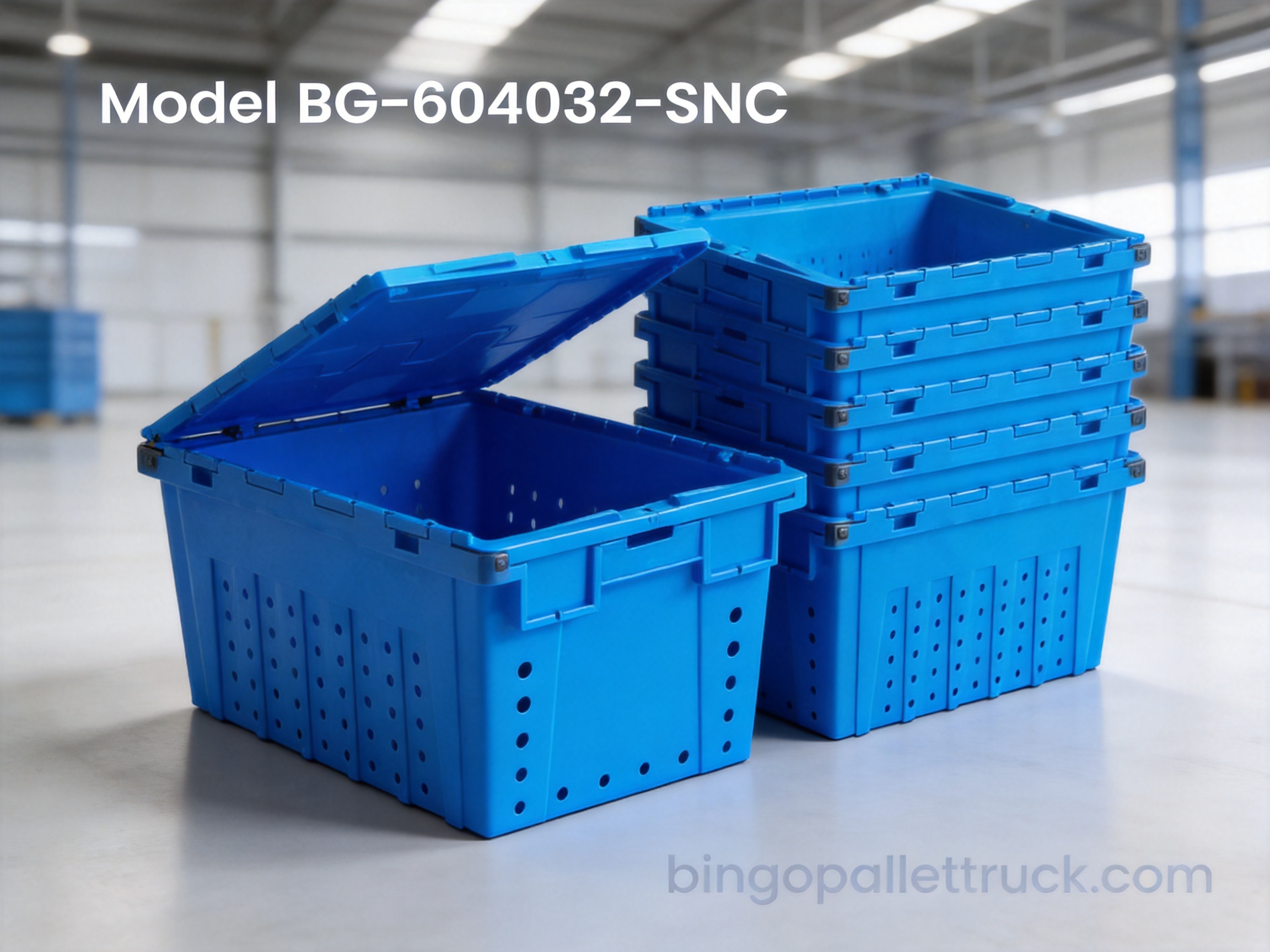
The stackable and nestable configuration is one of the product’s most important competitive features. Many plastic containers can either stack or nest, but not both. A crate that only stacks may use significant space when returned empty. A crate that only nests may not provide stable vertical storage when loaded. This model is designed to support both modes, allowing operators to select the configuration that matches the current workflow.
When filled and closed, the crates can be stacked to make better use of vertical warehouse space. Vertical storage reduces the amount of floor area required for the same inventory volume, which can be particularly valuable where rent, expansion, or floor congestion is a concern. Stable stacking also supports clearer organization of stock and helps separate product groups by location or order status.
When empty, the crates can be nested together. Nesting reduces the footprint of returnable packaging during backhaul, temporary storage, seasonal demand changes, and production line changeovers. This can lower the number of vehicle trips required to move empty containers and reduce the space allocated to empty-packaging areas.
The practical value of nesting can be expressed through the empty-return ratio. If several empty crates occupy the footprint of one or two stacked loaded crates, a company may transport significantly more empty packaging per vehicle journey. The actual ratio depends on the crate geometry and nesting depth, so logistics planners should request the confirmed nesting ratio when calculating transport savings.
Operators should follow safe stacking practices. Loads should be distributed evenly, lids should be properly closed, stacks should remain within recommended height limits, and damaged crates should be removed from service. Forklift operators and warehouse teams should also consider the floor condition, rack clearance, vehicle movement, and the weight of the combined stack.
Advantages over Ordinary Plastic Crates
Basic open plastic crates are often inexpensive, but their lower purchase price may be offset by operational limitations. Without a lid, contents can be exposed to dust and accidental contact. Without a nesting function, empty units can occupy large areas. Without ventilation, solid-wall containers may not be appropriate for products that benefit from airflow. The 63L model addresses these limitations through an integrated multifunctional design.
Compared with open crates, the attached lid provides an additional level of containment and organization. Compared with solid-wall totes, the round-hole design promotes air movement and can reduce the accumulation of moisture or debris. Compared with containers that have separate lids, the attached cover reduces the risk of lid loss and simplifies handling. Compared with single-use corrugated cartons, the reusable plastic body can withstand repeated cycles when correctly used and maintained.
The crate also offers a more flexible space strategy than a stack-only container. Loaded units can be arranged vertically, while empty units can be nested for compact return or storage. This dual-mode design supports the full logistics cycle rather than optimizing only one stage of operation.
Its approximate 2.8kg weight is another practical advantage. A container that is too heavy can increase labor effort before any goods are added. A lightweight body allows employees to handle empty crates more easily, while the durable polymer construction provides a balance between portability and service life. The final allowable load should always be confirmed from the manufacturer’s technical data and tested under the actual working conditions.
Reusable Packaging and Cost Efficiency
Reusable packaging can reduce the recurring expense associated with disposable cartons, plastic bags, shrink film, and temporary protective materials. The economic benefit is strongest in closed-loop or semi-closed-loop logistics systems where crates return to the same facility, supplier, store, or distribution center several times.
A reusable crate may require a higher initial investment than a single-use carton, but the cost per handling cycle can decline as the product is used repeatedly. The total benefit depends on purchase price, service life, cleaning cost, loss rate, repairability, transport efficiency, and the number of completed cycles. The attached lid and robust design can support better control of the container asset, while the nesting function can reduce empty-return costs.
Businesses should evaluate the entire packaging process rather than comparing only unit prices. Relevant questions include how often cartons are replaced, how much labor is spent assembling them, how much waste is generated, how much vehicle space is consumed by empty packaging, and how frequently products are damaged during movement. A reusable crate can create value through several improvements at the same time.
The crate’s standard footprint may also simplify internal material flows. When containers fit existing pallets, shelving, carts, and transport layouts, companies can avoid purchasing specialized support equipment. Better dimensional consistency can reduce unused space and make storage planning more predictable.
Applications in Warehousing and Distribution
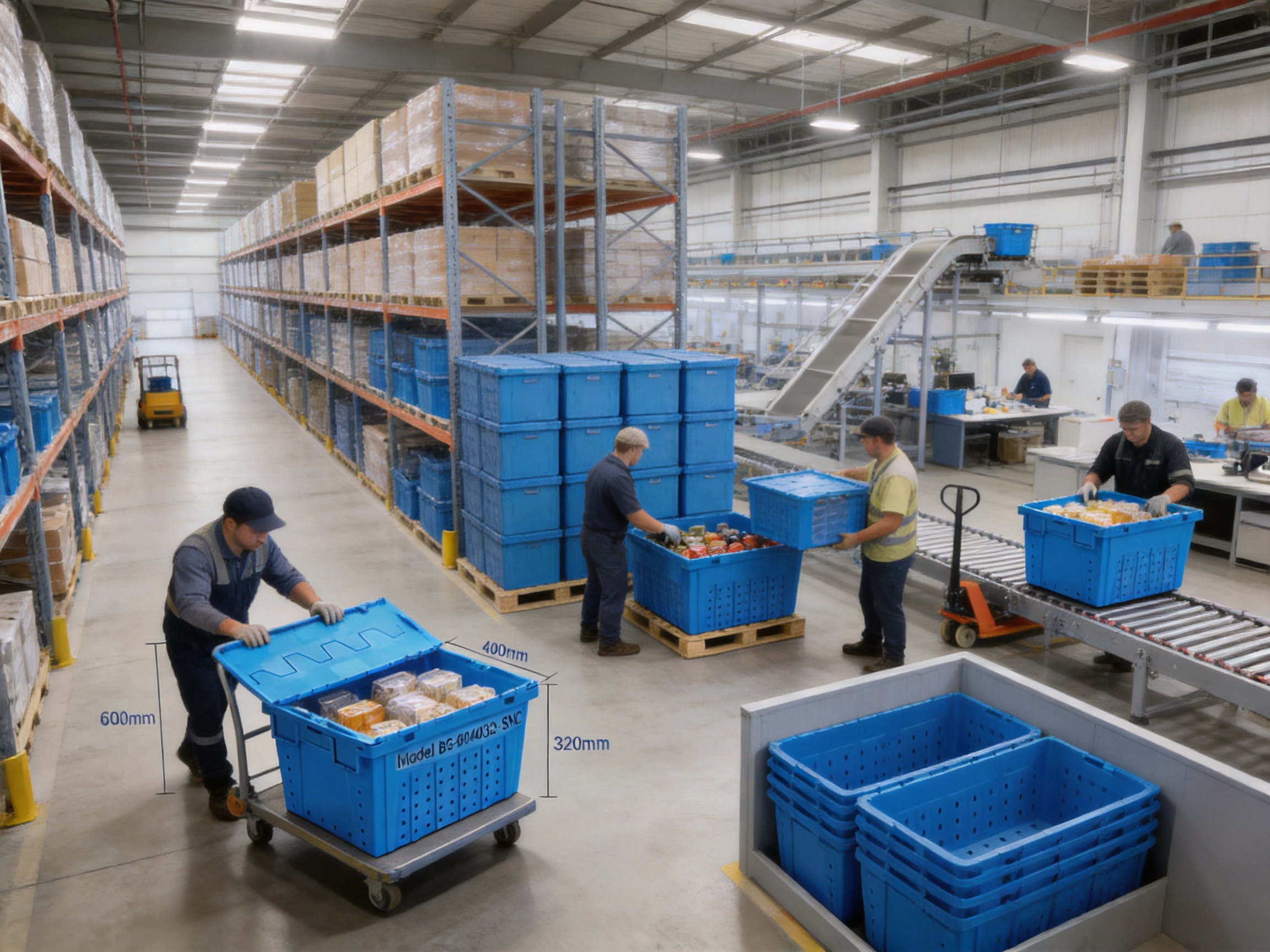
In distribution centers, the crate can serve as a picking, staging, consolidation, or delivery container. Workers can place products for a particular customer, store, route, or order inside the crate, close the attached lid, and move the unit to the next stage. The consistent size makes it easier to create repeatable workstations and define designated storage positions.
For e-commerce fulfillment, the crate can support order batching and internal transportation. Items can be grouped by order wave, delivery destination, or product category. The lid helps retain contents as the crate moves between picking, checking, packing, and dispatch areas. When the crate is returned, nesting reduces the footprint of the empty units.
In supermarkets and retail distribution, crates can be used to move merchandise from a central warehouse to individual stores. Ventilation can be useful for products that require airflow, while the lid offers additional protection during handling. Stores can also use the same crate for backroom organization, shelf replenishment, and return movement.
Manufacturing plants may use the crate for work-in-process parts, finished products, maintenance supplies, or component replenishment. The 600×400mm footprint can fit many industrial workstations and material-flow routes. A crate color system may be used to identify production lines, quality status, product families, or destination zones, subject to the available color options.
In agricultural and food-related logistics, the perforated walls can support ventilation and handling efficiency. However, food-contact use should be based on the confirmed material, manufacturing controls, cleaning process, and relevant local regulations. Buyers should request documentation if direct contact with food is required.
Manufacturing Quality and Process Control
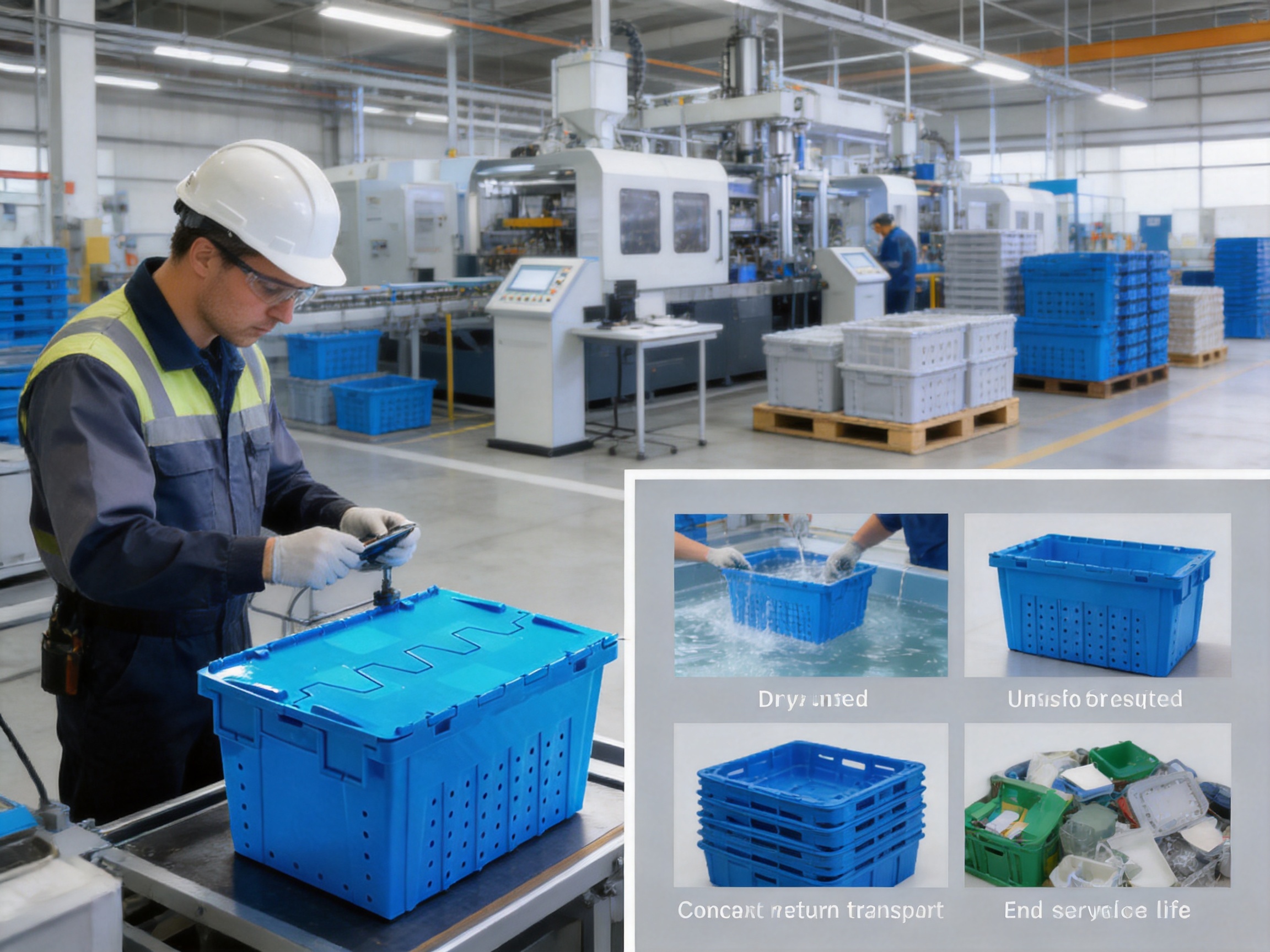
Product performance begins with material selection and continues through every stage of manufacturing. The supplied company information emphasizes the use of high-density polymer material, virgin material options, standardized processes, and inspections from raw-material sourcing through production. These controls are important because a crate’s strength, dimensional accuracy, lid operation, surface quality, and service life depend on consistent manufacturing.
High-density polyethylene is widely used for durable material-handling products because it offers a useful combination of toughness, impact resistance, chemical resistance, and low moisture absorption. Polypropylene is also commonly used for reusable logistics containers because of its rigidity, fatigue resistance, and relatively low weight. Since the supplied product records reference both HDPE and PP, the final material declaration should be confirmed for the specific production batch or configuration.
Virgin polymer can help manufacturers maintain more predictable mechanical and appearance characteristics than uncontrolled recycled mixtures. Consistent raw material supports stable molding behavior and helps reduce variation between production lots. Where recycled content or customized formulations are required, the formulation should be managed through documented quality procedures and validated against the intended load and environmental conditions.
Manufacturing a crate with an attached lid and nesting geometry requires accurate mold design. The body, hinge areas, lid interface, stacking supports, and perforations must work together. If dimensions vary excessively, crates may fail to nest correctly, lids may not close smoothly, and stacks may become unstable. Standardized production procedures help keep these interfaces within acceptable tolerances.
Quality control may include incoming material checks, mold and machine inspections, dimensional verification, visual inspection, weight checks, hinge and lid-function tests, stacking assessments, and load testing. The precise inspection plan depends on the manufacturer’s internal standards and the customer’s requirements. For large projects, buyers can request quality records, pre-shipment inspection, sample approval, and agreed acceptance criteria.
Strict process management also supports customization. The product information indicates that multiple colors and full specifications may be available. Color customization can improve warehouse identification, enable customer branding, or separate material streams. Any customized color, marking, label, or surface treatment should be reviewed for compatibility with the selected polymer and production process.
Advanced Production Capabilities
A modern plastic-crate factory must coordinate engineering, tooling, polymer processing, inspection, inventory, and logistics. Production equipment needs to produce consistent wall thickness and accurate geometry at a scale suitable for industrial supply. The company information highlights dedicated equipment and standardized processes, which support repeatable manufacturing for domestic and international customers.
Tooling quality is particularly important for this model. The round holes must be formed cleanly and consistently, while the stacking and nesting features must maintain their function across repeated cycles. The attached lid requires reliable hinge and connection areas that can tolerate normal opening and closing. Good mold maintenance helps control flash, distortion, incomplete filling, and surface defects.
Production planning can also influence delivery performance. The product is described as being in stock and ready to ship, with fast delivery options. Stock availability can help customers respond to seasonal demand, new warehouse projects, store rollouts, and packaging replacement needs. Buyers should still confirm available colors, quantities, lead times, export packaging, and shipping terms before placing an order.
For business customers, manufacturing strength is not limited to the physical factory. A capable supplier should also offer product selection support, technical communication, sample evaluation, order coordination, quality follow-up, and after-sales service. The supplied company profile describes a broader logistics-equipment supply chain covering handling equipment, storage containers, packaging materials, and warehouse racking. This wider range can help customers coordinate multiple categories through one sourcing partner.
Warehouse Integration
The crate can be integrated into a warehouse operating system in several ways. On shelving, it can provide a defined storage compartment for components or inventory. On pallets, multiple crates can be grouped for bulk movement. On picking carts, the units can separate orders or product categories. In staging areas, closed crates can identify goods waiting for dispatch, inspection, or replenishment.
Because the external footprint is 600×400mm, planners can calculate how many crates fit within a given floor zone, pallet pattern, vehicle bay, or rack level. The 320mm external height should be compared with shelf beam clearances, conveyor transfer points, door openings, and workstation dimensions. The internal dimensions are more important when checking product fit, especially for bulky or irregularly shaped items.
Labels, barcodes, QR codes, RFID tags, and color coding may be applied depending on the customer’s tracking system. The best identification method depends on surface texture, cleaning requirements, exposure to abrasion, and the expected number of handling cycles. If automated scanning is required, customers should test label placement and readability before full-scale deployment.
Crates should be positioned so that lids can be opened without striking nearby equipment or workers. In a stack, employees should avoid pulling a lower crate from beneath an unstable upper load. If crates are used on racks, the rack design must support the combined load and account for the crate’s base dimensions. The container should not be used beyond its rated capacity or in conditions for which it was not designed.
Cleaning, Maintenance, and Service Life
Reusable crates provide the greatest value when they are maintained as managed assets. A routine inspection should check the body, base, perforations, corners, handles, hinges, lid, and stacking surfaces. Crates with severe cracks, deformation, broken hinges, sharp edges, or compromised bases should be removed from service or evaluated by a qualified person.
Cleaning methods depend on the material and the products carried. Many industrial plastic crates can be cleaned with water and suitable detergents, but aggressive chemicals, excessive heat, pressure, or incompatible solvents may affect the polymer or markings. Before using automated washing equipment, confirm the temperature and chemical limits with the supplier.
Drying is important when crates are used for products sensitive to moisture. The round-hole construction can assist drainage, but containers should be stored in a way that allows residual water to evaporate. Clean crates should be separated from dirty or damaged units to prevent cross-contamination in controlled operations.
Good handling practices extend service life. Do not throw empty crates, drag them across abrasive floors, stand on the lids, overload them, or use forklifts to push them unless the design specifically permits it. Keep stacks within safe limits and avoid exposing the containers to unnecessary ultraviolet radiation or extreme temperatures.
Environmental and Operational Benefits
Reusable crates can support waste-reduction objectives by replacing some disposable packaging. A single crate may complete many handling cycles before requiring replacement, reducing the quantity of cartons, bags, and temporary protective materials consumed by the operation. The environmental result depends on actual reuse frequency, cleaning practices, transport distance, polymer composition, and end-of-life management.
Nesting can reduce the space required for empty-container transport. More efficient empty returns may reduce the number of trips or improve vehicle utilization. The same feature also reduces warehouse floor congestion, allowing facilities to use existing space more effectively without immediate expansion.
At the end of its useful life, a plastic crate may be suitable for material recovery where local recycling infrastructure accepts the relevant polymer. Clear material identification helps recyclers sort the product correctly. Companies should follow local waste-management rules and confirm the polymer type, especially because the supplied product information refers to both HDPE and PP in different sections.
Environmental performance should be assessed through the entire use cycle rather than by material choice alone. A durable crate that replaces many disposable packages and returns efficiently may deliver significant operational benefits. Establishing a reuse target, tracking losses, and repairing or recycling damaged units can improve the overall result.
Advantages for International Buyers
International customers often need more than a product specification. They need reliable communication, stable quality, export coordination, packaging guidance, and the ability to source related warehouse products. The supplier profile presents the company as a manufacturer and provider of integrated warehousing and logistics solutions, with product categories covering handling equipment, storage containers, packaging materials, and warehouse racking.
This broader portfolio can simplify procurement for projects that require both containers and material-handling equipment. A distribution center, for example, may need pallet trucks, stackers, plastic pallets, crates, stretch wrap, packing strapping, and racks. Coordinating these categories through one experienced supplier can reduce communication gaps and improve compatibility between equipment and storage systems.
The company is located in Yancheng, Jiangsu, China, and offers contact support for product inquiries, customized requirements, samples, and orders. Customers should provide details such as application, expected load, operating temperature, contact requirements, preferred color, annual quantity, delivery destination, and required certifications. Clear technical information at the quotation stage helps prevent misunderstandings and supports a more accurate recommendation.
Selection Guidance
Before purchasing, users should confirm that the 560×375×300mm internal space accommodates the intended goods. Measure the product including packaging, handles, protrusions, and any protective material. Leave enough clearance for easy insertion and removal. If products are flexible or irregularly shaped, test a representative sample rather than relying only on nominal measurements.
Next, assess the required load. The 63L capacity indicates volume, not necessarily the maximum safe mass. Dense metal parts may reach a high weight before the crate is full, while lightweight products may occupy the entire volume with little load on the base. Request static, stacking, and dynamic load information for the specific application.
Temperature and chemical exposure should also be reviewed. Warehouses may include cold rooms, outdoor staging, hot production areas, cleaning stations, or environments containing oils and chemicals. Confirm the polymer’s working range and chemical compatibility before deployment.
Finally, consider the complete logistics cycle. Decide whether crates will remain at one site, travel between suppliers and customers, or circulate through a national or international return system. Establish procedures for labeling, cleaning, inspection, loss prevention, and end-of-life recycling. The crate’s design creates opportunities for efficiency, but standardized operating procedures are necessary to capture those benefits.
Implementation in a Warehouse
A phased introduction is often the most effective approach. Begin with a pilot group in one process, such as inbound receiving, component replenishment, or e-commerce picking. Measure picking time, handling effort, damage rates, space consumption, cleaning requirements, and empty-return performance.
Train operators on correct stacking, nesting, lid use, lifting, and inspection. Explain that a nestable crate should not be nested while loaded and that a stack should be built only on a stable, level surface. Establish a clear method for separating clean, dirty, damaged, and available containers.
Use the pilot results to determine the required quantity. The number of crates should reflect peak inventory, average cycle time, return delays, cleaning time, and safety stock. Buying too few containers can interrupt operations, while buying too many can create unnecessary capital expenditure and storage pressure.
After implementation, review the system periodically. Record damaged units, missing lids or containers, customer returns, and areas where the crate does not fit the process. These records can guide changes to layout, labels, stacking height, cleaning schedules, and future orders.
Frequently Asked Questions
What is the capacity of the crate?
The nominal capacity is 63 liters. The usable volume depends on the shape and packaging of the goods placed inside. The internal dimensions are 560×375×300mm.
What are the external dimensions?
The external dimensions are 600×400×320mm. These dimensions should be compared with pallet patterns, shelves, conveyors, carts, vehicle spaces, and door clearances before installation.
Does the crate have a lid?
Yes. It has an attached lid that remains connected to the crate. The lid helps contain products and provides protection from dust and incidental contact when closed.
Is the crate waterproof?
The product is vented through round holes, so it should not be considered airtight or fully waterproof. Buyers requiring liquid-tight or highly sealed protection should request confirmation of the closure performance and evaluate a different container design if necessary.
Can empty crates be nested?
Yes. The crate is designed to nest when empty, helping reduce storage and return-transport volume. The exact nesting ratio should be confirmed for logistics planning.
Can loaded crates be stacked?
The design is intended to support stacking, particularly when crates are properly loaded and closed. The allowable stack height and load depend on the application and should be confirmed through the manufacturer’s technical data.
What material is used?
The specification table identifies high-density polyethylene, or HDPE. Other supplied product information refers to PP and virgin PP material. Because the records are not completely consistent, customers should confirm the final polymer specification for the ordered version.
It may be suitable for some food-related logistics applications, but direct food contact should be confirmed through the final material declaration, production controls, cleaning procedure, and required regulatory documentation. Do not rely on a general description alone when certification is mandatory.
How much does the crate weigh?
The listed weight is approximately 2.8kg. Actual production weight may vary slightly according to material formulation, tolerance, color, and manufacturing conditions.
Can the color be customized?
The product information indicates multiple colors and customization availability. Customers should confirm standard colors, minimum quantities, color matching, marking options, and lead times with the supplier.
What industries can use this product?
Typical applications include manufacturing, warehousing, e-commerce fulfillment, distribution, supermarket retail, general material handling, and selected agricultural or food-logistics operations.
How should the crate be cleaned?
Use a cleaning method compatible with the confirmed polymer and the products previously carried. Avoid unapproved chemicals, excessive heat, and methods that could damage the lid, hinges, or surfaces. A formal cleaning procedure should be established for repeated-use systems.
What should buyers confirm before ordering?
Buyers should confirm material, load capacity, stacking height, nesting ratio, temperature range, chemical compatibility, food-contact status if applicable, color, quantity, delivery schedule, packaging, and available inspection or certification documents.
Conclusion
The 63L Round-Hole Vented Stackable and Nestable Crate with Attached Lid is designed as a practical, reusable solution for businesses that need better control of storage and transport. Its 600×400×320mm external size, 63-liter capacity, 2.8kg approximate weight, attached lid, ventilation, and dual stack-and-nest functionality provide a strong combination of protection, flexibility, and space efficiency.
Its advantages over ordinary open crates and disposable packaging are clear: goods can be organized inside a durable container, protected by an integrated cover, ventilated through round perforations, stacked when in use, and nested when empty. These features can support lower packaging waste, improved warehouse organization, more efficient empty returns, and smoother material flow.
The supplier’s stated strengths in standardized production, quality inspection, polymer-material management, customization, stock availability, and broader logistics-equipment supply can further support industrial customers. For the best result, buyers should confirm the final material specification and technical performance for their application, especially because the supplied records mention both HDPE and PP.
When correctly selected, operated, cleaned, and maintained, this crate can become a dependable component of a modern returnable packaging system. It is suited to organizations seeking a durable storage container that performs across receiving, storage, picking, distribution, retail replenishment, and empty-return operations.
References
1. Product specification sheet for Model BG-604032-SNC, including dimensions, capacity, weight, lid configuration, and material information.
2. General industrial guidance on reusable plastic containers, returnable transport packaging, and warehouse material-flow management.
3. General engineering references concerning high-density polyethylene and polypropylene properties in logistics-container applications.
4. Standard warehouse practices for safe stacking, manual handling, container inspection, and storage-space planning.
5. General environmental guidance on reusable packaging systems, packaging-cycle assessment, polymer identification, and plastic recycling.
Product: 63L Round Hole Vented Stackable and Nestable Crate with Lid

Copyright @ Yancheng Bingo Machinery Equipment Co., Ltd. All rights reserved Warehouse Logistics Equipment Manufacturer Pallet Truck Supplier
