 en
 Español

67L Stackable Slanted Nesting Produce Crate with Integrated Lid: A Practical Guide to High-Performance Cold Chain Storage
Content
- 1 Introduction
- 2 Product Overview
- 3 Why the 600 × 400mm Footprint Matters
- 4 Stacking and Nesting: Two Functions in One Container
- 5 Integrated Attached Lid for Secure Handling
- 6 Ventilation for Produce and Perishable Goods
- 7 Reinforced Rib Structure and Load-Bearing Performance
- 8 Material Selection and Product Consistency
- 9 Manufacturing Quality and Process Control
- 10 Advantages over Ordinary Open Crates
- 11 Advantages over Disposable Cartons
- 12 Advantages over Non-Nesting Heavy-Duty Totes
- 13 Advantages over Improvised Storage Containers
- 14 Applications in Cold Chain Distribution
- 15 Applications in Supermarket Operations
- 16 Applications in Industrial Logistics
- 17 Warehouse Organization and Space Efficiency
- 18 Hygiene, Cleaning, and Maintenance
- 19 Ergonomics and Worker Handling
- 20 Implementation in a Returnable Packaging System
- 21 Customization and Procurement Considerations
- 22 Manufacturing and Supply Strengths
- 23 Cost Efficiency and Total Ownership Value
- 24 Recommended Operating Practices
- 25 Frequently Asked Questions
- 25.1 What is the capacity of the crate?
- 25.2 What are the external dimensions?
- 25.3 Can the crate both stack and nest?
- 25.4 Does the crate have a lid?
- 25.5 Why are there ventilation holes?
- 25.6 What material is used?
- 25.7 Is the crate suitable for food and produce?
- 25.8 How much does the empty crate weigh?
- 25.9 Can the crate be used in a warehouse racking system?
- 25.10 What makes it different from a conventional cardboard carton?
- 25.11 What makes it different from a standard plastic tote?
- 25.12 Can the crate be customized?
- 25.13 How should empty crates be transported?
- 25.14 How should the crate be cleaned?
- 25.15 Is the crate suitable for automated logistics?
- 25.16 How can a company evaluate whether the crate is cost-effective?
- 26 Conclusion
- 27 References
- 28 Product: 67L Stackable Slanted Nesting Produce Crate with Integrated Lid
Introduction
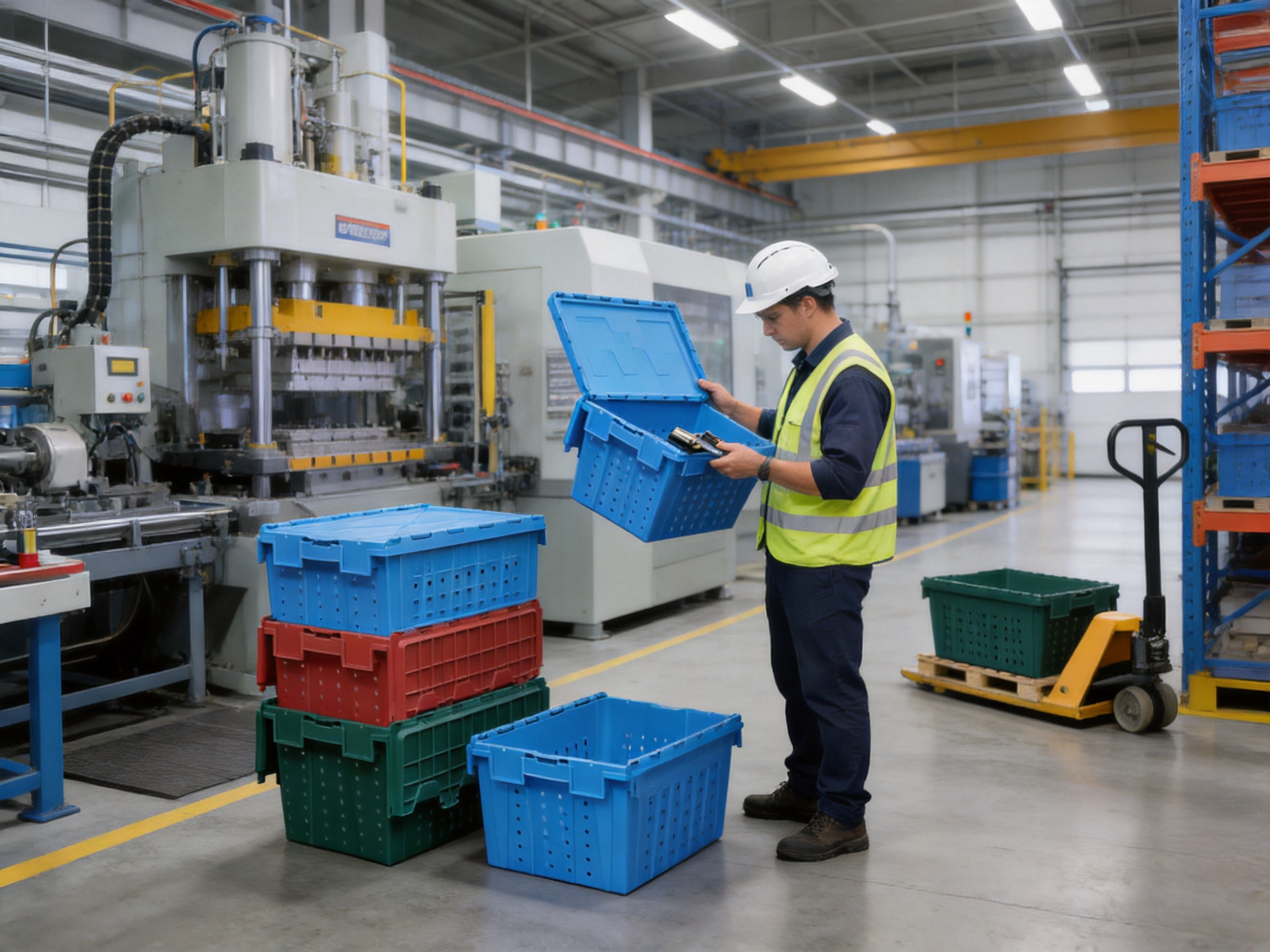
Efficient storage and transport are essential to modern supply chains. Fresh produce, packaged goods, components, and distribution materials must move through warehouses, vehicles, retail facilities, and processing sites without unnecessary handling, damage, contamination, or wasted space. For these operations, the right reusable crate can provide much more than basic containment. It can improve product protection, support hygienic handling, simplify warehouse organization, and reduce the recurring cost of disposable packaging.
The 67L stackable slanted nesting produce crate with integrated lid is designed for these demanding logistics environments. Identified by model BG-604035-SNC, the crate combines a 600 × 400 × 355mm external footprint with a nominal capacity of 67 liters. Its attached lid, ventilated wall design, reinforced rib structure, and stack-and-nest configuration make it suitable for cold chain distribution, supermarket supply, produce handling, manufacturing logistics, and general warehouse operations.
Unlike a basic open plastic box, this crate is designed as a complete reusable logistics unit. It can be closed during transport, stacked when loaded, and nested when empty. This combination helps users make better use of warehouse and vehicle space while providing a more secure environment for the contents. The full round-hole perforations also support airflow, which is important when handling fruits, vegetables, chilled products, and other goods that benefit from ventilation.
This article examines the product’s design, performance characteristics, operational advantages, manufacturing approach, and practical applications. It also explains why a well-engineered reusable crate can outperform disposable cartons, ordinary solid-wall totes, and non-nesting containers in demanding logistics systems.
67L Stackable Slanted Nesting Produce Crate with Integrated Lid
Product Overview
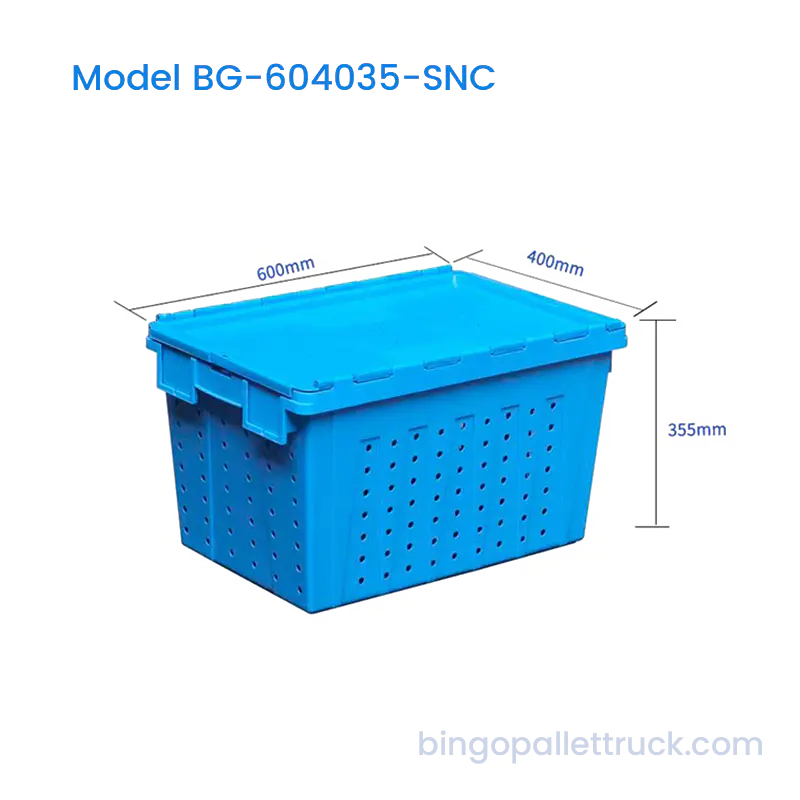
The BG-604035-SNC is a stackable and nestable plastic crate with an integrated attached lid. It is built around a standard 600 × 400mm footprint, a format widely used in warehousing, distribution, retail, and material-handling systems. The external height is 355mm, while the internal dimensions are approximately 545 × 370 × 335mm.
| Specification | Details |
| Model | BG-604035-SNC |
| Product Type | Stackable and nestable plastic crate with attached lid |
| External Dimensions | 600 × 400 × 355mm |
| Internal Dimensions | 545 × 370 × 335mm |
| Nominal Capacity | 67L |
| Net Weight | 3.16kg |
| Material Listed in Product Characteristics | HDPE |
| Design | Stackable, nestable, ventilated, attached lid |
| Primary Uses | Produce distribution, cold chain logistics, supermarkets, warehousing, and industrial handling |
The crate’s 67L nominal volume offers a useful balance between capacity and manageability. It is large enough to carry a substantial quantity of products, but its standardized footprint remains compatible with common warehouse layouts and palletized transport systems. Its 3.16kg net weight also helps keep the empty container practical for repeated manual handling, while the reinforced construction is intended to support demanding commercial use.
The internal dimensions are especially important when planning a packing system. The usable internal length of 545mm, width of 370mm, and height of 335mm give users a clear basis for estimating product fit, arranging dividers, and calculating vehicle or pallet utilization. Actual usable capacity will depend on the size, shape, and stacking pattern of the goods being packed.
Why the 600 × 400mm Footprint Matters
Standardized dimensions are a major advantage in logistics. A crate that fits predictable warehouse and transport layouts is easier to combine with pallets, shelves, conveyors, roll cages, delivery vehicles, and picking stations. The 600 × 400mm footprint is widely recognized as a practical modular size for reusable transport packaging.
When several crates share a common footprint, operators can organize them into repeatable loading patterns. This reduces unused gaps and makes it easier to calculate storage capacity. It can also improve the consistency of loading and unloading procedures, because employees do not need to adapt to a different base size for every product category.
The footprint supports efficient placement on standard pallet formats and warehouse shelving systems, subject to the dimensions and load limits of the specific installation. Crates can be arranged side by side, positioned in rows, or integrated into picking and replenishment processes. The consistent base geometry also helps support automation projects in which containers must move through a defined sequence of conveyors or workstations.
Compared with irregular cartons or mixed-size disposable packaging, a standardized reusable crate offers more predictable cube utilization. This is valuable in facilities where space is expensive, including distribution centers, supermarket backrooms, processing plants, and urban fulfillment operations.
Stacking and Nesting: Two Functions in One Container
One of the most important strengths of this crate is its dual stack-and-nest design. These two functions solve different logistics problems. Stacking is primarily used when the crate is filled, while nesting is primarily used when the crate is empty.
Stacking when loaded
When loaded crates are placed one above another, their vertical arrangement allows warehouses and vehicles to use height more effectively. The reinforced rim and rib structure help distribute forces through the crate body, reducing the likelihood that the sidewalls will deform under normal stacking conditions. The attached lid also creates a closed top surface that helps separate one layer from the next and protect the contents.
Stacking can improve floor-space utilization and make product groups easier to identify. For example, a distribution center may assign different crates to different product categories, delivery routes, production batches, or retail locations. The ability to stack these units neatly can reduce clutter and simplify inventory handling.
Nesting when empty
When the crates are empty, their nesting configuration allows one crate to sit partially inside another. This significantly reduces the volume required for return transport and empty-container storage. The benefit is particularly important in closed-loop supply chains, where crates must travel back from retailers, distribution points, or customers to a central warehouse or washing facility.
Traditional rigid boxes that can only stack often occupy nearly the same volume whether they are full or empty. A nestable crate reduces this inefficiency. More empty crates can fit into a vehicle, return cage, staging area, or storage zone. This can lower the number of return journeys, reduce handling time, and improve the availability of storage space.
The combination of stacking and nesting provides a practical advantage over containers that offer only one of these functions. A permanently tapered basket may nest well but lack stability when stacked with a heavy load. A straight-wall tote may stack securely but waste space during return transport. The slanted nesting structure is intended to provide both functions in a single reusable design.
Integrated Attached Lid for Secure Handling
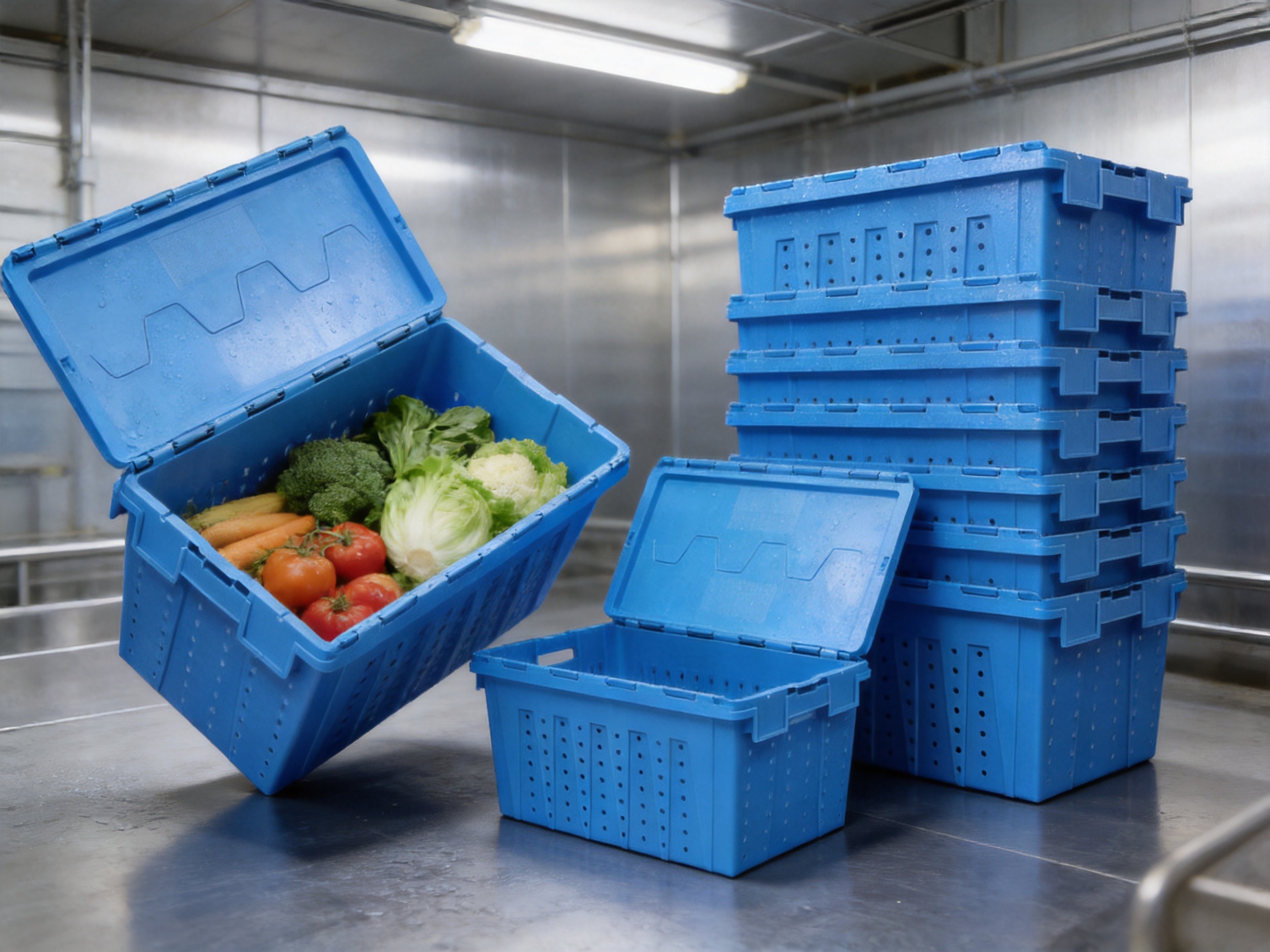
The integrated lid is another important feature. Because it is attached to the crate, it remains connected to the container during normal use. This helps reduce the risk of misplaced lids, mixed components, and interruptions during picking or packing operations.
A separate loose lid can easily be left behind at a loading dock, stored in the wrong area, or matched with the wrong container. In high-volume operations, these small inefficiencies can become a recurring cost. An attached lid simplifies the handling sequence because the operator opens, loads, closes, and secures the same container without searching for a compatible top.
The closed lid provides several practical benefits. It can help limit exposure to dust and airborne debris during storage and transportation. It can also reduce the chance that lightweight products will spill out during movement. In delivery operations, a closed crate offers a more controlled package than an open basket, especially when goods are transported over uneven roads or moved repeatedly between handling points.
The lid also helps create a more organized stack. When crates are closed before stacking, the contents are less exposed to contact with the underside of another container. This is particularly useful for packaged food, produce accessories, retail items, and industrial components that require separation from surrounding surfaces.
While the lid supports secure closure, users should select locking or handling procedures appropriate to their application. The container should not be overloaded, and the lid should be fully closed before stacking or transport. For regulated food, pharmaceutical, or temperature-sensitive applications, the user should also establish suitable cleaning, inspection, and traceability procedures.
Ventilation for Produce and Perishable Goods
The crate uses full round-hole perforations to support airflow through the sidewalls. Ventilation is a critical consideration when transporting fresh produce and other perishable products. Air movement can help distribute temperature more evenly, support cooling processes, and reduce the accumulation of heat and moisture inside the container.
A solid-wall box may provide greater protection from external contact, but it can restrict airflow. In a cold chain environment, restricted airflow may make it more difficult for chilled air to reach the center of a stacked load. The perforated design of this crate is intended to promote more consistent air circulation around the packed products.
Ventilation is especially relevant for fruits and vegetables that continue to respire after harvesting. The exact airflow requirement depends on the crop, packaging configuration, storage temperature, humidity, loading density, and transport duration. The crate does not replace a validated cold chain process, but its ventilated structure can support a better-designed distribution system.
The round-hole pattern also offers a practical balance between airflow and structural integrity. The holes are distributed across the crate walls rather than relying on a few large openings. This helps maintain a strong overall wall structure while providing regular ventilation throughout the container.
For produce operations, the crate can be used with appropriate liners, pads, dividers, or absorbent materials when required. These additions should be selected carefully so that they do not block the ventilation openings or interfere with the lid. Operators should also avoid compressing delicate products beyond their safe handling limits.
Reinforced Rib Structure and Load-Bearing Performance
Heavy-duty logistics containers must withstand more than the weight of their contents. They may be lifted, moved, stacked, loaded into vehicles, exposed to temperature changes, and handled repeatedly over a long service life. The reinforced rib structure of the BG-604035-SNC is designed to improve stiffness and support load-bearing performance.
Ribs add structural support without requiring the entire wall to be made excessively thick. They help control flexing and distribute localized forces across a wider area. This is important when a crate is stacked, placed on a rack, or handled with equipment. Reinforced edges and corners are also valuable because these areas commonly experience impact during loading and unloading.
The practical result is a container intended for repeated commercial use rather than one-way shipment. Reusability can make a significant difference in operations that move the same type of product every day. Instead of buying and discarding cartons for each shipment, users can establish a returnable packaging loop and spread the purchase cost over many cycles.
Load capacity depends on multiple factors, including the type of goods, distribution of weight, stacking height, temperature, handling method, and condition of the crate. Users should request the appropriate technical load data for their operating conditions and should conduct internal validation before implementing high-level stacking or automated handling.
A reinforced crate can also help maintain more consistent dimensions over time. Dimensional stability is useful when containers must pass through conveyors, shelving locations, pallet restraints, or vehicle loading guides. Excessive deformation can cause jams, unstable stacks, or difficulty closing the lid.
Material Selection and Product Consistency
The supplied product information identifies HDPE in the specification table and also refers to high-impact, food-safe PP and virgin PP material in the product description and manufacturing information. Because the documentation uses both material references, purchasers should confirm the exact resin grade for the final production configuration before placing an order, particularly when regulatory compliance, temperature resistance, or food-contact approval is critical.
Both HDPE and PP are widely used in reusable logistics containers because they offer useful combinations of impact resistance, low moisture absorption, chemical resistance, and processability. The most suitable resin depends on the specific design, additives, operating temperature, required stiffness, cleaning conditions, and application standards.
High-quality virgin material can help manufacturers achieve consistent color, mechanical performance, and dimensional stability. Consistency is important when crates are used in large fleets, because containers need to behave predictably during stacking, nesting, washing, and transport. Inconsistent recycled content or uncontrolled material blending can create variation in strength and appearance if not properly managed.
For food and produce applications, material selection should be considered together with the complete hygiene system. The resin is only one part of the solution. Surface condition, drainage, cleaning temperature, detergent compatibility, drying, storage, and inspection all influence the suitability of the crate for repeated food-related use.
Buyers should confirm the applicable food-contact documentation, material declaration, operating temperature range, and cleaning recommendations for their market. These requirements may differ by country and by product category.
Manufacturing Quality and Process Control
The strength of a reusable plastic crate depends not only on its design but also on the manufacturing process used to produce it. A well-designed mold cannot compensate for inconsistent material preparation, uncontrolled molding conditions, poor trimming, or inadequate inspection. The manufacturing approach described for this product emphasizes standardized processes and quality control at every stage.
Material preparation
The first stage is the selection and preparation of the polymer resin. Consistent material handling helps control melt behavior, color, mechanical performance, and finished-product stability. The production team must ensure that the selected material is suitable for the intended crate design and application.
Where virgin material is specified, the use of controlled raw material can help reduce variation between production batches. Material identification and batch management are important because they allow manufacturers to trace the inputs used for a particular production run.
Injection molding control
Large reusable crates are commonly produced through injection molding. In this process, heated polymer is injected into a mold under controlled pressure. The mold defines the external shape, internal cavity, ribs, perforations, lid geometry, corner structures, and nesting features.
Stable molding conditions are important for achieving uniform wall thickness and accurate dimensions. Injection speed, pressure, temperature, cooling time, and mold filling behavior all influence the finished product. If these variables are not controlled, the crate may show warping, incomplete filling, sink marks, weak weld lines, or dimensional inconsistency.
For a stack-and-nest crate, dimensional accuracy is especially significant. The crate must nest smoothly when empty while maintaining stable support when stacked with a load. The attached lid must also align correctly with the rim. A controlled molding process helps maintain the interaction between these components.
Inspection during production
Quality control should not be limited to the final inspection. In-process checks can identify problems earlier, reducing waste and preventing large batches of nonconforming products. Typical checks may include visual inspection, dimensional measurement, lid operation, nesting fit, stacking alignment, surface condition, and identification marking.
The product information emphasizes inspections at every stage, from raw material sourcing through production. This approach supports more reliable output and helps ensure that the crate meets the expected specification before shipment.
Final quality verification
Final verification may include checking the external dimensions, internal dimensions, weight, color, perforations, rib structure, lid attachment, and overall appearance. The crate should be free from sharp flashing, serious warping, cracks, or molding defects that could interfere with safe handling.
For customers purchasing in volume, sample approval and batch inspection can provide additional assurance. Buyers may also request inspection records, material documentation, production photographs, or testing information relevant to their application.
Advantages over Ordinary Open Crates
Ordinary open crates are useful for quick access, but they do not always provide adequate protection during storage and transport. Their open top can expose goods to dust, splashing, accidental contact, and loss during movement. They may also be difficult to stack securely when filled with irregular products.
The integrated lid of the BG-604035-SNC provides a clear advantage for operations that need a more controlled container. Workers can still open the crate quickly when picking or replenishing, but the contents can be covered during transport and storage. This offers a better balance between accessibility and protection.
The stack-and-nest design is another advantage. Some open baskets can nest but do not stack efficiently when loaded. Others stack but must be stored in a large empty volume. The combined configuration is more suitable for returnable logistics systems where both loaded delivery and empty return are part of the operating cycle.
Advantages over Disposable Cartons
Disposable cartons remain useful for some shipping applications, especially where low initial cost or one-way distribution is the main priority. However, cartons can weaken when exposed to moisture, condensation, rough handling, or repeated stacking. They also require regular replacement and create ongoing waste.
A reusable plastic crate can provide a longer service life when it is properly used, cleaned, inspected, and maintained. Its resistance to moisture makes it suitable for chilled and humid environments where corrugated packaging may lose strength. Its rigid structure also supports more consistent stacking and handling.
Reusable packaging can contribute to lower packaging waste and more predictable logistics costs. The financial outcome depends on purchase price, product loss, return rates, cleaning expenses, damage rates, and the number of reuse cycles. For organizations with established return routes, the economics can be particularly attractive.
The attached lid also reduces the need for additional tape, stretch film, or secondary covers in some applications. It does not eliminate all packaging materials, but it may simplify the packaging process and reduce the amount of disposable material used around each shipment.
Advantages over Non-Nesting Heavy-Duty Totes
Non-nesting totes can be strong and durable, but they often occupy substantial space when empty. This creates a hidden cost in return logistics. Empty containers may need dedicated warehouse zones, additional delivery vehicles, or more frequent collection trips.
The nesting capability of this crate addresses that problem directly. Empty units can be grouped into compact stacks, which improves the utilization of return vehicles and storage areas. This is particularly important for retailers and distribution networks that send large numbers of empty containers back to a central site.
The 3.16kg net weight also helps maintain practical handling characteristics. Although the crate is designed for heavy-duty use, an empty container should not be unnecessarily difficult to move. A manageable weight supports faster collection, cleaning, inspection, and redistribution.
Advantages over Improvised Storage Containers
Businesses sometimes use miscellaneous boxes, buckets, or unstandardized bins to move products internally. These improvised solutions may appear inexpensive, but they often create problems with stacking, identification, hygiene, space utilization, and worker safety.
A purpose-built logistics crate provides defined dimensions and repeatable handling characteristics. Employees can learn one standard loading method, supervisors can establish consistent storage procedures, and facility planners can calculate capacity more accurately. Standardization also makes it easier to track the number of containers in circulation.
The crate’s lid, ventilation, reinforced construction, and stack-and-nest geometry are integrated into one system. This is generally more effective than trying to combine separate boxes, covers, and restraints that were not designed to work together.
Applications in Cold Chain Distribution
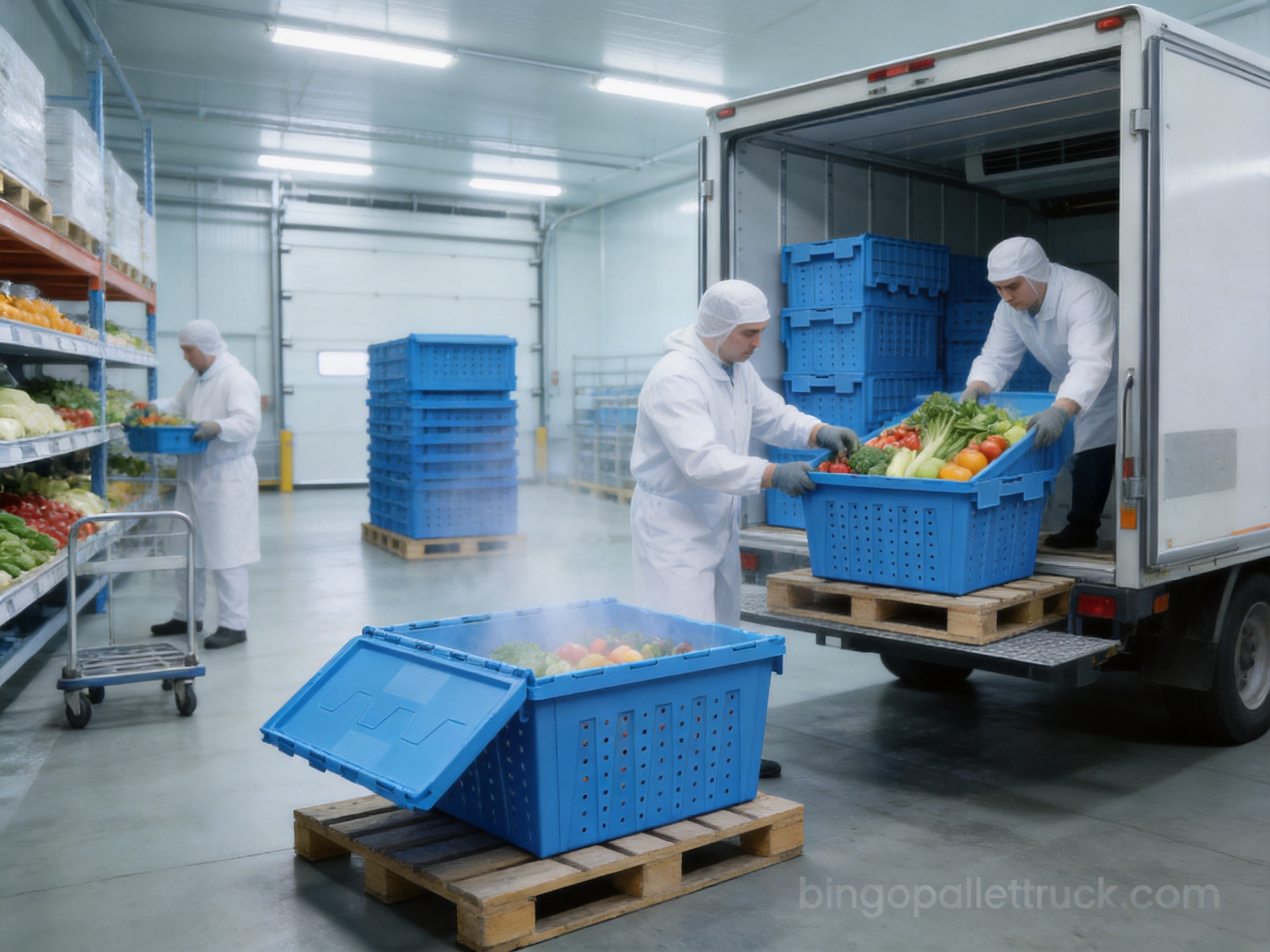
Cold chain operations require careful coordination between packaging, storage, transport, and temperature control. The crate’s ventilated walls can support airflow around chilled or perishable products, while the lid helps reduce exposure to dust and external handling.
Produce distributors can use the crate for vegetables, fruits, herbs, mushrooms, and other goods that require organized movement from farms or processing centers to distribution hubs and retail locations. The exact suitability depends on product type and the required ventilation, cushioning, drainage, and temperature conditions.
The standardized footprint can simplify loading into refrigerated vehicles and cold rooms. Crates can be grouped by route, product category, harvest lot, or customer order. When the containers return empty, their nesting capability reduces the space needed for the reverse journey.
Cold chain users should remember that a ventilated crate is one component of a larger system. Pre-cooling, pallet configuration, airflow clearance, refrigeration capacity, door-opening frequency, and transport duration must all be managed. The container should be loaded in a way that protects the product without blocking the intended ventilation paths.
Applications in Supermarket Operations
Supermarkets require frequent replenishment, compact backroom storage, and rapid movement from receiving areas to sales floors. A reusable crate with an attached lid can support these tasks by providing a secure and consistent handling unit.
Produce departments can receive goods in ventilated crates, remove or display the products, and return the empty units through an established collection process. The same crate can also be used for backroom organization, seasonal stock movement, and store-to-store transfers.
The lid helps protect products during overnight storage or movement through busy receiving areas. The standard footprint makes it easier to organize crates beneath worktables, on carts, or within designated storage lanes, subject to local equipment dimensions.
For supermarket operators, the main advantages are often operational rather than purely structural. Faster unloading, fewer damaged cartons, better space use, reduced packaging waste, and simpler reverse logistics can all contribute to lower handling costs.
Applications in Industrial Logistics
Although the design is suitable for produce, it can also be used in industrial logistics. Factories and assembly plants often need reusable containers for components, spare parts, work-in-progress goods, tools, and maintenance supplies.
The attached lid can help keep parts together as they move between production stages. Ventilation may be useful where condensation must be minimized, while the rigid structure can protect components from crushing during internal transport. The crate can be labeled with barcodes, route cards, or inventory identifiers according to the user’s system.
In manufacturing environments, standard containers can improve line-side replenishment. A fixed crate size supports predictable workstation layouts and helps material handlers calculate how many units are required at each stage. Nesting provides an efficient method for returning empty containers to the warehouse or kitting area.
Users handling small metal parts, sharp components, liquids, chemicals, or oily items should verify compatibility before deployment. Liners, inserts, dividers, or dedicated cleaning processes may be necessary depending on the application.
Warehouse Organization and Space Efficiency
Warehouse space is a valuable resource. Poorly organized packaging can occupy aisles, block access, and reduce the effective capacity of storage areas. The crate’s defined dimensions and stackable geometry can help establish more orderly storage zones.
Loaded crates can be assigned to different levels or lanes, while empty crates can be nested in compact groups. This separation makes it easier to distinguish inventory from packaging and helps reduce accidental mixing. The attached lid also creates a clear visual distinction between an active container and an empty one.
The crate can support zone-based management, route-based staging, or first-in-first-out handling. For example, a warehouse may use colored crates for different customers or product classes, provided the colors and identification system are managed consistently.
Operators should observe safe stacking limits and avoid placing unstable loads in high locations. Racking systems must be evaluated for the crate’s dimensions, weight, support conditions, and operating method. The container should never be treated as a substitute for a properly designed rack or load-restraint system.
Hygiene, Cleaning, and Maintenance
Reusable crates deliver the greatest value when they are incorporated into a disciplined cleaning and inspection program. After each use, the container should be emptied and checked for residue, foreign objects, damage, and unusual odors. Food-related applications may require washing and sanitizing according to the organization’s hygiene procedures.
The smooth plastic surfaces are generally easier to clean than absorbent packaging materials. However, the ventilation holes, lid joints, corners, and rib intersections should receive particular attention because residue can collect in these areas if cleaning is incomplete.
Cleaning chemicals, water temperature, pressure, and drying methods should be compatible with the confirmed resin and the manufacturer’s recommendations. Aggressive chemicals or excessive heat may affect certain plastics over time. Users should validate their cleaning process rather than assuming that every detergent or sanitation method is suitable.
Routine inspection should identify cracks, severe deformation, damaged hinges, broken lid sections, sharp edges, or structural changes. Damaged crates should be removed from service until they are assessed. A visible identification system can help operators distinguish approved containers from those awaiting cleaning, repair, or disposal.
Ergonomics and Worker Handling
Good container design can reduce unnecessary handling effort. The crate’s manageable empty weight, attached lid, standardized dimensions, and repeatable geometry help create a consistent workflow. Workers can open the lid, load the products, close the container, and move it through the facility without dealing with separate covers or mismatched boxes.
However, a 67L crate can become heavy when fully loaded. Organizations should evaluate the total filled weight, lifting frequency, travel distance, and handling equipment used in each application. Where appropriate, crates should be moved with carts, pallet trucks, conveyors, or other material-handling equipment rather than carried long distances manually.
Training should cover correct lifting methods, safe stacking, lid operation, inspection, and procedures for damaged containers. Clear operating rules can help prevent overloading and reduce the risk of unstable stacks.
Implementation in a Returnable Packaging System
The crate is particularly effective when used as part of a closed-loop or returnable packaging system. A successful program begins with a clear movement map. The user should identify where the crates are filled, where they are delivered, where they are emptied, how they are cleaned, and how they return to the point of origin.
Container ownership and responsibility should also be defined. A simple tracking system may record the number of units dispatched, received, cleaned, damaged, and available for reuse. For larger operations, barcodes, RFID tags, or warehouse management software can support more precise asset control.
Standard operating procedures should specify maximum filling levels, stacking configurations, cleaning intervals, inspection criteria, and rejected-container handling. The purpose is to ensure that the same crate performs consistently across all locations in the network.
The nesting feature should be included in transport planning. Empty crates should be nested according to a consistent method so that return loads remain stable and compact. The lid position should be managed carefully to avoid damage and to keep the nested group organized.
Customization and Procurement Considerations
The product information indicates that multiple colors and full specifications are available, with customization support. Color can be useful for product identification, route separation, customer allocation, or hygiene zoning. Custom markings, labels, logos, barcodes, and other identification features may also be considered depending on the production configuration.
Before purchase, buyers should confirm the exact external and internal dimensions, resin type, color, lid configuration, perforation pattern, surface finish, unit weight, packaging method, and available quantity. The buyer should also clarify whether the stated 67L capacity is nominal or usable capacity for the intended goods.
For large projects, it is advisable to request a sample or pre-production unit. Testing should include loading, stacking, nesting, lid operation, cleaning, temperature exposure, and transport simulation where appropriate. This allows the user to confirm compatibility with existing pallets, shelves, conveyors, washing systems, and vehicles.
Buyers should also discuss delivery schedules, minimum order quantities, inspection standards, spare-part availability, packaging for export, and after-sales support. These factors can influence the total value of the purchase as much as the unit price.
Manufacturing and Supply Strengths
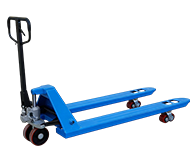
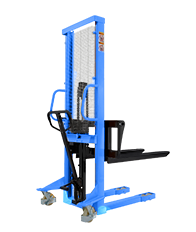
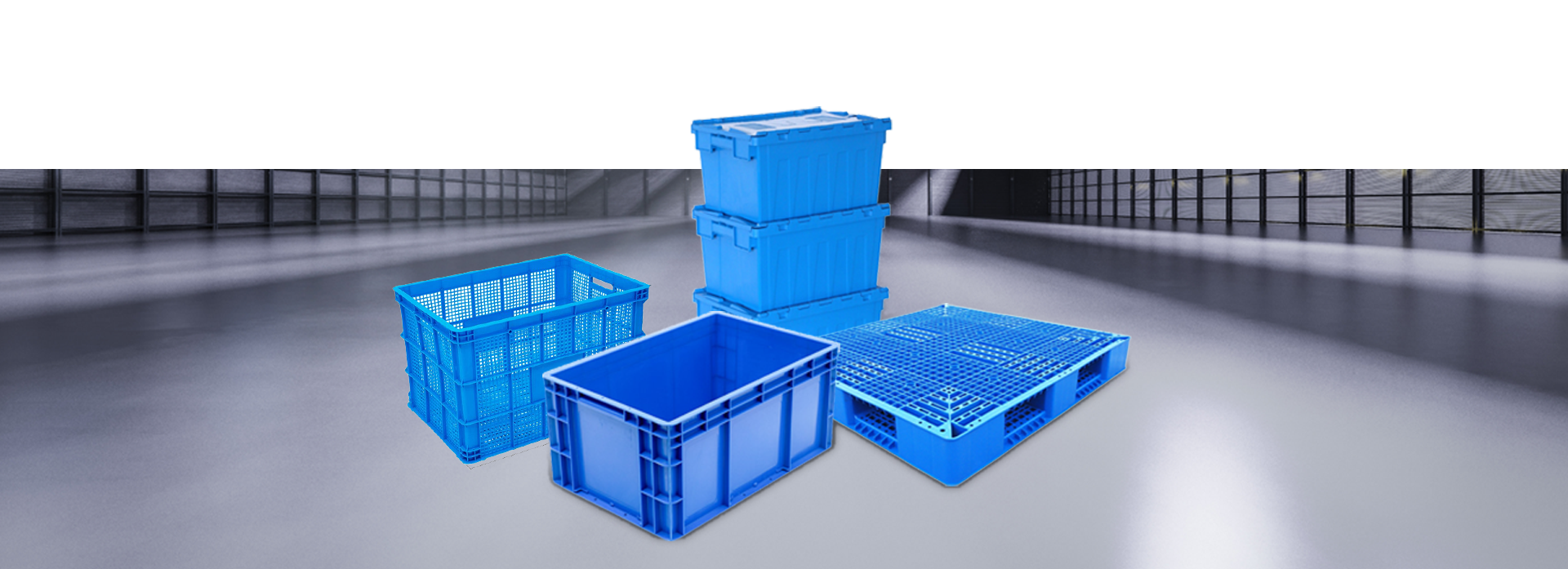
The manufacturer behind this product focuses on warehousing and logistics equipment across several related product categories. Its portfolio includes handling equipment, storage containers, packaging materials, and warehouse racking. This broad product coverage can be valuable to customers seeking coordinated solutions rather than isolated products.
A supplier familiar with pallet trucks, stackers, pallets, crates, packaging materials, and racking is better positioned to understand how a crate will function within a complete warehouse system. This wider perspective can support more practical recommendations for storage, movement, packaging, and space utilization.
The company emphasizes in-stock availability and fast delivery, which can be important for customers replacing damaged containers, expanding a distribution network, or responding to seasonal demand. Availability should still be confirmed for the required specification, color, and quantity before an order is finalized.
Strict quality control from raw material sourcing through production can help reduce variation. Standardized manufacturing processes support repeatable dimensions, consistent appearance, and reliable compatibility between batches. These strengths are especially important for fleet purchases, where every container must work with the same stacking and nesting system.
The company’s location in Yancheng, Jiangsu, China, also places it within a major manufacturing environment with access to industrial supply chains and export logistics. For international customers, communication, documentation, packaging, inspection, and shipping coordination should be discussed at the quotation stage.
Cost Efficiency and Total Ownership Value
The lowest purchase price is not always the lowest operating cost. A useful evaluation should include the container’s expected service life, damage rate, cleaning cost, return transport, storage volume, product protection, labor requirements, and packaging waste.
The BG-604035-SNC can create value in several ways. Its reusable construction may reduce the need for disposable cartons. Its attached lid may reduce the use of separate covers and some secondary packaging. Its nesting capability may reduce the space needed for empty returns. Its standardized footprint may improve pallet and warehouse utilization.
The financial benefit depends on the operating model. A company with frequent two-way movement and high packaging consumption may achieve a quicker return on investment than a company with irregular one-way shipments. A pilot program can help measure real-world results before a full fleet conversion.
Useful pilot measurements include average container cycles, cleaning time, damage frequency, return-load volume, loading time, product damage, labor hours, and disposable packaging consumption. These figures provide a more accurate basis for comparing reusable crates with existing packaging methods.
Recommended Operating Practices
Load products evenly so that weight is distributed across the crate base and the contents do not press excessively against the lid.
Close and secure the attached lid before moving or stacking the crate.
Do not exceed the approved load or stacking limits for the application.
Keep ventilation openings clear when handling chilled or perishable goods.
Use compatible liners, dividers, or cushioning materials where products require additional protection.
Nest empty crates in a consistent orientation to maintain stable return loads.
Inspect crates regularly for cracks, deformation, damaged lids, sharp edges, or contamination.
Clean and dry crates according to an approved hygiene procedure.
Keep food-contact and non-food-contact containers separated when required by the facility’s quality system.
Train personnel to use suitable lifting and moving equipment for fully loaded crates.
Frequently Asked Questions
What is the capacity of the crate?
The nominal capacity is 67 liters. The stated internal dimensions are approximately 545 × 370 × 335mm. Actual usable capacity depends on the product shape, packing method, and any liners or dividers used.
What are the external dimensions?
The external dimensions are 600 × 400 × 355mm. This standardized footprint is suitable for many warehouse, pallet, vehicle, and distribution applications, subject to the dimensions and load limits of the user’s equipment.
Can the crate both stack and nest?
Yes. It is designed to stack when loaded and nest when empty. Stacking supports vertical storage and transport, while nesting reduces the volume required for empty-container storage and return logistics.
Does the crate have a lid?
Yes. The crate has an integrated attached lid. The lid remains connected to the container, which helps reduce the risk of losing or mixing separate covers during daily operations.
Why are there ventilation holes?
The full round-hole perforations support airflow through the crate walls. This is useful for produce and other goods that benefit from ventilation during storage, cooling, and transport. The complete cold chain process must still be designed and validated for the specific product.
What material is used?
The product characteristics list HDPE, while other supplied product information refers to high-impact, food-safe PP and virgin PP. Because both descriptions appear in the documentation, buyers should confirm the exact resin grade and compliance documents for the final production model before ordering.
Is the crate suitable for food and produce?
It is designed for applications including produce handling, supermarket operations, and cold chain distribution. Buyers should confirm the applicable food-contact documentation, cleaning requirements, temperature range, and hygiene procedures for their specific market and product.
How much does the empty crate weigh?
The listed net weight is 3.16kg. The filled weight will vary according to the goods placed inside and should be evaluated for safe manual or mechanical handling.
Can the crate be used in a warehouse racking system?
It may be used in suitable warehouse systems, but compatibility must be confirmed. Rack dimensions, support conditions, container orientation, loaded weight, and stacking height should all be reviewed before implementation.
What makes it different from a conventional cardboard carton?
The reusable plastic construction is designed for repeated use and better resistance to moisture and handling. The attached lid, ventilation, reinforced ribs, and stack-and-nest functionality also provide capabilities that a standard cardboard carton may not offer.
What makes it different from a standard plastic tote?
The main differences are the integrated lid, ventilation pattern, dual stack-and-nest design, standardized 600 × 400mm footprint, and reinforced structure. These features are intended to support both loaded transport and compact empty returns.
Can the crate be customized?
The supplied information indicates multiple colors, full specifications, and customization availability. Customers should confirm available colors, markings, labels, dimensions, and minimum order requirements with the supplier.
How should empty crates be transported?
Empty crates should be nested in a stable and consistent configuration. The number of crates per nested group should follow the supplier’s guidance and the transport vehicle’s height and restraint requirements.
How should the crate be cleaned?
Cleaning should follow a procedure compatible with the confirmed resin, the goods handled, and the applicable hygiene requirements. The lid joints, corners, ribs, and ventilation holes should be inspected carefully after washing, and the crates should be fully dried before storage or reuse.
Is the crate suitable for automated logistics?
The standardized footprint and repeatable geometry may support use in organized conveyor or warehouse processes. However, automation compatibility must be tested with the specific equipment, including conveyor width, sensors, transfers, clearances, load limits, and lid position.
How can a company evaluate whether the crate is cost-effective?
A pilot program can compare container cycles, labor time, damage rates, cleaning costs, return-load volume, storage space, and disposable packaging consumption. These measurements provide a more reliable total-cost comparison than unit price alone.
Conclusion
The 67L stackable slanted nesting produce crate with integrated lid is designed to address several common problems in modern logistics: inefficient empty returns, exposed contents, inconsistent packaging dimensions, limited ventilation, and repeated dependence on disposable cartons.
Its 600 × 400mm footprint supports standardized warehouse and transport planning. Its 67L nominal capacity offers substantial room for produce, packaged goods, components, and other materials. The attached lid improves closure and handling convenience, while the full round-hole perforations support airflow for perishable products. Reinforced ribs contribute to structural performance, and the stack-and-nest design helps optimize space in both loaded and empty conditions.
The manufacturing approach is equally important. Controlled raw materials, standardized production methods, and inspection throughout the manufacturing process help create the consistency required for reusable container fleets. The supplier’s broader experience across handling equipment, storage containers, packaging materials, and warehouse racking also supports the development of integrated logistics solutions.
For the best results, customers should confirm the exact resin specification, food-contact documentation, load limits, cleaning requirements, customization options, and compatibility with existing equipment. When properly selected and managed, this crate can become a durable component of a more efficient, hygienic, and cost-conscious returnable packaging system.
References
1. Product specification sheet for model BG-604035-SNC, including dimensions, capacity, weight, material information, and design features.
2. Manufacturer-provided product information concerning stackable and nestable plastic crates, attached lids, ventilation, and logistics applications.
3. Manufacturer-provided quality information concerning raw material control, standardized production processes, and inspection procedures.
4. General principles of reusable transport packaging and returnable logistics systems.
5. General warehouse planning practices for standardized containers, pallet utilization, vertical storage, and reverse logistics.
6. General cold chain handling principles for ventilated packaging used with fresh produce and perishable goods.
Product: 67L Stackable Slanted Nesting Produce Crate with Integrated Lid


Copyright @ Yancheng Bingo Machinery Equipment Co., Ltd. All rights reserved Warehouse Logistics Equipment Manufacturer Pallet Truck Supplier
