 en
en  Español

58L Stackable Plastic Tote Box for Efficient Warehouse Storage and Transport
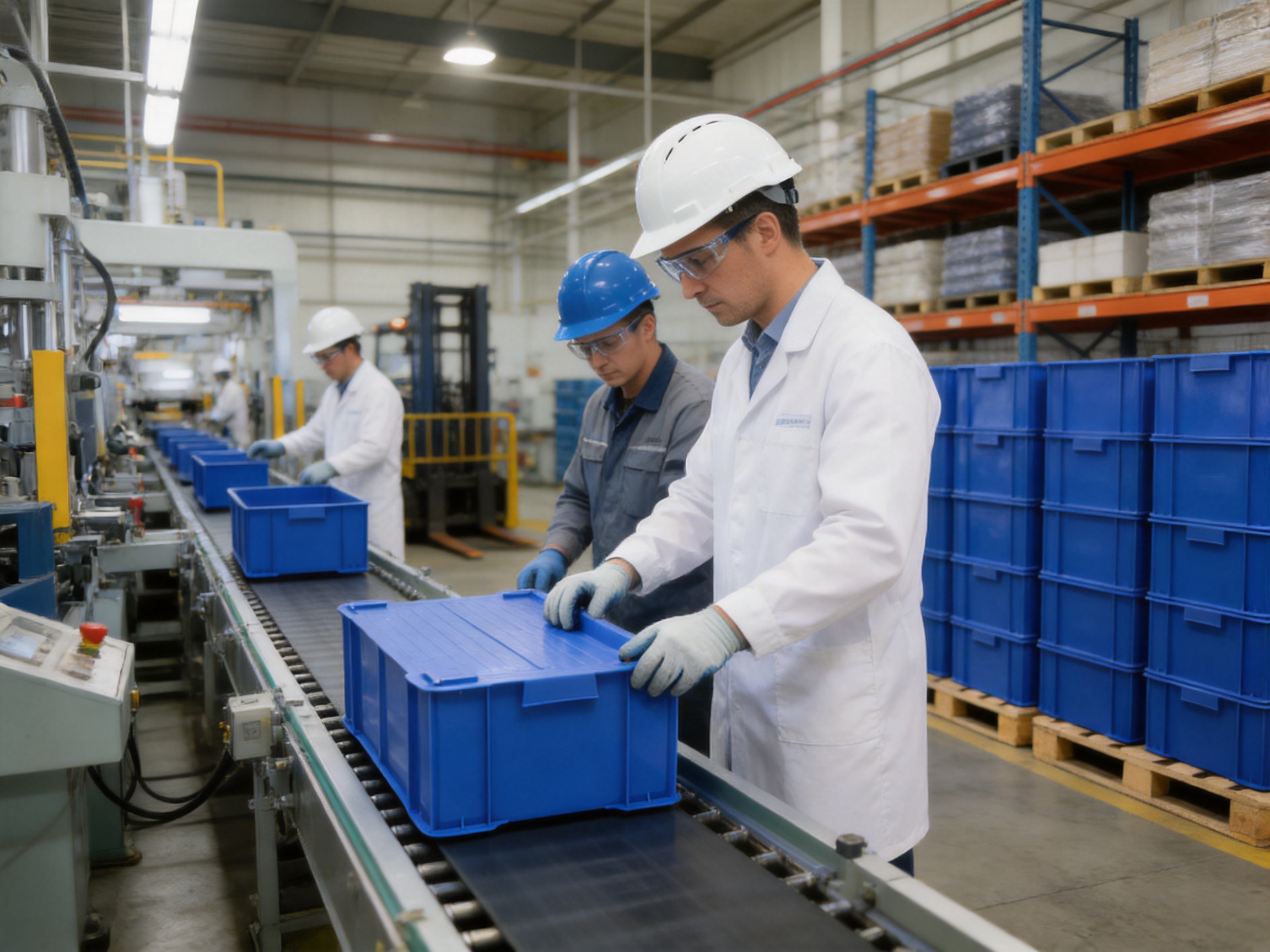
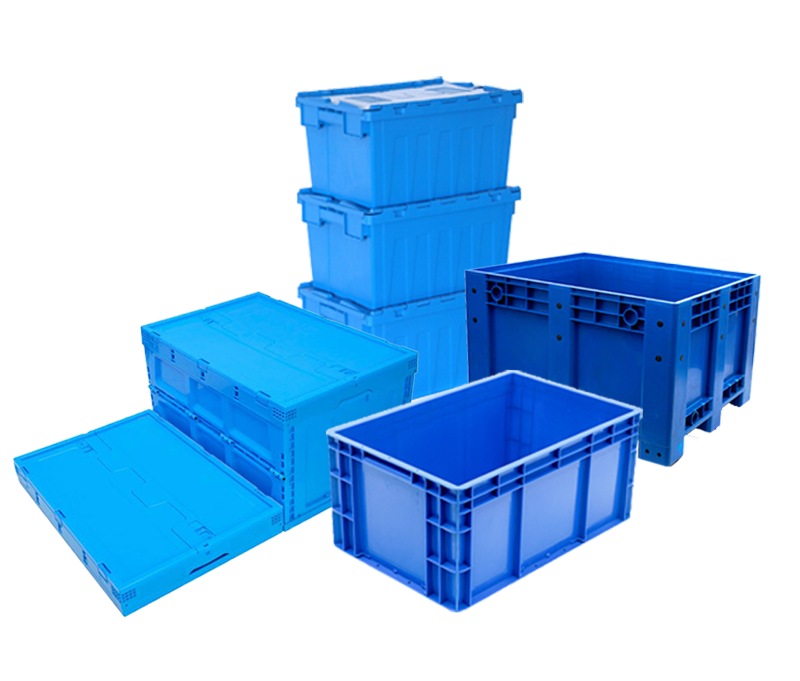
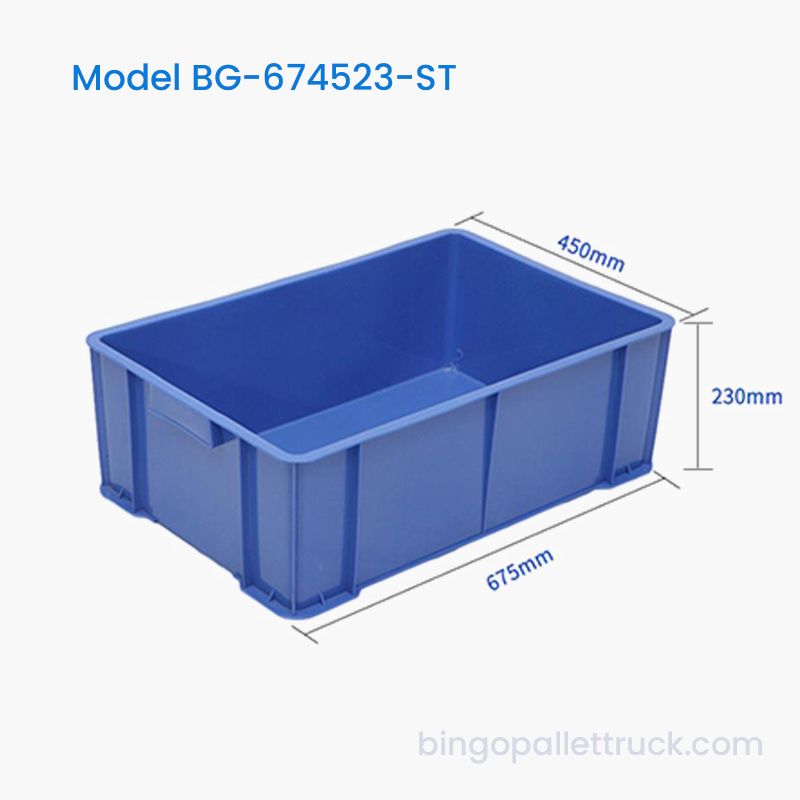
Modern warehouses, distribution centers, manufacturing plants, supermarkets, and e-commerce fulfillment operations depend on storage containers that can withstand repeated handling while using available space efficiently. The 58L Stackable Plastic Tote Box, model BG-674523-ST, is designed for these demanding material-handling environments. With external dimensions of 675×450×230mm, internal dimensions of 640×415×220mm, and a rated capacity of 58 liters, it provides a practical balance between usable volume, structural strength, and compatibility with organized logistics workflows.
Manufactured from durable HDPE, this heavy-duty plastic tote is intended for daily storage and transport applications where ordinary household containers or thin commercial bins may not provide sufficient durability. Its reinforced stackable structure allows operators to build stable vertical storage systems, reduce floor-space requirements, and move goods through receiving, picking, staging, and distribution processes with fewer handling complications.
More than a simple container, the tote forms part of a standardized warehouse system. When used with compatible pallets, shelves, conveyor systems, carts, and material-handling equipment, it can help businesses create repeatable processes for inventory control and internal transportation. Standardized dimensions also make it easier to plan storage locations, calculate capacity, and improve workplace organization.
Content
- 1 Product Overview
- 2 Why Stackable Plastic Totes Matter in Modern Logistics
- 3 Durable HDPE Construction
- 4 Optimized Dimensions and 58L Capacity
- 5 Reinforced Stackable Design
- 6 Advantages Over Common Alternative Containers
- 7 Applications Across Multiple Industries
- 8 Manufacturing Quality and Process Control
- 9 Company Manufacturing and Supply-Chain Strengths
- 10 Warehouse Workflow Improvements
- 11 Ergonomics and Safe Handling
- 12 Cleaning, Maintenance, and Service Life
- 13 Environmental and Economic Value
- 14 How to Select the Correct Configuration
- 15 Implementation Recommendations
- 16 Frequently Asked Questions
- 16.1 What is the capacity of the BG-674523-ST tote?
- 16.2 What are the external dimensions?
- 16.3 What material is used?
- 16.4 Can the tote be stacked?
- 16.5 Is the tote suitable for food storage?
- 16.6 How much does the empty tote weigh?
- 16.7 Can the tote be customized?
- 16.8 Is the product available from stock?
- 16.9 Can it be used with pallet trucks and warehouse racks?
- 16.10 How should loaded totes be stacked?
- 16.11 How can the service life of the tote be extended?
- 16.12 What industries can use this container?
- 17 Conclusion
- 18 References
- 19 Product: 58L Stackable Plastic Tote Box for Food Storage and Transport
Product Overview
The BG-674523-ST is a reusable stackable plastic tote designed for industrial and commercial logistics. Its low-profile rectangular format provides a relatively large footprint while maintaining a height that is convenient for access, visual inspection, and order picking. The container can be stacked when full or empty, subject to the load, stability, and operating conditions of the application.
The external size of 675×450×230mm gives the tote a stable base for warehouse handling. The internal size of 640×415×220mm provides approximately 58 liters of usable capacity. This difference between external and internal measurements accounts for the wall thickness, reinforced edges, structural ribs, and stack-support features required to make the container durable and safe for repeated use.
The 2.4kg product weight is light enough for practical manual handling while still providing a substantial structure for industrial use. A tote that is too light may flex excessively, deform during stacking, or suffer premature damage around its corners. This product is designed to provide a stronger and more dependable alternative to lightweight bins without becoming unnecessarily difficult to handle.
| Specification | Details |
| Product Type | Stackable plastic tote box |
| Model | BG-674523-ST |
| Material | HDPE |
| External Dimensions | 675×450×230mm |
| Internal Dimensions | 640×415×220mm |
| Nominal Capacity | 58L |
| Product Weight | 2.4kg |
| Design | Reinforced, reusable, stackable construction |
| Typical Applications | Warehousing, distribution, manufacturing, retail, inventory management, and transport |
Why Stackable Plastic Totes Matter in Modern Logistics
Warehousing is increasingly shaped by space limitations, labor costs, inventory accuracy, and the need for fast order fulfillment. Loose cartons, damaged packaging, and inconsistent container sizes can create wasted space and make material flow more difficult to control. Stackable plastic totes help address these problems by creating a more predictable storage unit.
A standard tote can be assigned to a product family, work order, customer shipment, or warehouse zone. Once loaded, it can be moved without repacking the contents into a different container at every stage. This reduces unnecessary touches and helps protect goods from compression, moisture, dirt, and accidental impact.
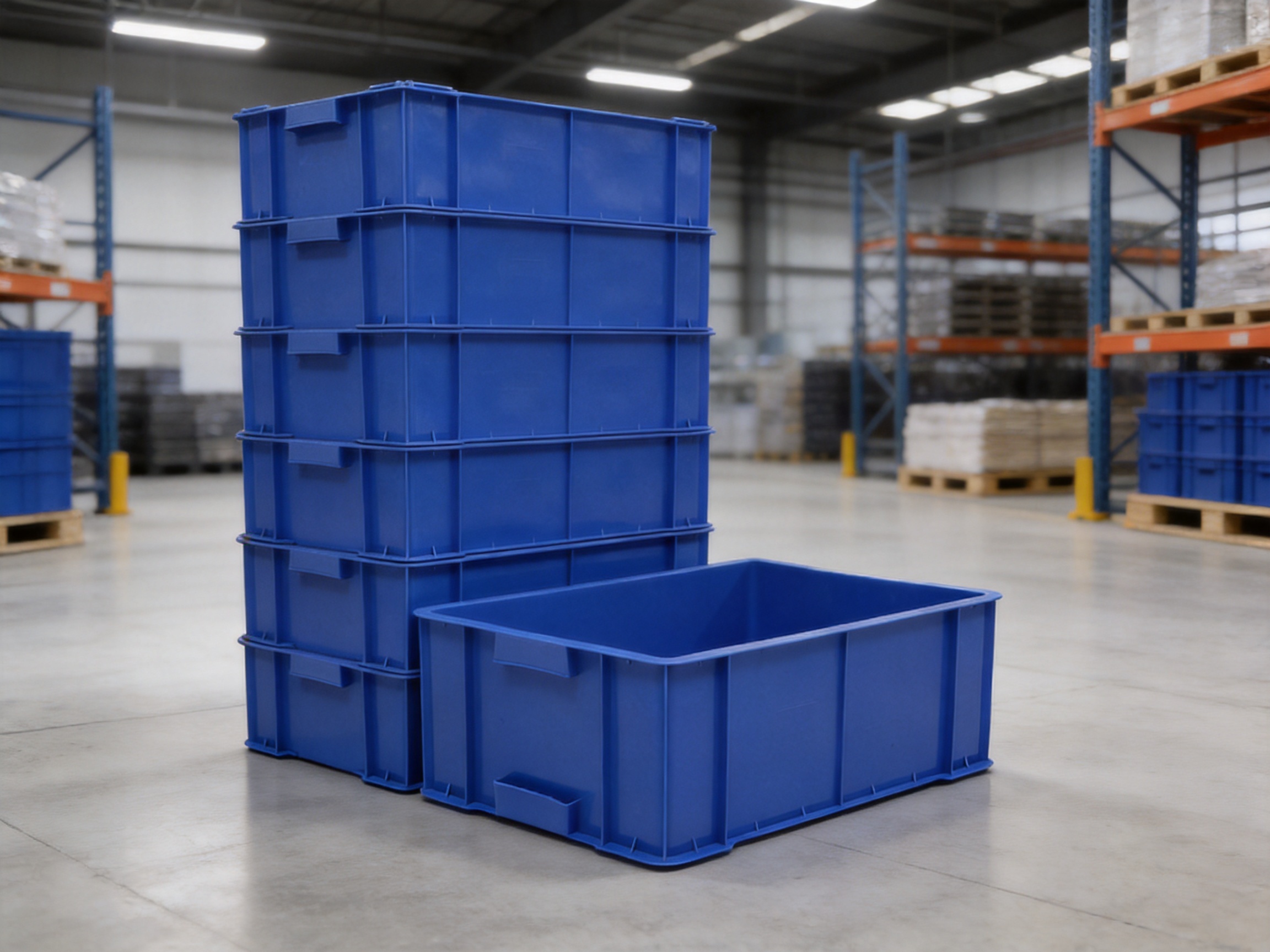
Vertical stacking is especially valuable in facilities where floor area is expensive. Instead of spreading containers across the floor, operators can use the height of a storage zone. The reinforced design of the BG-674523-ST supports stable stacking and can help organizations use higher-density storage layouts. The product information indicates that the totes may be stacked up to 10 or more layers, although the safe number of layers must always be confirmed according to load weight, product condition, floor flatness, and operating procedures.
When empty, standardized totes can also be nested or arranged in designated return areas if the specific operating configuration allows it. Even when nesting is not part of the design, the consistent footprint makes empty-container management more orderly than a collection of irregular boxes and bins.
Durable HDPE Construction
The tote is specified as being made from high-density polyethylene, commonly known as HDPE. HDPE is widely used for industrial containers because it offers a useful combination of toughness, impact resistance, chemical resistance, and relatively low weight. These properties make it suitable for demanding warehouse environments where containers may be placed on pallets, transferred between workstations, or exposed to repeated loading and unloading.
Compared with corrugated cardboard, HDPE provides significantly better resistance to moisture and repeated handling. Cardboard can weaken when exposed to humidity, condensation, spills, or friction against pallet surfaces. A rigid plastic tote maintains its basic shape under conditions that can reduce the reliability of disposable packaging.
Compared with thin consumer storage boxes, a heavy-duty industrial tote is designed with structural performance in mind. The walls, rim, corners, and base must work together to resist deformation. This is particularly important when several loaded totes are stacked vertically, because the force of the upper containers is transferred through specific load-bearing areas of the lower container.
HDPE also supports a reusable logistics model. When a container can be used repeatedly for internal transport and return cycles, the cost and waste associated with one-way packaging may be reduced. The actual service life depends on load weight, handling methods, temperature, exposure to chemicals, cleaning routines, and the level of impact in the facility.
Impact and Handling Resistance
Industrial totes may be pushed, lifted, placed on pallets, moved on carts, or transferred across warehouse floors. During these activities, corners and bottom edges are especially vulnerable to impact. A robust plastic formulation and reinforced design can reduce the risk of cracking or permanent deformation during ordinary handling.
Durability does not mean that the tote is indestructible. Operators should avoid dropping fully loaded containers from height, dragging them across abrasive surfaces, overloading them, or using forklifts in ways that place concentrated pressure on the side walls. Correct handling practices extend the working life of the product and protect both the tote and its contents.
Resistance to Moisture and Routine Industrial Conditions
Unlike paper-based packaging, the plastic body does not absorb water in the same way. This makes the tote appropriate for many areas where occasional moisture, condensation, or routine cleaning may occur. It can also be useful in facilities that need to separate goods from damp floors or warehouse dust.
Users should still verify chemical compatibility and operating-temperature requirements before placing aggressive chemicals, hot materials, or food products inside the container. For food-related applications, the buyer should confirm the specific resin grade, additives, cleanliness requirements, and applicable regulatory documentation before use.
Optimized Dimensions and 58L Capacity
The 675×450mm footprint creates a practical platform for storage and transport. At 230mm high externally, the tote is deep enough for many packaged products while remaining accessible for manual picking. The 640×415×220mm internal dimensions provide a clear working space for organized loading.
A 58-liter capacity is suitable for a broad range of applications. It can hold components, packaged goods, maintenance supplies, retail inventory, picking items, spare parts, or work-in-process materials. The size is large enough to improve handling efficiency but not so large that it necessarily becomes difficult to move when filled with moderately weighted products.
Capacity should not be confused with maximum load weight. A tote may have enough volume for 58 liters of material while the combined weight of the contents exceeds the recommended handling or stacking limit. Businesses should assess both the volume and density of the goods. Heavy metal parts, dense liquids, or compact machinery components may reach a safe weight limit before the container is full.
Space Planning Benefits
Consistent dimensions simplify warehouse planning. Managers can estimate how many totes fit on a pallet, within a rack bay, beside a picking station, or on a transport cart. The rectangular base also reduces the unused gaps commonly associated with irregular containers.
By creating a repeatable storage unit, the tote can support slotting strategies. Frequently picked products may be placed close to operators, while slower-moving goods can be assigned to higher or more distant locations. A consistent tote footprint helps make these decisions based on measurable space and movement requirements rather than guesswork.
The container can also support visual management. Labels, barcodes, identification cards, or other tracking systems may be attached or used with the tote, subject to the preferred labeling method. Clear identification reduces search time and helps prevent products from being placed in the wrong location.
Reinforced Stackable Design
The main advantage of this product over basic plastic bins is its focus on secure stacking. A stackable tote must do more than simply sit on top of another container. Its base and upper rim need to maintain alignment, resist sliding, and transfer weight in a controlled manner.
The BG-674523-ST is designed for vertical stacking in warehouse and transport environments. This allows organizations to create compact storage columns and keep goods organized during internal movement. When used correctly, stacking can reduce the need for additional shelving in temporary staging areas and improve the use of available vertical clearance.
Stacking performance depends on several factors. Containers should be placed on a level surface, loaded evenly, and aligned correctly. The heaviest totes should generally be placed at the bottom, while lighter goods should be placed above them. Damaged or deformed totes should be removed from service because even a small distortion can affect the stability of the stack.
Stacking in Storage Areas
In static warehouse storage, totes can be arranged in rows and columns according to product category, inventory turnover, or order destination. This approach can make stock counting and replenishment more systematic. It can also reduce clutter around workstations by keeping supplies in defined vertical groups.
Before creating high stacks, operators should check ceiling height, sprinkler clearance, access routes, emergency requirements, and local safety rules. The stated ability to stack 10 or more layers should be treated as a general design indication rather than a universal operating instruction. The actual safe stacking height must be determined for the specific goods and environment.
Stacking During Transport
During transport, vibration, acceleration, braking, and turning can create horizontal forces that are not present in static storage. Totes should therefore be aligned, secured, and placed on suitable pallets or transport platforms. If the load is moved by truck, cart, pallet truck, or other equipment, the complete unit should be protected against shifting.
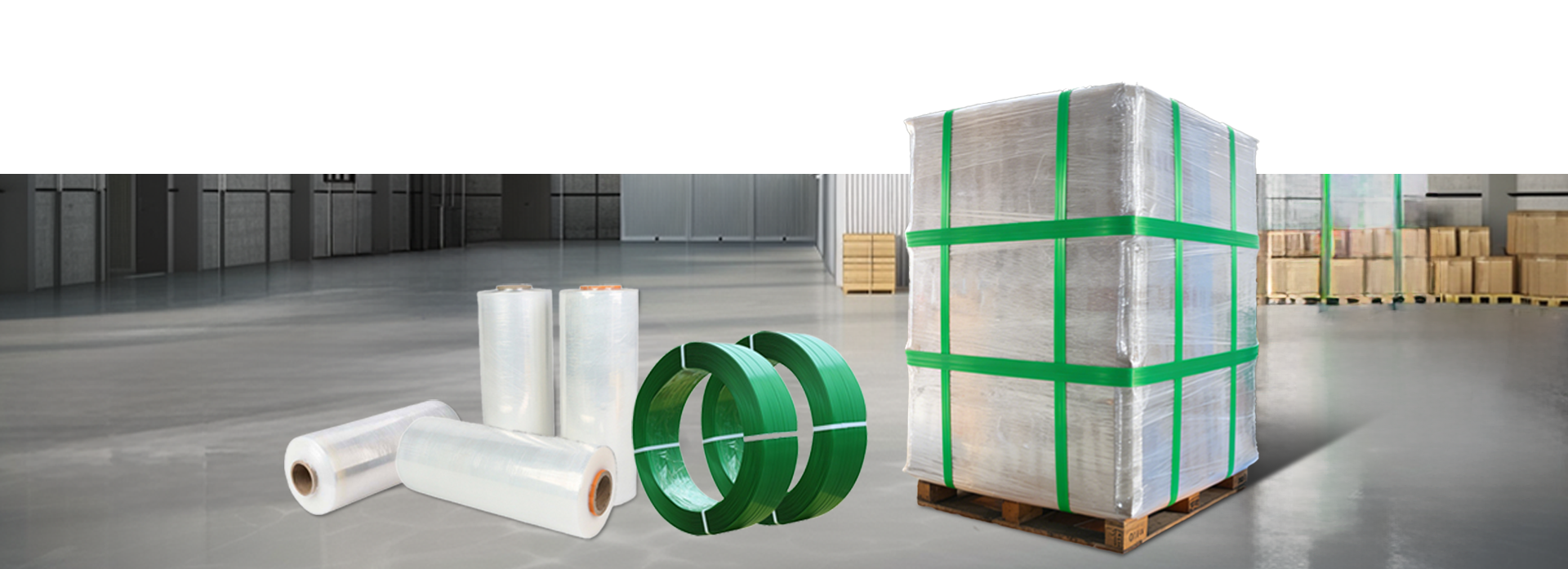
For long-distance transport, users may need stretch wrap, straps, lids, containment systems, or additional stabilization. The tote's stackable design helps create a stable load, but it does not replace proper load-securing procedures.
58L Stackable Plastic Tote Box for Food Storage and Transport
Advantages Over Common Alternative Containers
Compared with Corrugated Cartons
Corrugated cartons are inexpensive and convenient for one-way shipping, but they gradually lose strength through handling. Moisture, compression, abrasion, and repeated opening can make cartons less reliable. A reusable HDPE tote offers better resistance to these conditions and can be returned, cleaned, and reused for future cycles.
The rigid walls of a plastic tote also provide better protection against side impacts. A carton may collapse when another package presses against it, while a heavy-duty tote is designed to preserve its shape. This can be particularly useful for components that must remain separated or protected during warehouse movement.
Cartons may still be preferable for lightweight outbound shipments, product presentation, or applications where low initial cost is the primary consideration. However, for repetitive internal logistics, the reusable tote can offer better long-term value by reducing replacement frequency and improving handling consistency.
Compared with Fabric Bags
Fabric bags are flexible and can be useful for soft goods, but they generally do not provide the same level of rigid protection or stable stacking. They may collapse when empty, deform when loaded, or require additional outer support. A rigid tote is better suited to organized vertical storage and automated or semi-automated handling environments.
Compared with Lightweight Household Bins
Household bins are often designed for occasional storage rather than continuous industrial use. Their walls, handles, and bases may not be engineered for repeated stacking, pallet movement, or warehouse impacts. The BG-674523-ST is positioned as a heavy-duty logistics container with standardized dimensions and a reinforced structure, making it more appropriate for commercial operations.
Compared with Non-Stackable Open Containers
Open containers without stacking features can waste vertical space and may slide or collapse when placed on top of one another. A purpose-built stackable tote provides better alignment between units and supports more organized storage. This can reduce floor congestion and make inventory locations easier to maintain.
Applications Across Multiple Industries
Distribution Centers
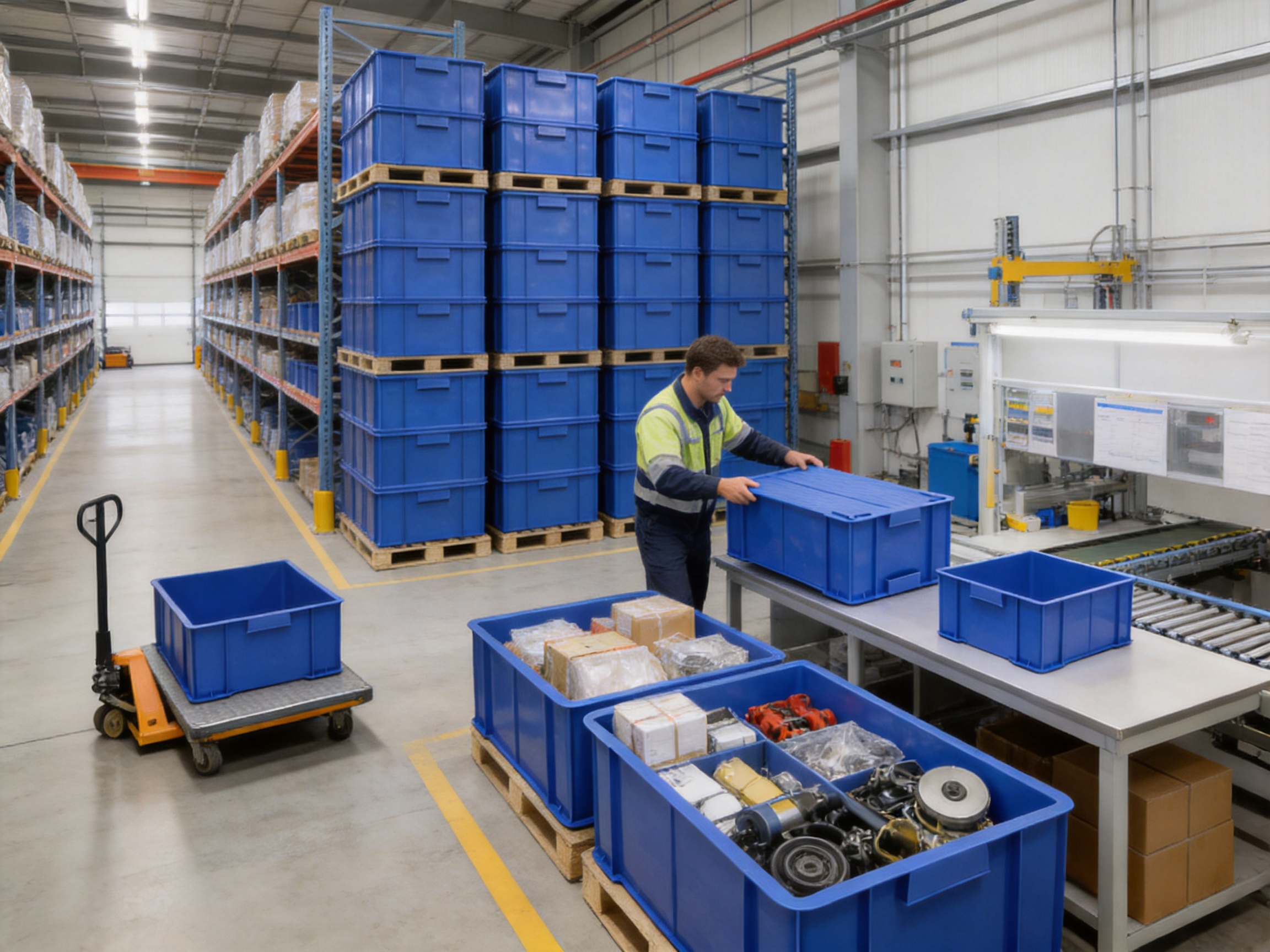
Distribution centers can use the tote for sorting, temporary staging, order consolidation, and internal transportation. A container assigned to a route, customer group, or product category can travel through several work areas without requiring the contents to be repacked.
Its 58L capacity is useful for medium-volume picking tasks. Operators can place selected items into the tote, scan the tote or its associated order, and transfer it to packing or dispatch. The consistent dimensions also make it easier to use standard carts, pallet positions, and shelving systems.
Manufacturing Plants
Manufacturers can use stackable totes for raw-material staging, component storage, work-in-process handling, and finished-goods movement. Separating components into dedicated containers can reduce mixing errors and help production teams maintain orderly workstations.
For assembly operations, one tote may hold the components needed for a production batch or work order. The tote can then move between inspection, assembly, testing, and packing areas. This supports a more controlled material flow and can help reduce time spent searching for parts.
E-Commerce Fulfillment
E-commerce operations require fast, accurate, and repeatable order processing. A rigid tote can serve as a picking container, replenishment bin, or transfer unit between storage and packing areas. It offers stronger protection than loose bags and can be arranged on carts or shelving according to the facility's workflow.
When products are picked into standardized totes, the operation may experience fewer product drops, less packaging damage, and more efficient movement between stations. The tote can also help separate orders or route items to the correct packing lane.
Supermarket and Retail Distribution
Retail distribution centers can use the containers for store replenishment, backroom inventory, seasonal goods, and stock transfers. Durable reusable totes are especially useful when products travel repeatedly between a central warehouse and multiple retail locations.
Retailers may also benefit from improved organization in receiving areas. Totes can be assigned to departments, delivery routes, or product types, allowing employees to identify and process incoming goods more efficiently.
Food-Related Storage and Transport
The product title identifies food storage and transport as an intended application area. The durable plastic format can be useful for packaged food, ingredients, supplies, or food-service logistics. However, food-contact suitability should be verified before use. Buyers should request confirmation of the resin grade, production cleanliness, intended temperature range, and any required compliance documents.
Food-related users should establish cleaning and inspection procedures. Totes should be cleaned using methods suitable for the material and the products being handled. Cracked, heavily scratched, contaminated, or otherwise compromised containers should be removed from food-contact service.
Maintenance and Service Operations
Maintenance departments can use the tote to organize tools, spare parts, fasteners, electrical components, and repair kits. A dedicated tote for each machine, line, or maintenance task can reduce preparation time and improve accountability for small parts.
The container's stable shape is also helpful for mobile workstations. It can be placed on a cart or beside a repair area while keeping contents separated from the floor and protected from incidental contact.
Manufacturing Quality and Process Control
A reliable industrial tote depends not only on its material but also on the consistency of its manufacturing process. Variations in resin quality, mold temperature, cooling, wall thickness, or dimensional control can affect stacking performance and service life. For this reason, the manufacturing process should be managed through standardized procedures and inspections at multiple stages.
The supplied company information describes a production approach based on strict quality control from raw-material sourcing through production. It also emphasizes standardized processes, inspection procedures, and a mature supply-chain system. These factors are important because a logistics container must perform consistently across repeated production batches, not only in an individual sample.
Raw-Material Management
Material control begins before molding. The resin should be sourced through approved channels and checked against the required specification. For this product, the stated construction material is HDPE. The provided production information also refers to high-density virgin PP material in one quality statement. Because HDPE and PP are different polymers with different performance characteristics, purchasers should request confirmation of the exact resin used for the specific BG-674523-ST production batch.
This clarification is particularly important for customers with food, pharmaceutical, chemical, export, or regulatory requirements. Material certificates, compliance declarations, and batch records can help buyers verify that the delivered product matches the agreed specification.
Injection-Molding Control
Industrial plastic totes are commonly produced through injection molding. In this process, prepared polymer is heated until it reaches a suitable flow condition, injected into a precision mold, held under pressure, and cooled before the molded part is ejected.
Process parameters such as injection pressure, melt temperature, holding pressure, cooling time, and cycle time must be controlled carefully. If the settings are inconsistent, the result may include warping, sink marks, incomplete filling, uneven wall thickness, or dimensional variation. Any of these defects can affect the way containers stack or fit into warehouse equipment.
A mature manufacturing operation uses documented settings and trained personnel to keep the molding cycle stable. Regular inspection of molds and production equipment is also essential. Clean mold surfaces, properly maintained gates, and accurate alignment contribute to consistent dimensions and appearance.
Dimensional Inspection
Dimensional checks can verify the external length, width, and height as well as critical internal measurements. The 675×450×230mm external dimensions and 640×415×220mm internal dimensions should be monitored according to the agreed manufacturing tolerance.
Inspection should also consider the flatness of the base, the straightness of the walls, the condition of the upper rim, and the alignment of stacking surfaces. A tote may have acceptable overall dimensions but still create problems if its rim is distorted or its base is uneven.
Load and Stack Testing
Because the product is intended for stacking, quality evaluation should include practical load tests. These may involve placing loaded containers in a stack, observing deformation over time, checking stability, and evaluating performance after repeated handling cycles.
Testing conditions should reflect the customer's actual use. A tote used for lightweight retail items may require a different validation approach from one used for dense industrial parts. Temperature, humidity, loading pattern, and duration should be considered when establishing test procedures.
Visual and Surface Inspection
Every production batch should be checked for visible defects such as cracks, sharp flash, incomplete molding, serious discoloration, contamination, or damaged corners. Smooth and properly finished surfaces make the tote easier to clean and safer to handle.
Quality control at multiple stages reduces the likelihood that defective units will reach the warehouse. It also provides traceability when a customer reports an issue or requests an investigation into a particular batch.
Company Manufacturing and Supply-Chain Strengths
Yancheng Bingo Machinery Equipment Co., Ltd. operates as a supplier of warehousing and logistics equipment, material-handling products, storage containers, packaging materials, and warehouse racking. This broader product range is valuable to buyers seeking coordinated logistics solutions rather than isolated container purchases.
The company describes its business as covering four core systems: handling equipment, storage containers, packaging materials, and warehouse racks. This includes manual and electric pallet trucks, stackers, plastic pallets, plastic totes, crates, bulk containers, stretch wrap, packing strapping, and multiple categories of racking.
For a customer purchasing the BG-674523-ST, this wider capability can simplify procurement. The tote may be evaluated alongside compatible pallets, pallet trucks, storage racks, and packaging products. Coordinated sourcing can help reduce compatibility problems and make it easier to standardize equipment across a facility.
Integrated Logistics Equipment Expertise
A supplier that understands both containers and handling equipment is better positioned to consider the complete movement process. The tote must not only hold goods; it must also interact with pallets, carts, racks, loading areas, and operators. Knowledge of material-handling workflows helps ensure that product recommendations are based on actual warehouse requirements.
For example, a buyer may need to confirm whether the tote fits a particular rack bay, whether its footprint is suitable for a pallet, or whether its loaded weight is practical for manual pallet-truck movement. A supplier with experience across these product categories can help address such questions during the planning stage.
Standardized Production Procedures
The company emphasizes standardized processes and strict production standards. Standardization supports repeatability. It helps production teams follow the same procedures for material preparation, molding, inspection, packing, and dispatch.
For international buyers, process repeatability is especially important because replacement orders may be placed months after an initial purchase. Consistent production helps customers maintain uniform container dimensions across different deliveries and avoid operational disruption caused by mismatched products.
Quality-Focused Supplier Management
Quality control should extend beyond the molding machine. Supplier management, material verification, equipment maintenance, worker training, inspection records, and packaging control all contribute to the delivered product. The company's stated emphasis on quality inspection and supply-chain coordination supports a more controlled purchasing experience.
Buyers should still define their own acceptance requirements. These may include the resin specification, color, dimensions, weight tolerance, load requirements, labeling, packaging, sample approval, and documentation. Clear specifications allow both the buyer and supplier to evaluate the product using the same criteria.
Customization and Inventory Availability
The supplied information indicates that multiple colors, full specifications, customization support, and in-stock availability may be offered. Color coding can help separate product categories, production lines, customers, or warehouse zones. Customization may involve color, labels, markings, or other details, depending on tooling and order requirements.
Customization should be discussed early because it may affect minimum order quantities, lead times, tooling, packaging, and product documentation. For urgent requirements, standard in-stock versions may provide a faster route to deployment.
Warehouse Workflow Improvements
Receiving
At receiving, empty totes can be assigned to incoming product groups or purchase orders. Goods can be transferred from unloading areas into standardized containers, reducing the number of loose packages on the floor. The tote's rigid structure helps protect products while they wait for inspection, counting, or put-away.
Put-Away
During put-away, totes can be placed in designated rack positions, shelving locations, or floor stacks. Their consistent dimensions make location planning easier. Warehouse management systems can record the tote's location, contents, quantity, and status, improving inventory visibility.
Order Picking
For picking operations, the container can be used as a reusable order tote. Employees may pick goods into the container by route, order number, customer, or workstation. The 58L volume can reduce the need for multiple small boxes while remaining manageable for many manual applications.
Staging and Consolidation
After picking, totes can be staged in groups according to carrier, destination, dispatch time, or delivery route. Stackable containers help maintain a more organized staging area and can reduce the risk of products being misplaced among loose cartons.
Returns and Reverse Logistics
Reusable totes can also support reverse logistics. Returned goods, inspection items, repair products, and reusable packaging can be placed in dedicated containers. This makes it easier to distinguish returned stock from saleable inventory and helps create a controlled flow for inspection and disposition.
Ergonomics and Safe Handling
A container's practical value depends partly on whether employees can handle it safely and efficiently. The 2.4kg empty weight is relatively manageable, but the final handling weight depends on the contents. Supervisors should establish maximum fill weights according to employee capability, local regulations, and the handling equipment used.
Operators should lift with a stable posture, avoid twisting while carrying, and use carts or pallet equipment for heavier loads. If the tote is filled with dense products, it may be safer to limit the fill level even when substantial space remains unused.
Stacked containers should not be climbed on, used as steps, or moved as unstable columns. When a tall stack must be relocated, containers should be separated and moved using an appropriate transport method. Any tote showing cracks, severe distortion, broken edges, or weakened stacking surfaces should be isolated for inspection.
Load Distribution
Contents should be distributed evenly across the base. Concentrating heavy items at one corner can create localized stress and make the tote unstable. Smaller items can be grouped into inner packaging or dividers if necessary to prevent shifting during transport.
For fragile products, protective inserts, foam, separators, or secondary packaging may be used. The plastic tote provides an outer protective structure, but the internal arrangement should still be adapted to the sensitivity of the goods.
Cleaning, Maintenance, and Service Life
Reusable totes require a maintenance program if they are expected to remain in service for many handling cycles. Cleaning frequency depends on the application. Food-related operations, medical supply logistics, and dusty manufacturing environments may require more frequent cleaning than general storage operations.
Cleaning methods should be compatible with HDPE and should not damage the surface or leave residues that could affect the next load. Users should consult the supplier for recommended detergents, water temperatures, and sanitation procedures when the application has special requirements.
Regular inspections should check the base, side walls, corners, rim, stacking areas, and any identification labels. Containers should be removed from circulation if they no longer stack securely or if damage creates a risk to workers or products.
Proper storage also supports service life. Empty totes should be stored away from unnecessary heat, sharp objects, direct physical abuse, and incompatible chemicals. Avoiding uncontrolled outdoor exposure can help preserve color and surface condition over time, depending on the material formulation and environmental conditions.
Environmental and Economic Value
Reusable plastic totes can contribute to packaging efficiency by replacing some disposable cartons, bags, or single-use containers. Their environmental value is strongest when they complete many successful reuse cycles. The longer a tote remains serviceable, the more effectively its original material and manufacturing energy are distributed across repeated uses.
The economic benefit should be assessed over the complete operating cycle rather than only the purchase price. Relevant factors include replacement frequency, labor savings, product damage, storage density, cleaning cost, return logistics, and disposal requirements. A durable container may provide better total value when it reduces repacking and protects goods during repeated internal movement.
At the end of its service life, the tote should be managed according to local recycling and waste procedures. Material identification and separation can support appropriate recycling where facilities are available. Companies should also consider repair, reuse in lower-risk applications, or controlled recycling before disposal.
How to Select the Correct Configuration
Before placing an order, buyers should evaluate the dimensions of their products and the available warehouse infrastructure. The internal dimensions of 640×415×220mm should be compared with the actual product size, including protective packaging. Products that fit tightly may be difficult to remove, while excessive empty space may allow movement and damage.
The buyer should also calculate the expected filled weight. Consider the heaviest product combination, not only the average load. If the tote will be stacked, the load at the bottom of the stack should be evaluated carefully.
Other selection factors include color requirements, labeling, cleaning methods, temperature exposure, chemical contact, pallet compatibility, rack compatibility, and transport conditions. A sample evaluation is recommended before a large-scale rollout.
| Evaluation Area | Questions to Consider |
| Product Fit | Will the goods fit within 640×415×220mm without excessive compression or wasted space? |
| Load Weight | What is the maximum filled weight during normal and peak operations? |
| Stacking | How many layers are required, and are the floor and load conditions suitable? |
| Handling | Will employees, carts, pallet trucks, or conveyors move the tote? |
| Environment | Will the tote face moisture, chemicals, heat, cold, dust, or outdoor exposure? |
| Compliance | Are food-contact, export, traceability, or material-certification documents required? |
| Identification | Will the operation use colors, labels, barcodes, or other tracking methods? |
| Supply | Are standard in-stock units sufficient, or is customization required? |
Implementation Recommendations
A controlled implementation is usually more successful than introducing containers throughout an entire facility at once. Begin with a pilot area such as receiving, order picking, or a specific production line. Track how the totes fit the workflow and whether employees can handle them comfortably.
Measure practical results such as storage density, picking time, damage rate, replenishment time, empty-tote return rate, and container loss. These measurements help determine whether the selected size and operating procedures are suitable.
Develop a simple standard operating procedure covering loading, stacking, movement, cleaning, labeling, inspection, and damage reporting. Employees should know the maximum acceptable fill weight, the correct stacking arrangement, and the conditions that require a tote to be removed from service.
Warehouse teams should also establish a location for empty totes. Without a return and storage process, reusable containers can become scattered throughout the facility and reduce the expected efficiency gains. A designated collection area, counting routine, or tracking system can improve availability and control.
Frequently Asked Questions
What is the capacity of the BG-674523-ST tote?
The nominal capacity is 58 liters. The internal dimensions are 640×415×220mm. Actual usable capacity may vary depending on the shape of the goods, internal packaging, and the amount of free space required for safe handling.
What are the external dimensions?
The external dimensions are 675×450×230mm, measured in length, width, and height. These dimensions should be compared with pallet sizes, rack openings, carts, conveyor equipment, and storage locations before purchase.
What material is used?
The product specification identifies HDPE as the material. Because the supplied manufacturing notes also mention virgin PP in a general quality statement, buyers should confirm the exact resin specification for the BG-674523-ST model and request supporting documentation where necessary.
Can the tote be stacked?
Yes. The tote has a reinforced stackable design intended for vertical storage and transport. Product information indicates stacking of 10 or more layers may be possible, but the safe height depends on the contents, weight, floor condition, alignment, and operating environment.
Is the tote suitable for food storage?
The product title identifies food storage and transport as an application. However, food-contact suitability should be confirmed with the supplier before use. Buyers should verify the resin grade, additives, manufacturing hygiene, cleaning requirements, and applicable regulatory documentation.
How much does the empty tote weigh?
The listed product weight is 2.4kg. The total handling weight will be higher after goods are loaded, so users should establish a safe maximum filled weight for their operation.
Can the tote be customized?
The supplied information indicates that customization is supported and that multiple colors may be available. Customers should confirm options such as color, markings, labels, packaging, and minimum order quantities with the supplier.
Is the product available from stock?
The product information states that in-stock units may be available for fast delivery. Availability can change according to color, quantity, customization, and destination, so buyers should confirm current inventory and lead time before ordering.
Can it be used with pallet trucks and warehouse racks?
The tote is designed for logistics environments, but compatibility depends on the specific pallet, rack, cart, or handling system. Buyers should compare the tote's 675×450mm footprint and filled weight with the working dimensions and rated capacity of their equipment.
How should loaded totes be stacked?
Loaded totes should be aligned on a level surface, filled evenly, and arranged with heavier loads at the bottom. Operators should avoid unstable surfaces, excessive height, uneven loads, and damaged containers. Transport stacks may require stretch wrap, straps, or other load-securing methods.
How can the service life of the tote be extended?
Use the tote within its intended load and environmental limits, avoid dropping or dragging it, inspect it regularly, clean it with compatible products, and remove damaged units from demanding applications. Correct stacking and careful movement also reduce stress on the walls and base.
What industries can use this container?
Potential users include distribution centers, manufacturing facilities, e-commerce warehouses, retail supply chains, supermarket distribution operations, maintenance departments, inventory-control teams, and selected food-related logistics applications.
Conclusion
The 58L Stackable Plastic Tote Box, model BG-674523-ST, offers a practical solution for businesses seeking stronger organization, repeatable handling, and improved use of warehouse space. Its 675×450×230mm external dimensions, 640×415×220mm internal dimensions, 2.4kg weight, and 58-liter capacity make it suitable for many medium-volume storage and transport tasks.
Its HDPE construction provides a durable alternative to disposable cartons, lightweight household bins, flexible bags, and non-stackable containers. The reinforced stackable design supports vertical storage and helps create standardized logistics units for receiving, put-away, picking, staging, production, and distribution.
The product's value is strengthened by the supplier's broader experience in handling equipment, storage containers, packaging materials, and warehouse racks. The stated focus on standardized production, strict quality control, supply-chain coordination, customization, and stock availability can support customers that need reliable logistics products and integrated material-handling solutions.
For the best results, buyers should confirm the exact resin specification, load requirements, stacking conditions, food-contact documentation where applicable, and compatibility with existing equipment. When correctly selected and managed, this reusable tote can improve warehouse cleanliness, reduce handling complexity, protect goods, and support more efficient supply-chain operations.
References
1. Product specification sheet for stackable plastic tote box model BG-674523-ST, including dimensions, material, capacity, and weight.
2. General material-handling principles for reusable containers, warehouse storage, palletized transport, and safe stacking practices.
3. General industrial guidance on HDPE material performance, reusable plastic packaging, and container maintenance.
4. Warehouse planning principles covering inventory organization, storage density, order picking, staging, and reverse logistics.
5. Supplier-provided company information concerning warehousing and logistics equipment, quality control, standardized manufacturing processes, and integrated storage solutions.
Product: 58L Stackable Plastic Tote Box for Food Storage and Transport

Copyright @ Yancheng Bingo Machinery Equipment Co., Ltd. All rights reserved Warehouse Logistics Equipment Manufacturer Pallet Truck Supplier
