 en
en  Español

50L Collapsible Plastic Tote with Lid: A Space-Saving Solution for Modern Logistics
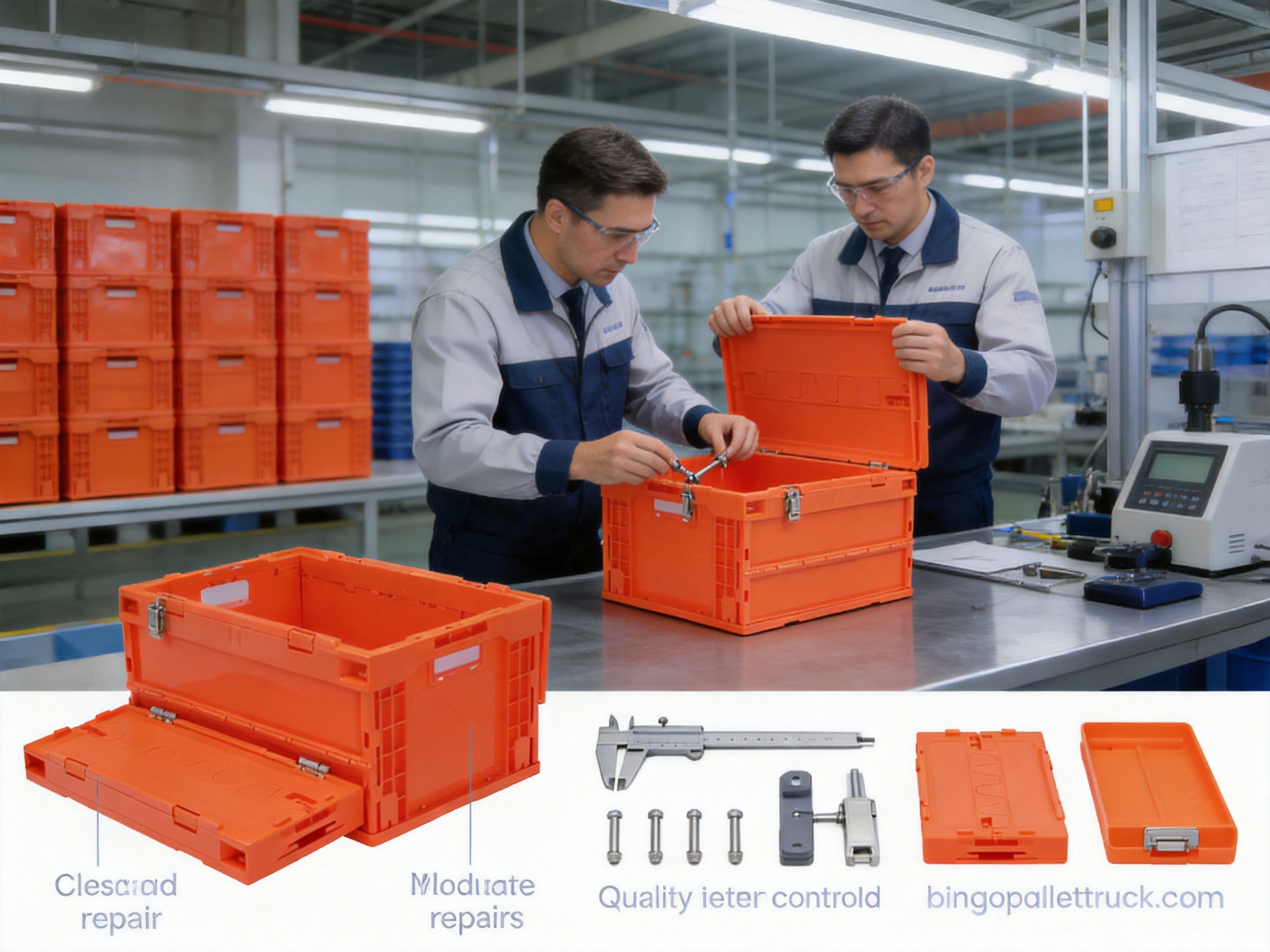
Efficient storage, secure product handling, and controlled transportation are essential to modern supply chains. Warehouses, distribution centers, retail networks, e-commerce fulfillment operations, and cold chain providers all need containers that can withstand repeated use while reducing the space and cost associated with empty returns. The 50L Collapsible Plastic Tote with Lid, model BG-533634B-CTL, is designed to answer these needs with a combination of generous capacity, structural strength, folding efficiency, and practical operating features.
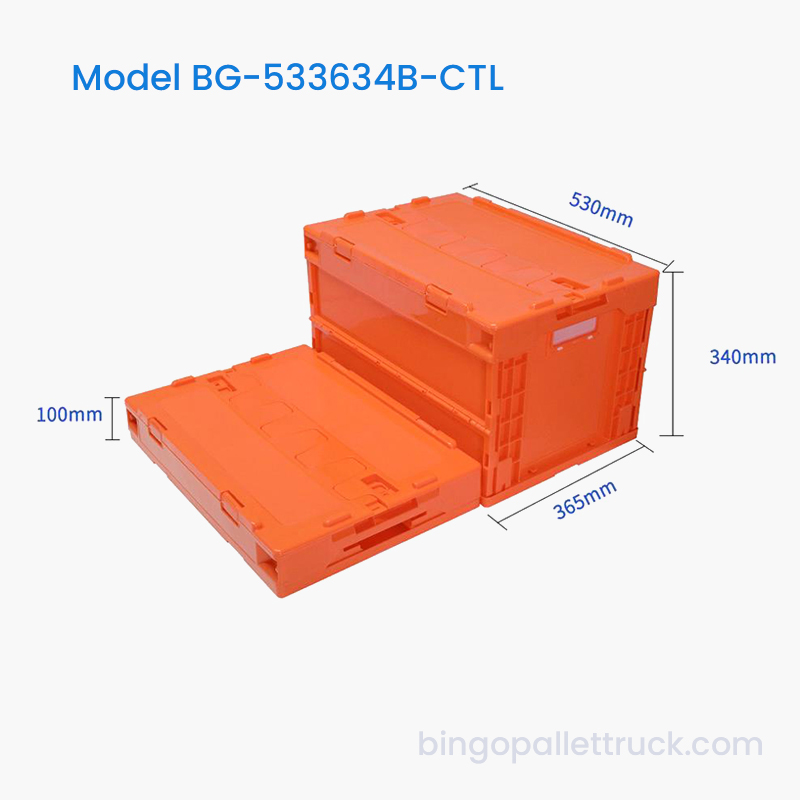
Built from durable polypropylene, this reusable tote provides a 530 × 365 × 340 mm external footprint and a 50-liter working capacity. When opened, it offers sufficient internal room for a broad range of packaged goods, components, retail products, warehouse supplies, and transport items. When empty, it folds to a height of only 100 mm. This significant reduction in volume makes it easier to store, consolidate, and return, helping companies control the hidden costs associated with empty packaging.
The integrated lid provides an additional level of protection during handling and transportation. Instead of requiring separate covers that can become lost or mixed with other containers, the lid remains part of the tote system. This supports more organized warehouse operations and helps protect contents from dust, incidental contact, and shifting during movement. The lid design also contributes to safer stacking and more secure distribution workflows.
Compared with ordinary rigid plastic boxes, disposable cartons, and basic foldable containers, this model is intended to deliver a more complete logistics solution. It is reusable, modular, stackable, space-saving, and suitable for demanding industrial environments. Its design also incorporates replaceable components, security lock holes, label card slots, integrated latches, and pin shaft connections, making it more serviceable and adaptable over its operating life.
Content
- 1 Product Overview
- 2 Why Collapsible Design Matters in Supply Chains
- 3 Durable Polypropylene Construction
- 4 Capacity and Practical Dimensions
- 5 Integrated Lid for Safer Handling
- 6 Heavy-Load Performance and Stackability
- 7 Modular Components and Lower Lifetime Cost
- 8 Pin Shaft and Latch Engineering
- 9 Security Lock Hole and Label Card Slot
- 10 Opening and Folding Workflow
- 11 Advantages over Rigid Plastic Boxes
- 12 Advantages over Cardboard Packaging
- 13 Advantages over Basic Foldable Crates
- 14 Applications in E-Commerce Fulfillment
- 15 Applications in Manufacturing
- 16 Applications in Retail Distribution
- 17 Applications in Cold Chain Logistics
- 18 Warehouse Space Optimization
- 19 Manufacturing Quality and Process Control
- 20 Advanced Production Strengths
- 21 Quality Control from Raw Material to Finished Product
- 22 Operating Recommendations
- 23 Total Cost of Ownership
- 24 Sustainability Benefits
- 25 Comparison of Packaging Options
- 26 Implementation in a Logistics System
- 27 Frequently Asked Questions
- 27.1 What is the capacity of the collapsible tote?
- 27.2 How compact is the tote when folded?
- 27.3 What material is used to manufacture the tote?
- 27.4 Does the tote include a lid?
- 27.5 Can the tote be stacked?
- 27.6 What is the empty weight?
- 27.7 Can damaged parts be replaced?
- 27.8 How does the security feature work?
- 27.9 What is the purpose of the label card slot?
- 27.10 Is the tote suitable for e-commerce?
- 27.11 Can it be used in cold chain logistics?
- 27.12 How does it compare with cardboard packaging?
- 27.13 How should the tote be folded?
- 27.14 Who manufactures the product?
- 28 Conclusion
- 29 References
- 30 Product: 50L Collapsible Plastic Tote with Lid
Product Overview
The 50L Collapsible Plastic Tote with Lid is a heavy-duty reusable container developed for professional storage and material movement. Its design combines a stable open configuration with a compact folded configuration, allowing the same container to perform efficiently during both loaded and empty stages of the logistics cycle.
The tote is identified by model BG-533634B-CTL. It is manufactured from PP, or polypropylene, a material widely used for reusable industrial containers because of its balance of strength, low weight, chemical resistance, and impact performance. The product weighs approximately 3 kg, which allows operators to move it manually while still benefiting from a robust construction suitable for repeated warehouse use.
Its external dimensions are 530 × 365 × 340 mm, while the internal dimensions are approximately 485 × 332 × 310 mm. These dimensions create a practical 50-liter capacity without making the tote unnecessarily large or difficult to handle. The container can be used individually, arranged in rows, placed on pallets, or incorporated into standardized warehouse and transport systems.
| Specification | Details |
| Product Type | Collapsible plastic tote box with lid |
| Model | BG-533634B-CTL |
| Material | Polypropylene, or PP |
| External Dimensions | 530 × 365 × 340 mm |
| Internal Dimensions | 485 × 332 × 310 mm |
| Nominal Capacity | 50 L |
| Product Weight | Approximately 3 kg |
| Folded Height | 100 mm |
| Fold Ratio | 70.60% |
| Primary Applications | Warehousing, e-commerce, retail distribution, manufacturing, and cold chain logistics |
Why Collapsible Design Matters in Supply Chains
Traditional rigid containers maintain their full volume whether loaded or empty. This creates a major inefficiency in reverse logistics. A truck, storage area, or warehouse aisle occupied by empty containers represents cost without generating additional transport value. When containers are returned to a supplier, distribution center, or production site, the volume of air being transported can be nearly as important as the weight of the packaging itself.
The collapsible construction of this tote directly addresses that problem. With a folded height of approximately 100 mm, the container occupies far less vertical space than it does when open. Its stated folding ratio of 70.60% demonstrates a substantial reduction in empty-container volume. The result is improved utilization of warehouse floors, return vehicles, staging areas, and storage racks.
For a warehouse managing hundreds or thousands of reusable totes, the space savings can become significant. Empty units can be grouped into compact stacks rather than occupying the same volume required for loaded units. This can reduce the need for additional storage locations and simplify inventory organization. In return logistics, more empty containers can be placed into one vehicle, reducing the number of trips or increasing the number of usable containers moved per trip.
The foldable design also supports fluctuating demand. During peak seasons, totes can be opened and deployed quickly. During slower periods, they can be folded and stored without consuming excessive space. This flexibility is particularly useful for e-commerce facilities, seasonal retailers, manufacturers with variable production schedules, and third-party logistics providers serving multiple customers.
50L Collapsible Plastic Tote with Lid
Durable Polypropylene Construction
Material selection is central to the performance of a reusable tote. Polypropylene is a practical choice for industrial packaging because it offers a favorable combination of mechanical strength, low density, moisture resistance, and chemical stability. A PP tote can be used repeatedly in environments where paper cartons may soften, split, or lose their shape.
The material also contributes to the product’s relatively low weight. At approximately 3 kg, the tote is sturdy enough for professional handling while remaining manageable for warehouse staff. A lighter container can help reduce manual handling fatigue, especially when operators repeatedly open, load, close, stack, and move units throughout a work shift.
Polypropylene surfaces are also easier to clean than porous packaging materials. This is useful in distribution environments where dust, moisture, oil residue, or product debris may accumulate. Depending on the operating environment and applicable sanitation procedures, the tote can be incorporated into cleaning and inspection routines designed for reusable packaging.
The use of virgin PP material in manufacturing supports consistent physical properties and product quality. The manufacturer states that high-density PP virgin material is used and that quality control begins with raw material sourcing. Consistency in the material helps ensure that side panels, bases, lids, hinges, latches, and other structural elements perform predictably from one production batch to another.
Capacity and Practical Dimensions
A 50-liter capacity gives this tote a useful balance between storage volume and operator ergonomics. It is large enough for many common logistics tasks but compact enough to fit within organized warehouse layouts. The external dimensions of 530 × 365 × 340 mm allow businesses to plan storage positions, pallet arrangements, picking zones, and transport configurations with greater accuracy.
The internal dimensions of approximately 485 × 332 × 310 mm provide a practical loading area while preserving wall thickness and structural reinforcement. The difference between external and internal dimensions allows the container to maintain strength without sacrificing all of its usable space. Product selection should always consider the shape, weight, fragility, and packaging format of the goods being handled.
The tote can be used for finished goods, spare parts, components, packaged food items, consumer products, retail replenishment stock, and warehouse supplies. In manufacturing, it may support line-side material delivery and component circulation. In e-commerce, it can organize picking and order consolidation. In retail distribution, it can help move goods between regional warehouses and stores.
Because the container has a lid, products can remain enclosed during temporary storage and transport. This helps create a more orderly workflow and can reduce the risk of contents being displaced during movement. Businesses may also use standardized labels or product identification cards in combination with the integrated label card slot.
Integrated Lid for Safer Handling
The integrated lid is one of the key distinctions between this product and open-top crates. A separate lid system requires additional purchasing, storage, matching, and inventory control. It can also be misplaced or separated from the container during busy warehouse operations. An integrated lid remains connected to the tote and is available whenever the container is required for enclosed storage or transport.
The lid helps protect contents from external contact and supports a cleaner, more controlled presentation. It can be closed after picking, during staging, or before loading onto a vehicle. For products that should not remain exposed in an open crate, this added protection can improve handling discipline and reduce the chance of accidental loss or contamination.
When closed, the lid also contributes to container stability. Depending on the stacking arrangement and the specific load, closed totes can be positioned more securely than open containers. Operators should follow their own load testing, stacking, and safety procedures, particularly when handling high or uneven loads.
Heavy-Load Performance and Stackability
Modern logistics containers must withstand more than their nominal contents. They may be stacked, moved by hand, placed on pallets, loaded into vehicles, or handled repeatedly in fast-paced distribution environments. A weak container can deform, become difficult to fold, or fail at its connection points. The design of the BG-533634B-CTL focuses on structural performance for repeated professional use.
Product information indicates that the foldable crates can support more than 120 kg under high-strength load testing. Actual allowable loads can vary according to the distribution of weight, temperature, stacking height, handling method, and operating conditions. Nevertheless, the stated test performance illustrates the heavy-duty design intention of the product.
Reinforced panels and a stable base help the tote retain its shape when loaded. The base must carry the weight of the contents while also transferring forces to the supporting surface or the tote below it. Side panels must resist outward pressure and impacts during loading. The upper frame helps maintain alignment and supports the lid and stacking interface.
For warehouses, stackability is important because vertical storage can increase capacity without expanding floor area. Stable stacking also supports safer aisle organization and reduces the risk of containers leaning or falling. As with any packaging system, users should establish maximum stacking levels based on the load, site conditions, rack configuration, and applicable workplace requirements.
Modular Components and Lower Lifetime Cost
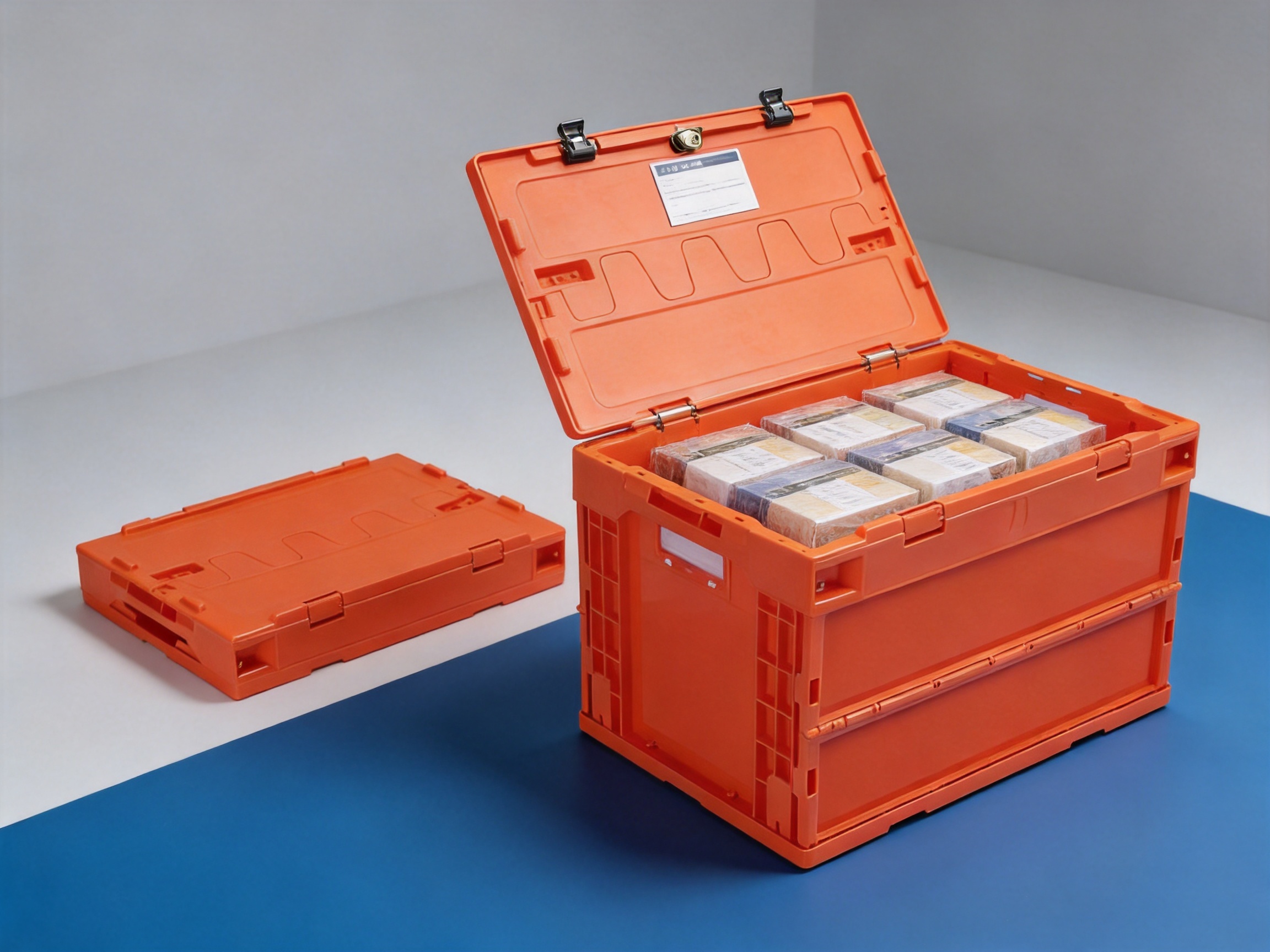
A major advantage of the design is its modular construction. The tote is made up of identifiable components, including the long side panels, base, short side panels, pin shafts, latches, label card elements, and upper frame. If a particular component is damaged, it may be possible to replace the affected part rather than discard the entire container.
This approach can reduce the lifetime cost of reusable packaging. In a conventional one-piece container, a damaged hinge, wall, or locking feature may make the complete unit unusable. Replacing the entire box creates additional purchase costs and increases waste. With a modular system, maintenance personnel can identify the damaged section and arrange a targeted replacement.
Local replacement is especially valuable for large fleets. When hundreds of totes circulate through multiple locations, minor damage is inevitable. A repair-oriented structure allows companies to keep more units in service and reduce the disruption caused by removing complete containers from operation.
Modularity may also simplify spare-parts management. Instead of holding complete replacement totes for every possible failure, a business can focus on the components most likely to require service. The result can be a more efficient maintenance program and better control over packaging assets.
The design supports a more sustainable approach as well. Extending the useful life of a container reduces the demand for new materials and lowers the amount of plastic sent for disposal. Reusable packaging already has an environmental advantage over many single-use alternatives, and replaceable parts can strengthen that advantage when maintenance is properly managed.
Pin Shaft and Latch Engineering
The connection between moving and fixed components is critical in a collapsible container. The product uses pin shaft connections to join the box body and support folding movement. A properly fitted pin shaft can help maintain alignment while allowing the side panels to pivot through the opening and folding process.
Pin shaft construction also supports serviceability. If a connection component becomes worn or damaged, the modular design provides a basis for inspection and possible replacement. Regular inspection is recommended for high-frequency applications, especially where totes are folded and opened many times per day.
The latches are integrated into the short side panels. This arrangement helps secure the side panels in the open position and prevents the container from collapsing unintentionally during loading or movement. Integrated latch placement also keeps the operating mechanism close to the structural panel it controls, which can simplify the opening and closing process.
Operators should ensure that all latches are fully engaged before loading, stacking, or transporting the tote. A simple visual and tactile inspection can help confirm that the side panels are correctly positioned. Proper training is particularly important in high-volume facilities where speed must be balanced with safe operating practices.
Security Lock Hole and Label Card Slot
The tote includes a security lock hole that can be used with cable ties or combination locks. This feature gives businesses an additional way to protect products during transportation. While a lock hole does not replace a full security system, it can provide visible evidence of unauthorized opening and help discourage casual access to the contents.
Security sealing can be useful for inter-warehouse transfers, retail replenishment, high-value components, returns processing, and controlled product distribution. A facility may assign a seal number to a shipment and record that number in its transport documentation. If the seal is broken or replaced, the receiving team can perform an inspection according to company procedures.
The label card slot on the short panel supports faster identification and classification. A card can show a product code, destination, route, department, handling instruction, order number, or inventory category. Clear identification reduces the need to open each tote to determine its contents and can improve picking, staging, and receiving efficiency.
Label cards are also useful when tote fleets circulate between different locations. A removable card allows the same container to be reassigned to a new product or destination without permanently marking the plastic body. This supports flexible use and reduces confusion when many similar totes are present in one facility.
Opening and Folding Workflow
The tote is designed for straightforward operation. To open it, the user places the folded unit on a stable surface, releases the relevant securing features, and raises the side panels into position. The panels are then fixed using the integrated latches. Before loading, the operator should check that the base is flat, the walls are correctly aligned, and the latches are engaged.
To fold the container, the operator first removes or redistributes the contents, opens the lid, releases the latches, and folds the side panels inward according to the intended sequence. The resulting folded unit is approximately 100 mm high. Units can then be stacked in a designated empty-container area or prepared for return transport.
A standardized operating procedure can improve both safety and container life. Staff should avoid forcing panels, striking latch areas, or folding a tote while it contains products. Any dirt or foreign material that interferes with the folding joints should be removed before operation. Damaged components should be reported instead of being bypassed or improvised.
The simple operating process is an advantage over complicated reusable packaging systems that require special tools or extensive training. Faster folding and opening can improve labor productivity, particularly in distribution centers handling large daily volumes.
Advantages over Rigid Plastic Boxes
Rigid plastic boxes provide strength and durability, but they maintain their full height when empty. This can create storage and transport inefficiencies. The collapsible tote offers similar reusable-container benefits while adding a substantial empty-volume reduction.
When filled, the tote provides a stable enclosure for goods. When empty, it can be folded into a compact form. This dual-state design allows companies to use the same asset efficiently in both forward and reverse logistics. A rigid box may require dedicated return space, whereas a folded tote can be consolidated with many other units.
The integrated lid also gives the collapsible tote an advantage over open rigid crates. Users do not need to source a separate cover, and the lid remains associated with the container. The label slot and lock hole provide further functionality that may not be available on basic rigid boxes.
Another advantage is maintainability. If the collapsible tote uses replaceable panels or hardware, selected parts can be serviced. A rigid box with an integral molded body may have fewer repair options once a wall or corner is damaged.
Advantages over Cardboard Packaging
Cardboard cartons remain useful for many applications, but they are generally intended for limited reuse or one-way distribution. They can be affected by moisture, compression, tearing, and rough handling. Their performance may decline after repeated opening, closing, and stacking.
The PP tote is designed for repeated circulation. It can be opened and closed many times, folded when empty, and returned through a controlled logistics loop. Its rigid walls can provide more consistent protection for goods than a carton that has already experienced compression or moisture exposure.
Reusable plastic totes can also improve warehouse consistency. Their dimensions remain stable, making them easier to organize on racks, pallets, and conveyor interfaces. Cardboard cartons may vary in condition and shape, complicating stacking and storage planning.
Although the initial purchase price of a reusable tote can be higher than that of a single carton, the total cost should be assessed over the full usage cycle. The relevant factors include the number of trips, return transport, storage space, damage rates, labor, disposal, and replacement requirements. In high-frequency operations, the reusable model can provide a stronger long-term economic case.
Advantages over Basic Foldable Crates
Not all collapsible crates provide the same level of functionality. Basic foldable crates may reduce empty volume but lack a lid, security feature, labeling system, or replaceable components. They may also use lighter construction intended for low-load applications.
The 50L Collapsible Plastic Tote with Lid combines folding capability with enclosed storage. It adds a lock hole for optional security sealing, a label card slot for identification, and integrated latches for operational stability. Its stated high-load testing and modular construction further distinguish it from simple lightweight folding boxes.
The product is therefore suited to organizations that need more than occasional space-saving. It is intended for structured supply chain use, where containers are repeatedly loaded, moved, identified, stacked, returned, and maintained.
Applications in E-Commerce Fulfillment
E-commerce operations require speed, accuracy, and flexible packaging. Orders may contain different product sizes, destinations, and handling requirements. Reusable totes can support picking, batch consolidation, replenishment, returns, and outbound staging.
The 50-liter capacity is suitable for grouping multiple small and medium-sized items. A label card can identify an order batch, route, customer region, or processing stage. The lid can remain closed while orders wait for final packing or collection, helping maintain a more organized fulfillment environment.
When empty totes return from delivery routes, they can be folded to reduce the space used in reverse logistics. This is particularly beneficial for retailers and fulfillment networks that operate a high number of delivery cycles. The reduced empty profile can help delivery vehicles carry more returnable packaging per trip.
In returns processing, a closed tote can be assigned to a product category, inspection status, or disposition route. Reusable containers can help separate sellable returns, damaged items, products awaiting testing, and items requiring further documentation.
Applications in Manufacturing
Manufacturing facilities often need to move components between suppliers, warehouses, production lines, inspection stations, and finished-goods areas. A reusable tote helps establish a consistent internal material flow while protecting parts from unnecessary exposure.
The container can be used for fasteners, molded parts, electrical components, mechanical assemblies, packaged subcomponents, and maintenance materials. The label slot supports identification by part number, work order, production line, or batch. The lid can help keep components together during movement between workstations.
At the end of a production cycle, empty totes can be folded and stored near the return point. This prevents empty packaging from occupying valuable line-side space. In closed-loop supplier systems, folded totes can be returned more efficiently to component vendors or central warehouses.
The modular design is also useful in industrial environments where minor damage may occur over time. Instead of removing an entire fleet from service because of one failed component, maintenance teams may be able to replace selected parts and preserve the value of the container.
Applications in Retail Distribution
Retail distribution centers must replenish stores efficiently and manage a wide range of product categories. Reusable totes can support store-specific sorting, route preparation, stock transfers, and backhaul operations.
A label card can identify the receiving store, department, delivery route, or merchandise category. The lid provides a practical way to keep products enclosed during movement through the distribution center and onto delivery vehicles. Once store staff unload the contents, the empty tote can be folded for return to the distribution center.
Compared with disposable cartons, reusable totes can create a more uniform backroom and warehouse environment. Their stable dimensions make them easier to stack and move, while their long service life can reduce the volume of packaging waste generated by routine replenishment.
Applications in Cold Chain Logistics
Cold chain logistics requires careful handling of products that must remain within defined temperature conditions. The tote is not a substitute for a validated insulated container or temperature-control system, but its PP construction and enclosed format can support organized handling within cold storage and refrigerated distribution processes.
The container can be used to group packaged products, organize transfer batches, and protect goods from unnecessary contact during handling. Its washable plastic surface may be more practical than absorbent packaging in environments where moisture is present, subject to the user’s sanitation and temperature requirements.
Cold temperatures can affect the behavior of plastics and latching components. Users should validate the tote under their actual temperature range, load condition, cleaning process, and transport cycle before large-scale deployment. A proper evaluation should include folding performance, latch engagement, impact resistance, stacking, and sanitation compatibility.
Warehouse Space Optimization
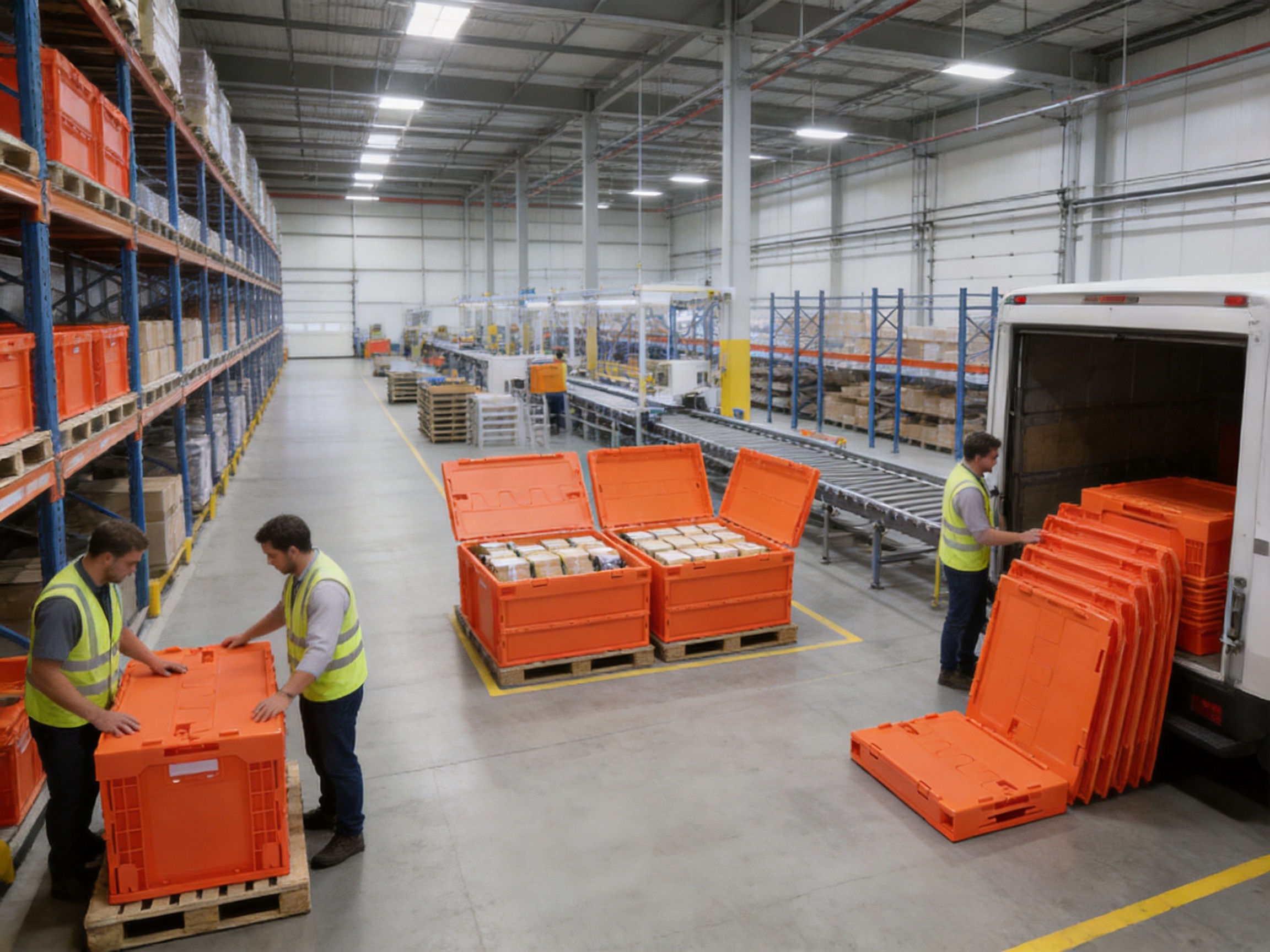
Warehouse space is expensive, and packaging often occupies more room than expected. Loaded containers are necessary for operations, but empty containers can quickly become an unmanaged source of congestion. The folding feature of this tote allows facilities to separate loaded and empty storage strategies.
Open totes can be positioned in active picking or staging locations. Empty totes can be folded and stored in compact stacks, ideally in a designated returnable-packaging zone. This separation improves visibility and makes it easier to know how many containers are available for immediate use.
Racking and stacking plans should account for the tote’s dimensions, folded height, load distribution, and access requirements. A warehouse may create standard locations for one open tote, several folded totes, or a palletized group of empty units. Clearly marked locations can help prevent folded containers from being mixed with active inventory.
Manufacturing Quality and Process Control
The performance of a reusable tote depends not only on its design but also on the consistency of its manufacturing process. The manufacturer identifies strict quality control from raw material sourcing through production and final inspection. This process-oriented approach is important because small variations in material, molding, assembly, or hardware installation can affect folding performance and service life.
Production begins with material preparation. Polypropylene resin must be selected and managed according to the required strength, appearance, dimensional stability, and processing characteristics. Consistent material preparation helps reduce differences between production batches and supports more reliable molding results.
During forming and molding, process parameters must be controlled to create panels with consistent thickness, reinforcement, and geometry. The base, side panels, upper frame, and lid each have distinct structural functions. Proper production control helps ensure that these components fit together correctly and that moving elements operate without excessive resistance.
After molding, components are checked for visible defects, deformation, incomplete formation, sharp edges, and dimensional irregularities. Assembly personnel then install or connect the pin shafts, latches, lid elements, label features, and other hardware. Correct alignment is essential because the tote must open, close, fold, and lock repeatedly during its service life.
Functional inspection may include opening and folding tests, latch checks, lid operation, dimensional verification, and visual assessment. Load testing helps evaluate the behavior of the assembled unit under specified conditions. The manufacturer’s standardized production procedures are intended to ensure that only qualified products are delivered.
Advanced Production Strengths
Yancheng Bingo Machinery Equipment Co., Ltd. presents itself as a warehousing and logistics equipment enterprise with a supply chain covering handling equipment, storage containers, packaging materials, and warehouse racking. This broader industry focus gives the company experience across multiple stages of material movement and storage.
Its storage container range includes plastic pallets, plastic totes, crates, and bulk containers. This product breadth can help customers develop compatible packaging systems instead of purchasing isolated items from unrelated suppliers. A customer may require totes for small parts, pallets for larger loads, stretch wrap for stabilization, and racking for warehouse organization. A supplier with knowledge of these categories can support a more coordinated solution.
The company emphasizes strict quality inspection and standardized processes. For the 50L tote, this means attention to material sourcing, component production, assembly, operational testing, and shipment readiness. A systematic approach can reduce the risk of inconsistent products entering a customer’s container fleet.
The company also states that products are kept in stock and ready to ship. Availability can be important when a customer is expanding a fulfillment center, replacing damaged packaging, or responding to seasonal demand. Stock access may shorten deployment time compared with products requiring a completely new production schedule.
In addition to manufacturing, the company offers product sales and service. This is relevant to reusable packaging because customers may need guidance on specifications, replacement parts, application conditions, and fleet planning. Product service can help organizations achieve better performance after the initial purchase.
Quality Control from Raw Material to Finished Product
Quality control should be viewed as a series of connected stages rather than a single final inspection. Raw material quality influences molding behavior. Molding consistency influences assembly. Assembly accuracy influences folding and load performance. Packaging and shipment protection influence the condition in which the product reaches the customer.
At the raw material stage, the focus is on using suitable PP material with consistent characteristics. At the component stage, dimensions and surfaces are inspected. During assembly, pin shafts and latches are checked for correct installation. At the finished-product stage, the tote is evaluated for appearance, operation, and conformance with key specifications.
Documented inspection procedures can improve traceability and provide a basis for corrective action. If a recurring issue is discovered, production teams can examine the relevant material batch, tooling condition, assembly step, or operating parameter. This structured method is more effective than relying only on visual checks after production is complete.
Customers purchasing large quantities should consider requesting information about inspection standards, load testing methods, component replacement procedures, and operating recommendations. Such information helps align product use with the manufacturer’s validated conditions.
Operating Recommendations
Before first use, inspect the tote for visible damage, loose components, deformation, or contamination. Confirm that the lid opens and closes correctly and that all latches engage. Open the side panels fully before loading products.
Distribute the load evenly across the base. Avoid placing sharp edges against the side panels or forcing items into the container. If internal dividers, liners, or protective inserts are used, ensure that they do not interfere with the lid or folding mechanism.
Do not fold a loaded tote. Remove the contents and confirm that the base and side panels are clear before beginning the folding process. Store folded totes on a stable, level surface and avoid creating unstable stacks.
Inspect high-use units regularly. Pay particular attention to pin shafts, latch areas, lid connections, corners, and the base. A tote with a cracked structural panel, failed latch, or severely deformed base should be removed from service until it has been assessed.
Cleaning methods should be selected according to the type of goods handled and the operating environment. Avoid chemicals or temperatures that may adversely affect polypropylene or hardware components. After cleaning, allow the tote to dry as required before folding and storing it.
Total Cost of Ownership
The purchase price is only one part of the economic value of a reusable tote. A total cost analysis should include the expected number of cycles, empty return volume, storage requirements, labor, product damage, cleaning, maintenance, replacement parts, and disposal.
The folding ratio can reduce costs associated with empty-container storage and return transport. If a vehicle can carry more folded totes per trip, the cost per returned unit may decline. If a warehouse can store more empty units in the same area, the company may delay or avoid additional storage expansion.
The 3 kg product weight can also contribute to manageable handling costs. A tote that is too heavy may increase labor demands, while a container that is too light may not withstand the required service. This model attempts to balance structural durability with practical manual handling.
Replaceable components may further improve economic performance. Instead of calculating the life of the container around its first damaged part, companies can evaluate the service life of the main structure and the replacement cost of individual components. This can provide a clearer basis for fleet maintenance and asset planning.
Sustainability Benefits
Reusable packaging can reduce reliance on single-use cartons, bags, and temporary containers. Every additional use spreads the material and manufacturing impact of the tote across more logistics cycles. The folding design adds another sustainability benefit by reducing empty transport volume.
Lower return volume can mean more efficient vehicle utilization and fewer transport movements for the same quantity of reusable packaging. Compact storage may also reduce the energy and infrastructure required to hold empty containers.
The modular design supports repair rather than immediate disposal. If one panel or hardware element is damaged, replacing that part can preserve the remaining materials and manufacturing value of the tote. This repair-oriented approach is consistent with longer-life product management.
Sustainability performance depends on actual usage. A reusable container delivers greater benefits when it is circulated frequently, maintained properly, returned efficiently, and eventually recycled through an appropriate material recovery channel. Businesses should track usage cycles and loss rates to evaluate their results.
Comparison of Packaging Options
| Evaluation Factor | 50L Collapsible Tote | Rigid Plastic Box | Cardboard Carton | Basic Open Crate |
| Reusable Design | Yes | Yes | Usually limited | Yes |
| Empty-Volume Reduction | High, folds to approximately 100 mm | Low | Variable | Usually moderate |
| Integrated Lid | Yes | Depending on model | Often separate or formed into carton | Usually no |
| Security Lock Hole | Yes | Model dependent | Limited | Rare |
| Label Card Slot | Yes | Model dependent | Requires labels or printing | Model dependent |
| Replaceable Components | Designed for modular replacement | Usually limited | No practical component replacement | Usually limited |
| Moisture Resistance | Good for typical logistics exposure | Good | Limited compared with plastic | Good |
| Suitable for Empty Returns | Highly suitable | Less efficient | Not normally returned | Moderately suitable |
Implementation in a Logistics System
Introducing reusable totes works best when the containers are treated as managed assets rather than ordinary packaging. The company should define where totes are issued, how they are identified, when they are returned, and how damaged units are handled.
A basic implementation plan can begin with a pilot area, such as one picking zone, production line, or retail route. The pilot should measure loading time, folding time, empty return volume, damage frequency, storage space, and operator feedback. These results can then guide wider deployment.
Standard operating procedures should cover opening, loading, closing, stacking, folding, cleaning, inspection, labeling, and reporting. Staff should understand the importance of fully engaging latches and avoiding overloading or improper folding.
Fleet identification can be managed through label cards, barcodes, RFID tags, or internal asset numbers, depending on the customer’s requirements. The built-in label card slot provides a simple starting point for visual identification, while larger operations may combine it with digital tracking systems.
Performance should be reviewed periodically. Useful indicators include average number of cycles per tote, percentage of empty capacity saved, container loss rate, repair frequency, product damage, and transport utilization. These measurements help confirm whether the reusable system is meeting its intended objectives.
Frequently Asked Questions
What is the capacity of the collapsible tote?
The nominal capacity is 50 liters. The external dimensions are approximately 530 × 365 × 340 mm, and the internal dimensions are approximately 485 × 332 × 310 mm.
How compact is the tote when folded?
The folded height is approximately 100 mm. The stated fold ratio is 70.60%, allowing empty totes to occupy significantly less space during storage and return transport.
What material is used to manufacture the tote?
The tote is manufactured from polypropylene, commonly abbreviated as PP. The manufacturer states that high-density virgin PP material is used in production.
Does the tote include a lid?
Yes. The product includes an integrated lid that remains connected to the container and helps enclose contents during storage and transportation.
Can the tote be stacked?
The tote is designed for heavy-duty handling and stacking. The manufacturer reports load testing above 120 kg under high-strength stress. Users should establish stacking limits based on load type, temperature, height, and site-specific safety requirements.
What is the empty weight?
The product weighs approximately 3 kg. This provides a balance between durability and manual handling convenience.
Can damaged parts be replaced?
The modular design allows selected components, such as side panels, bases, pin shafts, latches, and other structural elements, to be considered for replacement when damaged. The exact replacement process should be confirmed with the supplier.
How does the security feature work?
A security lock hole is provided for use with cable ties or combination locks. This can help indicate whether the tote has been opened during transportation and provide an additional layer of product control.
What is the purpose of the label card slot?
The label card slot allows users to identify contents, destinations, routes, product categories, work orders, or processing status without opening the tote.
Is the tote suitable for e-commerce?
Yes. Its capacity, lid, label card slot, folding design, and reusable construction make it suitable for picking, order consolidation, staging, returns, and reverse logistics in e-commerce operations.
Can it be used in cold chain logistics?
It can support organized handling in cold chain operations, but it is not automatically an insulated or temperature-controlled container. Users should validate its performance under their actual temperature, sanitation, loading, and transport conditions.
How does it compare with cardboard packaging?
The PP tote is intended for repeated use, offers greater structural consistency, resists typical moisture exposure better than cardboard, and can be folded for empty returns. Cardboard may have a lower initial cost but is generally less suitable for repeated circulation.
How should the tote be folded?
The contents should first be removed. The lid is opened, the latches are released, and the side panels are folded inward according to the designed operating sequence. Operators should never fold the tote while it is loaded.
Who manufactures the product?
The product is manufactured and supplied by Yancheng Bingo Machinery Equipment Co., Ltd., a China-based supplier of warehousing, logistics, storage, packaging, and material handling equipment.
Conclusion
The 50L Collapsible Plastic Tote with Lid is designed to solve several common supply chain problems in one reusable packaging format. It provides 50 liters of working capacity, durable PP construction, an integrated lid, a compact 100 mm folded height, and a stated 70.60% folding ratio. These features help businesses manage products efficiently when the tote is full and minimize space consumption when it is empty.
Its advantages extend beyond folding. Heavy-load performance, stackability, integrated latches, pin shaft connections, security lock holes, label card slots, and modular replacement capability make it more functional than a basic open crate or disposable carton. The design is suited to e-commerce, manufacturing, retail distribution, warehouse storage, and selected cold chain applications.
The product also reflects a broader manufacturing and service capability. Yancheng Bingo Machinery Equipment Co., Ltd. combines storage containers with handling equipment, packaging materials, and warehouse racking, enabling customers to consider more integrated logistics solutions. Its stated use of virgin PP material, standardized production procedures, stock availability, and quality inspection from raw materials through finished products supports the reliability expected from professional reusable packaging.
For organizations seeking to reduce empty-container volume, improve warehouse organization, protect goods, and lower long-term packaging waste, this collapsible tote offers a practical and scalable option. Its greatest value is realized when it is incorporated into a managed returnable-packaging system with clear loading procedures, regular inspections, asset identification, and planned maintenance.
References
1. Product specification sheet for the BG-533634B-CTL 50L Collapsible Plastic Tote with Lid.
2. Manufacturer-provided technical information concerning polypropylene construction, dimensions, folding ratio, load testing, modular components, and operating features.
3. General principles of reusable transport packaging and returnable logistics systems.
4. Industrial guidance on warehouse storage optimization, container stacking, manual handling, and packaging asset management.
5. General technical references concerning polypropylene material properties and reusable plastic container applications.
6. Supply chain management principles for e-commerce fulfillment, retail distribution, manufacturing logistics, and reverse logistics.
Product: 50L Collapsible Plastic Tote with Lid

Copyright @ Yancheng Bingo Machinery Equipment Co., Ltd. All rights reserved Warehouse Logistics Equipment Manufacturer Pallet Truck Supplier
