 en
 Español

33L Stackable Plastic Tote Box for Industrial Fasteners and Warehouse Efficiency
Content
- 1 Why Industrial Storage Totes Matter
- 2 Product Overview and Core Specifications
- 3 Durable HDPE Construction
- 4 Interlocking Stackability and Vertical Storage
- 5 Designed for Industrial Fasteners
- 6 Benefits Compared with Alternative Storage Methods
- 7 Ergonomics and Daily Warehouse Productivity
- 8 Manufacturing Quality and Process Control
- 9 Customization, Colors, and Inventory Identification
- 10 Warehouse Applications Beyond Fasteners
- 11 Reducing Logistics and Operating Costs
- 12 Recommended Implementation Strategy
- 13 Inspection, Cleaning, and Service Life
- 14 Why Supplier Capability Matters
- 15 Important Purchasing Considerations
- 16 Q&A
- 16.1 What is the capacity of the tote?
- 16.2 What are the external and internal dimensions?
- 16.3 What material is used?
- 16.4 Can the totes be stacked?
- 16.5 Is the tote suitable for industrial fasteners?
- 16.6 Is the container food-safe?
- 16.7 Can the product be customized?
- 16.8 Is the tote available from stock?
- 16.9 Can the tote be used in a warehouse rack?
- 16.10 Does the tote have a guaranteed load rating?
- 16.11 How can the totes improve inventory control?
- 16.12 What should be checked upon delivery?
- 17 Conclusion
- 18 References
- 19 Product: 33L Stackable Durable Plastic Tote Box for Industrial Fasteners
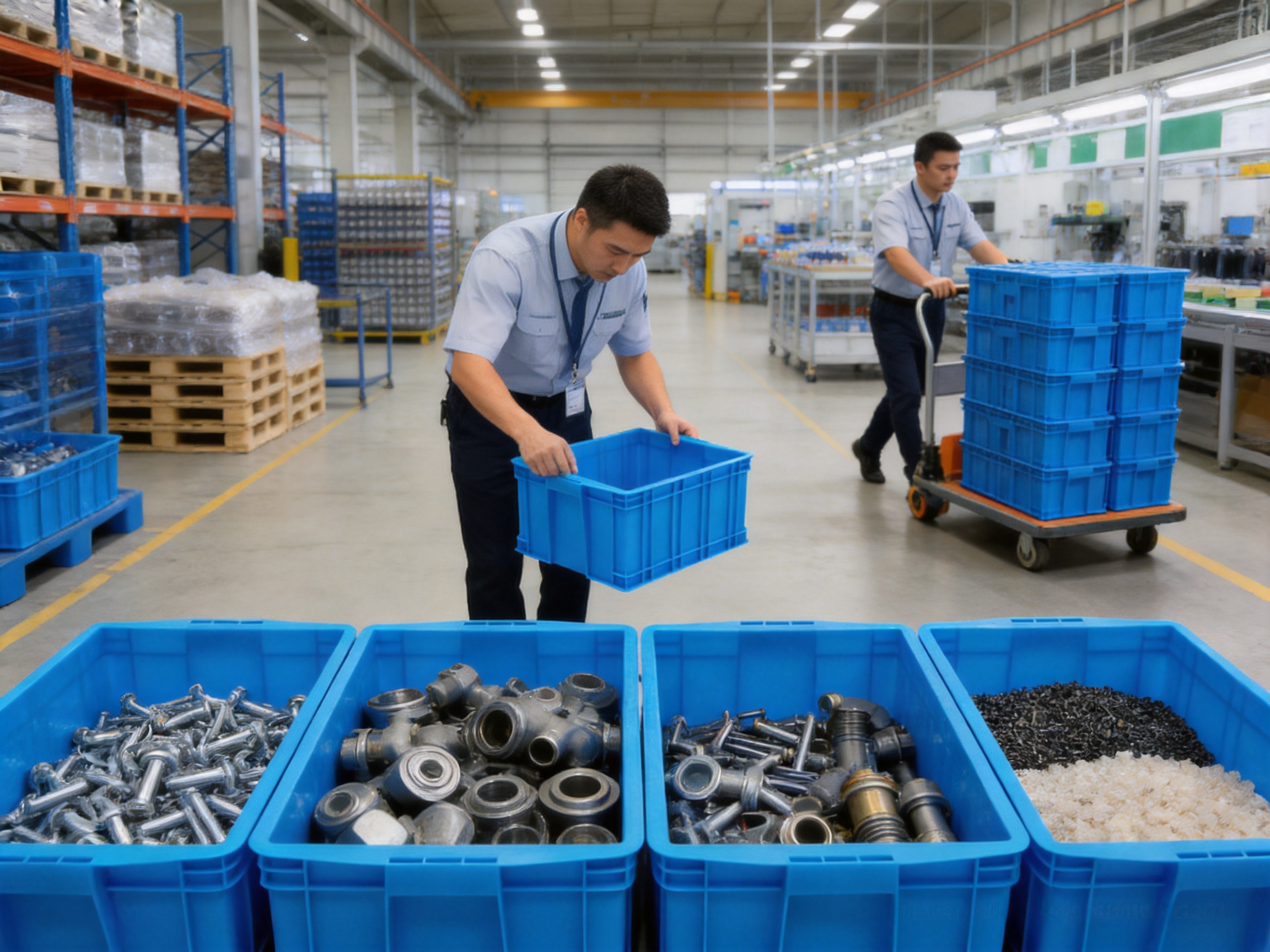
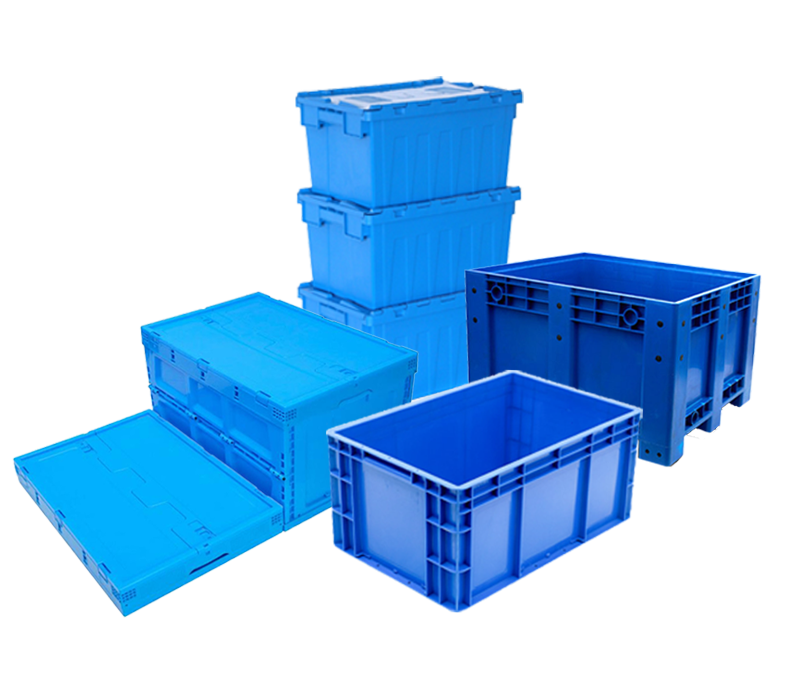
Modern warehouses need storage containers that do more than hold products. A useful tote must protect inventory, support efficient picking, make transport safer, use vertical space effectively, and remain reliable through repeated handling. The 33L stackable plastic tote box, model BG-513524-ST, is designed around these practical requirements. With a durable HDPE construction, a 33-liter capacity, interlocking stackability, and dimensions suited to warehouse shelving and distribution workflows, it offers a balanced solution for industrial fasteners, components, retail inventory, and small bulk goods.
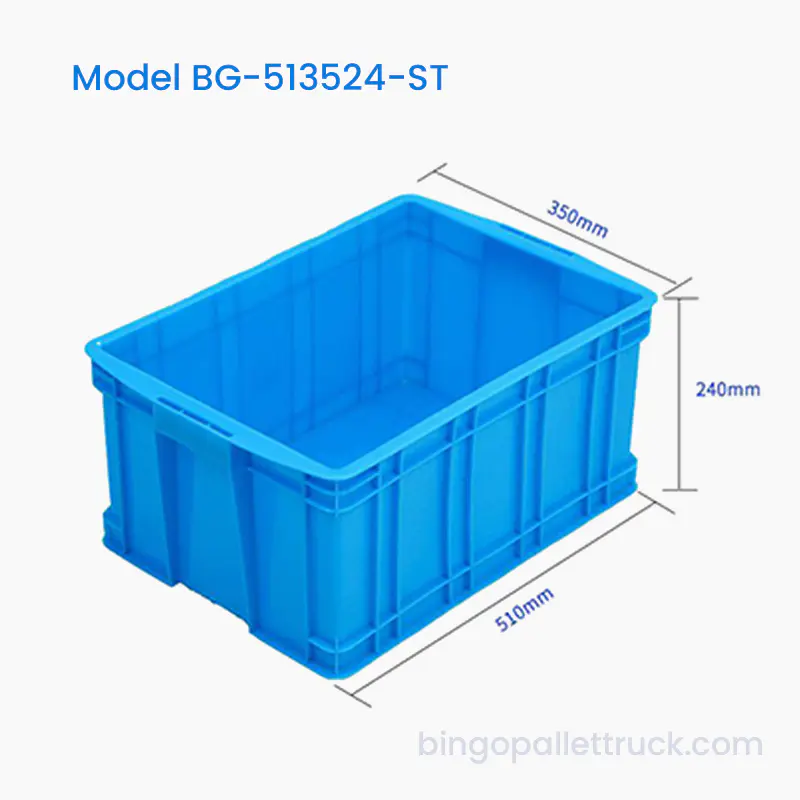
Measuring 510 × 350 × 240 mm externally and 450 × 320 × 230 mm internally, the tote provides useful storage volume while maintaining a manageable footprint. Its 1.48 kg empty weight makes it easier for employees to move, load, and position than many heavier industrial containers. At the same time, the impact-resistant structure is intended to withstand the everyday demands of manufacturing facilities, stockrooms, fulfillment centers, and logistics operations.
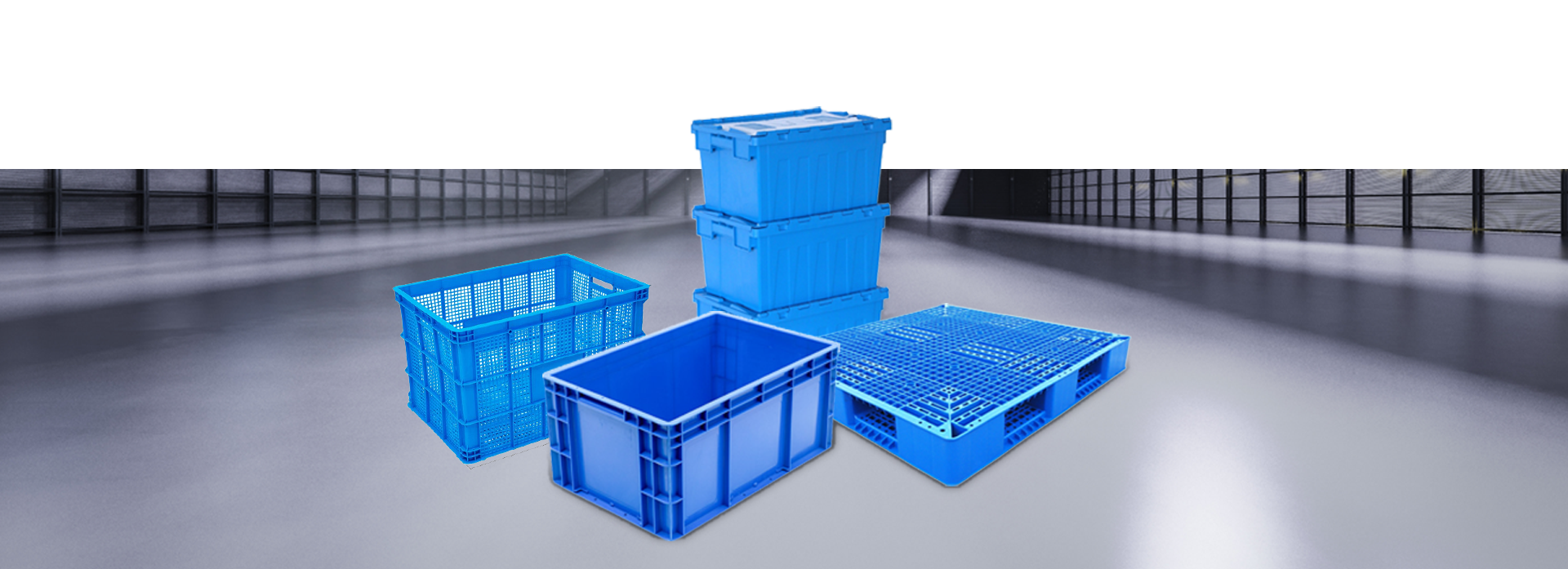
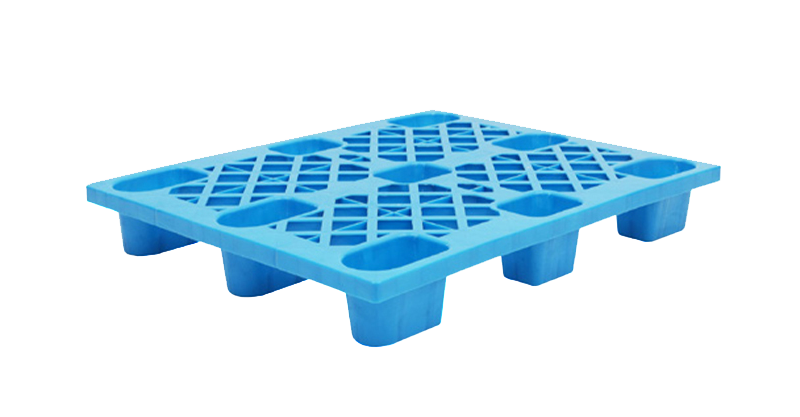
Yancheng Bingo Machinery Equipment Co., Ltd. develops and supplies warehouse logistics equipment, storage containers, packaging materials, and warehouse racking systems. Its product range includes material-handling equipment, plastic pallets, plastic totes, crates, bulk containers, stretch wrap, packing strapping, and warehouse racks. This broader product capability is important because customers can evaluate the tote as part of a complete storage and material-handling system rather than as an isolated container.
Why Industrial Storage Totes Matter
Industrial storage containers influence nearly every stage of warehouse work. They affect how products are received, sorted, stored, replenished, picked, transported, counted, and shipped. A poorly designed container can create wasted space, unstable stacks, damaged goods, slow picking, and unnecessary handling. A well-designed tote can standardize operations and reduce the number of individual decisions employees must make during a busy shift.
For industrial fasteners, the need for organization is especially clear. Bolts, nuts, washers, screws, rivets, fittings, clips, and other small components are often handled in large quantities. These products may look similar while having different sizes, grades, finishes, or specifications. If containers are weak, difficult to label, or poorly arranged, the risk of mixing items increases. A dedicated tote provides a defined storage location and makes inventory more visible and manageable.
The BG-513524-ST is suitable for a wide range of applications, including component storage, work-in-process handling, production-line replenishment, order picking, spare-parts management, retail distribution, and small-bulk transport. Its internal dimensions provide practical room for boxed, bagged, or loose goods, while its external dimensions help businesses plan shelving positions, pallet layouts, and vehicle loading patterns.
Unlike disposable cardboard cartons, a reusable plastic tote can support repeated handling cycles. It is less vulnerable to moisture than conventional paper-based packaging, easier to clean, and better suited to standardized return flows. Compared with improvised open bins, the tote offers more consistent dimensions and improved stack stability. These features make it appropriate for companies seeking repeatable warehouse processes instead of temporary storage solutions.
Product Overview and Core Specifications
The product is a stackable plastic tote box with an external footprint of 510 × 350 mm and an external height of 240 mm. Its internal dimensions are 450 × 320 × 230 mm. The stated capacity is 33 liters, and the empty product weight is 1.48 kg. The product model is BG-513524-ST.
| Specification | Details |
| Product type | Stackable plastic tote box |
| Model | BG-513524-ST |
| Material | HDPE according to the core product specification |
| External dimensions | 510 × 350 × 240 mm |
| Internal dimensions | 450 × 320 × 230 mm |
| Capacity | 33 L |
| Empty weight | 1.48 kg |
| Stacking capability | Designed for stacking, with product information indicating more than 10 layers under suitable conditions |
| Typical applications | Industrial fasteners, components, inventory, small bulk goods, manufacturing, retail distribution, and warehouse storage |
The relationship between internal and external dimensions is important for warehouse planning. The external footprint allows managers to determine how many totes can be placed on a shelf, pallet, cart, or staging area. The internal dimensions indicate the usable space available for products. The difference between the external and internal measurements also accommodates the structural walls, rim, stacking features, and load-bearing elements required for a durable container.
The listed capacity should be understood as a nominal volume rather than a recommendation to fill every tote with any product up to the rim. Actual usable capacity depends on the shape and density of the stored goods. Fasteners packed in bags may use space differently from loose parts, boxed accessories, or irregularly shaped components. Businesses should evaluate the container with their actual product packaging and handling methods before setting a standard fill level.
Durable HDPE Construction
The core product specification identifies HDPE, or high-density polyethylene, as the material. HDPE is widely used for industrial containers because it offers a practical combination of impact resistance, stiffness, chemical resistance, low moisture absorption, and relatively low weight. These properties are valuable in warehouse environments where containers may be moved by hand, placed on carts, loaded onto pallets, or stacked repeatedly.
Impact resistance is particularly important for storage totes. Containers may experience contact with shelving, pallets, conveyor equipment, carts, and other totes. They may also be exposed to uneven floors, loading-area traffic, or accidental knocks during picking. A rigid but resilient plastic structure can help the tote maintain its form through routine handling and reduce the likelihood of cracks or deformation compared with fragile packaging materials.
The product is also described as food-safe. This characteristic can be useful for businesses that require cleanable storage or operate in environments where material-contact considerations matter. However, the suitability of a specific tote for direct food contact depends on the exact resin, additives, production conditions, cleaning method, and applicable regulations. Buyers with regulated food applications should request the relevant compliance documentation before use.
The supplied product information also refers to the use of virgin material and mentions high-density PP in a quality-control description. Because the main product specification identifies HDPE while that supporting statement references PP, customers should confirm the precise resin formulation for the purchased batch. This clarification is important when a particular material grade, regulatory approval, temperature range, or chemical-resistance profile is required. The broader point remains that material selection and raw-material control are central parts of the manufacturer’s quality approach.
For ordinary warehouse applications, the value of a durable polymer tote is not limited to strength. The smooth, nonporous surface is easier to wipe down than many fibrous packaging materials. The container does not absorb moisture in the same way as cardboard, and its standardized shape supports consistent storage routines. These advantages can reduce replacement frequency and help maintain cleaner work areas.
Interlocking Stackability and Vertical Storage
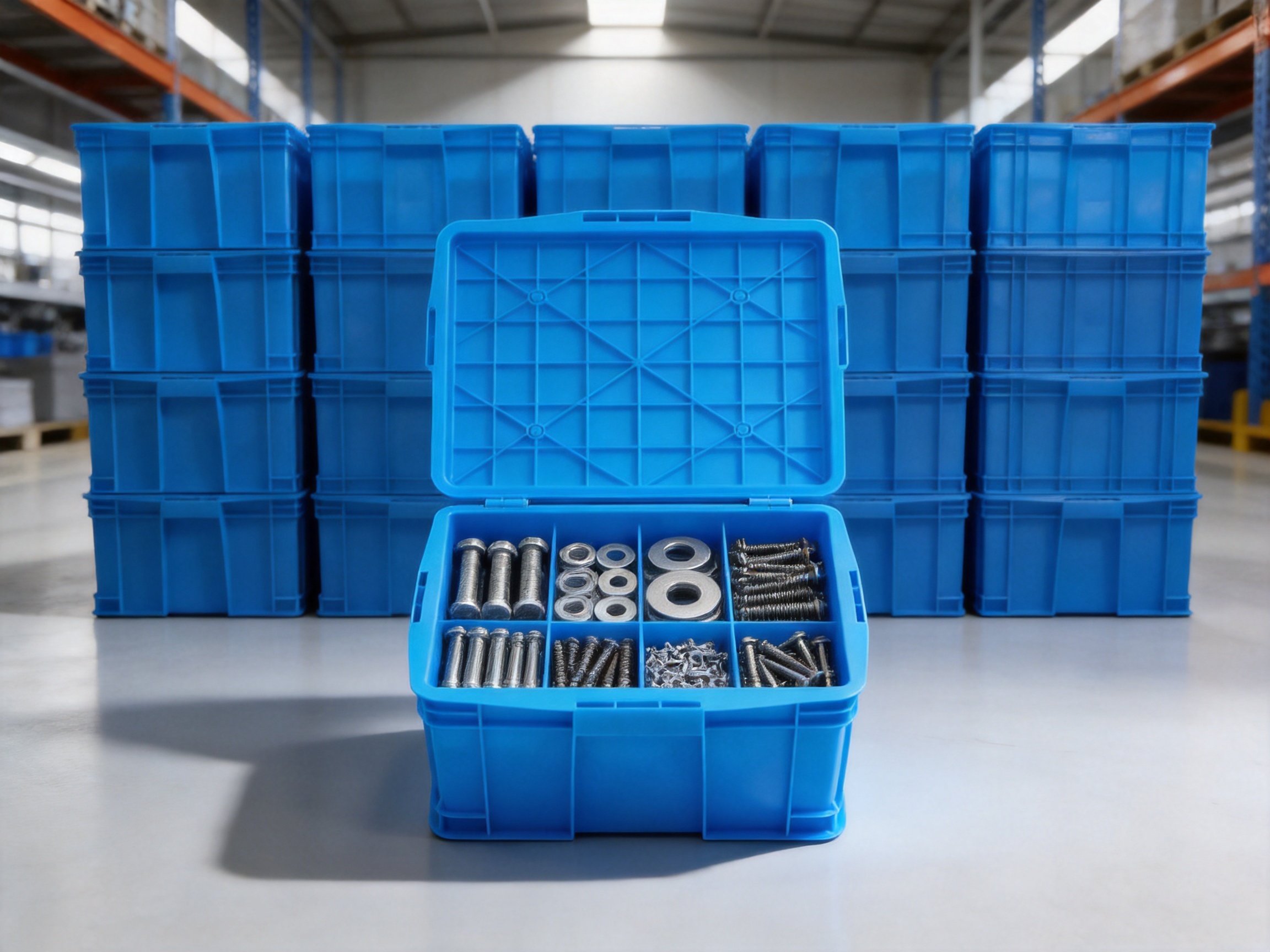
The most important design advantage of the BG-513524-ST is its stackable and interlocking structure. The totes are designed to sit securely on one another, helping prevent load shift during storage and movement. Product information indicates that the containers can be stacked more than ten layers under suitable conditions. The actual safe stacking height depends on factors such as load weight, floor condition, rack configuration, product distribution, temperature, and handling equipment.
Vertical stacking allows a warehouse to increase storage density without expanding its floor area. In a facility where floor space is expensive, using the available height can provide a measurable operational advantage. Totes can be arranged in dedicated zones according to part number, production stage, customer order, or replenishment frequency. By creating stable vertical columns, the warehouse can make better use of floor positions while preserving defined access paths.
Interlocking features are also valuable during internal transportation. A stack that shifts while being pushed on a cart or moved by pallet truck can create safety risks, product loss, and delays. By helping neighboring totes remain aligned, the interlocking design supports more controlled movement. It does not eliminate the need for proper load securing, stable floors, or safe handling procedures, but it can reduce avoidable movement between containers.
Compared with ordinary open bins that simply rest on one another, an interlocking stackable tote offers a more repeatable arrangement. Operators can rebuild stacks with greater consistency, and supervisors can establish clearer storage standards. Consistent stacking also helps maintain aisle appearance, improves visual control, and makes it easier to identify misplaced containers.
Businesses should avoid treating the stated stacking capability as a universal load rating. A stack of empty totes behaves differently from a stack filled with dense metal fasteners. The center of gravity, the weight in each container, and the condition of the floor all influence stability. Operators should develop a site-specific stacking procedure and follow the supplier’s instructions for maximum height and load distribution.
Designed for Industrial Fasteners
Industrial fasteners are often small, numerous, and difficult to manage without a consistent storage system. A 33-liter tote provides enough space for a useful quantity of components while remaining compact enough for manual handling and organized shelving. Companies can assign one tote to a part number, size, material, finish, customer order, or production task.
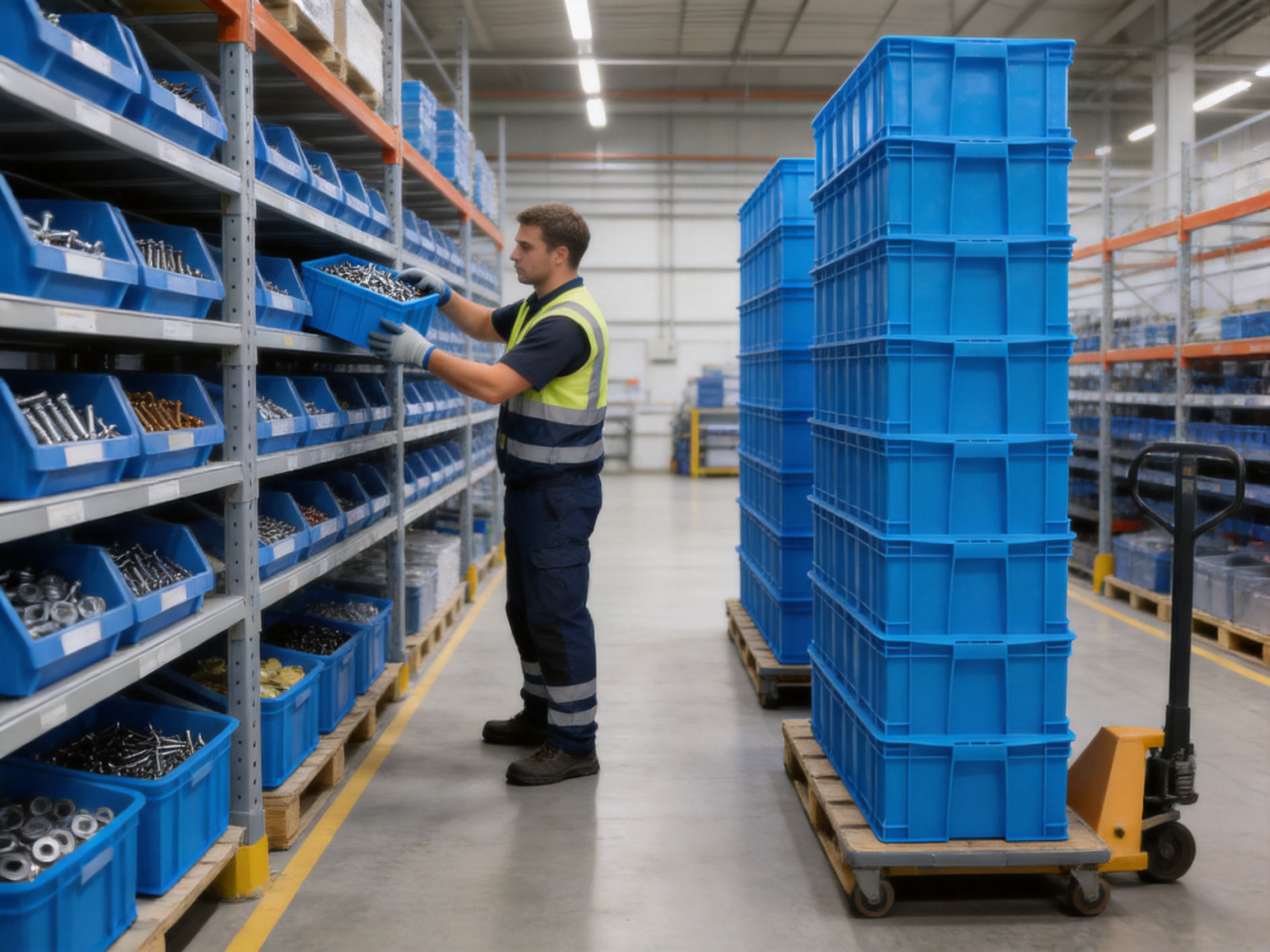
For example, a manufacturing facility may use separate totes for different bolt lengths, thread types, or grades. A maintenance department may dedicate containers to replacement bearings, washers, retaining rings, and machine-specific repair kits. An e-commerce warehouse may use the totes for order-picking stock, with each container positioned in a designated shelving location. In each case, the tote becomes part of a visual and procedural inventory system.
The internal dimensions of 450 × 320 × 230 mm are suited to products that need more volume than a small parts tray can provide. The 230 mm internal height can accommodate packaged components, bags of fasteners, or multiple smaller cartons. At the same time, the tote is not so tall that the contents necessarily become difficult to reach. Operators can inspect and retrieve products without handling an excessively deep container.
Fasteners are commonly made from steel, stainless steel, brass, aluminum, or coated alloys. These products can be dense, so users should consider the weight of a fully loaded tote. The 33-liter capacity describes volume, not maximum permissible mass. A business should conduct a practical load test based on its own fastener type and filling method. Heavy components may need a lower fill level or a dedicated handling plan even when unused volume remains.
Labels, barcodes, color coding, and location identifiers can further improve the tote’s usefulness. Although the container itself is a physical storage product, it can support digital warehouse systems when each tote is assigned a barcode or tracking number. This enables more accurate cycle counting, replenishment, and order verification. Color options can also help separate product families, work areas, or inventory statuses when customization is requested.
Benefits Compared with Alternative Storage Methods
Compared with Cardboard Cartons
Cardboard cartons are inexpensive and convenient for one-way shipping, but they are more vulnerable to moisture, crushing, tearing, and repeated handling. They may also lose their shape after being opened and closed several times. A reusable plastic tote is a stronger option for internal warehouse circulation and long-term component storage.
The BG-513524-ST offers standardized dimensions and a stackable structure that can be used repeatedly. It is less affected by ordinary humidity and can be cleaned more easily when dust or residue accumulates. For companies that frequently move the same categories of products between receiving, production, storage, and dispatch, reusable totes can provide a more consistent workflow than constantly replacing cartons.
Compared with Flexible Bags
Flexible bags are useful for low-cost packaging but often lack shape retention and stacking stability. Contents can settle unevenly, making the bags difficult to arrange on shelves. Bags may also be harder to label, count, and retrieve from a crowded storage location. A rigid tote establishes a predictable footprint and protects contents from some external impacts.
Compared with Open Shelving Bins
Open shelving bins are convenient for visual access, but they may not be suitable for closed-loop transportation or high-density vertical stacking. A tote that can be lifted, moved, and stacked as one unit offers greater flexibility between storage and handling operations. It can be taken from a rack to a production line or staging area without transferring the contents into another container.
Compared with Non-Interlocking Containers
Containers without stacking features may slide or shift when placed in columns. This can reduce usable height and create extra work during every movement. The interlocking design of the BG-513524-ST supports more stable stack formation and helps reduce alignment problems. This is especially useful in facilities that frequently build and dismantle stacks throughout the day.
Compared with Heavier Industrial Boxes
Some heavy-duty boxes provide very high load ratings but can be unnecessarily heavy for applications involving frequent manual handling. At 1.48 kg empty, this tote aims to balance durability and manageable weight. It can help reduce the effort required to lift and reposition empty containers, although users must still evaluate the total loaded weight before establishing manual handling procedures.
33L Stackable Durable Plastic Tote Box for Industrial Fasteners
Ergonomics and Daily Warehouse Productivity
Warehouse productivity depends not only on storage capacity but also on how easily employees can interact with the storage system. A tote that is difficult to lift, reach into, identify, or relocate can create small delays that become significant over thousands of handling cycles. The BG-513524-ST is promoted as an ergonomic solution for loading and picking, with a form intended to support regular warehouse activity.
The 510 mm length and 350 mm width provide a stable base while remaining compatible with many conventional storage layouts. The proportions can be useful on shelving, pallets, staging tables, and warehouse carts. Before large-scale deployment, managers should measure their existing rack beams, shelf depths, pallet patterns, conveyor widths, and aisle clearances to confirm compatibility.
The 240 mm external height is also relevant to reachability. A very deep container can force workers to bend or reach excessively when retrieving small items. A moderate-height tote can keep contents accessible while still providing meaningful volume. For fast-moving products, businesses may place the most frequently picked items in upper-accessible or waist-height locations and use the totes to maintain organized replenishment units.
Ergonomics also includes reducing unnecessary transfers. If parts arrive in a suitable tote, can be stored in that tote, and can later be delivered to a production station in the same container, the operation may avoid repacking. Fewer transfers mean fewer opportunities for counting errors, product damage, and misplaced components. The tote can therefore support process simplification as well as physical storage.
Operators should receive training on safe lifting techniques and stack handling. A container that is easy to move when empty may become difficult to handle when filled with metal parts. Facilities can improve safety by setting maximum fill levels, using carts for heavy loads, and applying team-lift or mechanical-assistance rules where necessary.
Manufacturing Quality and Process Control
The company presents quality control as a process that begins with raw-material sourcing and continues through production. This approach is important for plastic storage products because consistency in resin, molding conditions, dimensions, wall formation, and finishing affects the final container’s performance.
Raw-material control is the first stage. The material used in a tote influences impact resistance, rigidity, surface quality, color consistency, and service life. A disciplined sourcing process helps reduce variation between production batches. For customers operating large fleets of identical containers, dimensional consistency is particularly important because even small differences can affect stacking, shelving, and automated handling.
Production control is the next stage. Standardized manufacturing procedures can help maintain repeatable cycle conditions and reduce defects. Depending on the production method and factory configuration, relevant controls may include mold condition, material preparation, processing temperature, cooling time, dimensional checks, edge finishing, and visual inspection. The supplied company information emphasizes streamlined and standardized processes designed to deliver qualified products meeting strict internal standards.
Inspection at multiple stages is valuable because defects are easier to correct when found early. Incoming-material checks can identify problems before production. In-process inspection can detect dimensional or appearance deviations while a batch is being manufactured. Final inspection can verify that finished totes meet the required product specification before packing and shipment.
Quality control should examine more than appearance. A tote may look acceptable while having a problem with wall thickness, rim alignment, bottom flatness, or stacking geometry. A comprehensive process therefore considers dimensional accuracy, structural integrity, surface condition, stability, and functional performance. Customers purchasing at scale may also request inspection reports, sampling procedures, or agreed acceptance criteria.
The manufacturer’s stated emphasis on strict standards and qualified products supports a more dependable purchasing process. Buyers can further strengthen quality assurance by specifying the required resin, color, dimensions, label area, packaging method, inspection level, and application conditions in the purchase agreement. Clear specifications help prevent misunderstandings between the supplier and the end user.
Customization, Colors, and Inventory Identification
The product information indicates that multiple colors, full specifications, and customization are available. Color selection can support practical warehouse management. For example, a company may use blue totes for raw materials, yellow totes for quality-hold goods, green totes for finished components, and red totes for urgent or nonconforming material. Such visual controls can make process status easier to recognize at a distance.
Color coding should be standardized rather than used randomly. A written color policy can define what each color means, where it may be used, and when a tote should be moved to another category. This prevents employees from interpreting colors differently across departments.
Customization may also involve product markings, labels, identification areas, packaging configurations, or coordinated sizes. Customers should discuss the available options with the supplier because not every customization is appropriate for every application. A permanent molded marking may suit a long-term asset, while a replaceable label may be better when product assignments change frequently.
Clear identification is essential for industrial fasteners. A label should ideally include the part number, description, size, material, grade, quantity, supplier, and replenishment information required by the facility. Barcodes or QR codes can connect the physical tote to an inventory-management system. The container then becomes part of a traceability process rather than simply a box on a shelf.
When custom colors or markings are ordered, customers should confirm minimum order quantities, lead times, color tolerances, sample approval procedures, and packaging requirements. The company’s stated in-stock availability may apply to standard configurations, while custom variants may require additional production planning.
Warehouse Applications Beyond Fasteners
Although the product is well suited to industrial fasteners, its use can extend to many other categories. Manufacturing facilities can store machined parts, molded components, electrical accessories, hand tools, maintenance supplies, and work-in-process items. The tote can help separate production stages and deliver component kits to assembly areas.
In e-commerce fulfillment, the tote can function as a picking or replenishment container. Products can be sorted by stock-keeping unit, order batch, or dispatch route. Its stackable design can help organize temporary staging zones when orders are waiting for packing or carrier collection.
Retail distribution centers can use the totes for backroom inventory, shelf-replenishment units, promotional goods, accessories, and replacement stock. Because the container is reusable, it may support a returnable flow between a distribution center and individual stores.
Maintenance and repair departments can benefit from dedicated totes for spare parts. A container can be assigned to a machine, service team, job number, or maintenance schedule. This reduces the need to search through mixed boxes and helps ensure that frequently used parts remain available.
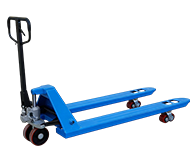
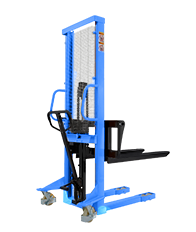
Warehouses handling packaging materials can use the totes for labels, small rolls, cutting accessories, strapping tools, clips, and related supplies. The product can also complement warehouse racking, pallet systems, hand pallet trucks, stackers, and carts supplied as part of a broader logistics-equipment program.
Users should assess material compatibility before storing chemicals, hot parts, sharp-edged products, or substances that may attack the selected plastic. The tote is intended for general warehouse and industrial storage, but specialized applications may require additional technical confirmation.
Reducing Logistics and Operating Costs
The product is positioned as a way to help reduce logistics expenses and operational effort. Cost savings do not come from the purchase price alone. They may result from reduced damage, improved space usage, fewer repacking steps, faster picking, better inventory accuracy, and longer service life.
Vertical stackability can increase the number of units stored within a defined floor area. Better space utilization may postpone the need for additional storage space or reduce the number of temporary staging locations. Before calculating savings, a business should measure its current storage density, stack height, aisle requirements, and access frequency.
Reusable totes can reduce dependence on disposable cartons and single-use packing materials for internal movements. The actual financial benefit depends on the number of trips, cleaning requirements, loss rate, replacement rate, and reverse-logistics process. A tote fleet delivers the greatest value when the company has a controlled return loop and clear ownership rules.
Standard dimensions can reduce handling time. Employees become familiar with the tote’s weight, shape, and storage position. Carts, shelves, pallets, and workstations can be designed around the same container footprint. Standardization also simplifies purchasing and replacement because fewer container types need to be stocked.
Improved product protection may reduce the cost of damaged components. Fasteners can be contaminated, mixed, scratched, or lost when stored in unsuitable packaging. A durable tote cannot replace correct packaging or inventory discipline, but it provides a stronger foundation for controlled handling.
Productivity gains should be measured rather than assumed. Useful metrics include picking time per line, replenishment time, damaged-unit rate, misplacement rate, storage positions used, container loss rate, and labor hours spent repacking. Comparing these measures before and after adoption can show whether the tote is delivering the expected operational benefit.
Recommended Implementation Strategy
Companies introducing the tote should begin with a pilot area. A small trial can test the container with actual fasteners, shelving, carts, labels, and operators. The pilot should include both high-frequency and low-frequency items so that the business can understand how the tote performs in different workflows.
The first step is to classify the products to be stored. Record the dimensions, weight, quantity, packaging format, picking frequency, and environmental conditions for each product group. This information helps determine whether a 33-liter tote is appropriate and whether some items need dividers, bags, smaller bins, or lower fill levels.
The second step is to inspect the storage environment. Measure shelf depth, beam spacing, pallet dimensions, aisle width, cart capacity, conveyor clearances, and access height. Confirm that the 510 × 350 × 240 mm external dimensions work with existing equipment. If the tote will be stacked, identify approved floor areas and define maximum stack heights.
The third step is to establish identification standards. Decide whether labels, barcodes, color coding, or a warehouse-management-system identifier will be used. Make sure labels remain visible when totes are stacked or placed on shelving. If containers are assigned to specific parts, define a replacement and cleaning procedure so old labels do not cause confusion.
The fourth step is to train employees. Training should cover safe lifting, correct stacking, load distribution, inspection for damage, label use, and procedures for moving full stacks. Employees should know that the container’s nominal capacity is not the same as its maximum safe weight.
The fifth step is to measure performance. Compare the pilot area with a similar area using existing packaging. Record space usage, picking speed, damage, counting accuracy, and worker feedback. The results can guide the number of totes required and reveal whether additional accessories or process changes are needed.
Inspection, Cleaning, and Service Life
Reusable plastic totes perform best when they are included in a simple maintenance program. Employees should inspect containers during normal use for cracks, severe deformation, damaged rims, broken interlocking features, sharp edges, or contamination. A damaged tote should be removed from service or evaluated according to the company’s safety procedure.
Cleaning requirements depend on the stored products and the operating environment. For ordinary warehouse use, dry wiping or washing with a suitable mild detergent may be sufficient. The cleaning process should not use chemicals or temperatures that are incompatible with the selected plastic. After washing, totes should be allowed to dry before being filled with moisture-sensitive components.
Inventory managers should track tote losses and damage. If containers regularly disappear from the site, a return system may be needed. If damage occurs in a particular area, the cause may be overloaded containers, forklift contact, unstable stacks, rough floors, or unsuitable handling practices. Correcting the process can extend service life more effectively than simply replacing damaged units.
Storage of empty totes should also be organized. Empty units can be nested or stacked according to the design and supplier instructions. They should be protected from unnecessary heat, direct sunlight, and contact with substances that could degrade the material. Clear empty-tote zones prevent them from obstructing aisles or becoming mixed with filled inventory.
A service-life assessment should consider the number of handling cycles, load conditions, exposure to temperature changes, cleaning frequency, and impact history. No universal lifespan should be assumed without application-specific testing. The durable construction is intended to support repeated use, but good operating practices remain essential.
Why Supplier Capability Matters
Choosing a tote is also a decision about supply continuity. A container program may involve hundreds or thousands of units, and inconsistent replenishment can disrupt warehouse standards. A supplier with an established product range and in-stock availability can help customers maintain a consistent fleet.
Yancheng Bingo Machinery Equipment Co., Ltd. describes itself as a manufacturer and supplier serving global warehouse and logistics applications. Its broader portfolio covers handling equipment, storage containers, packaging materials, and warehouse racks. This range can be valuable for companies that want to coordinate container dimensions with pallet trucks, stackers, shelving, pallets, packaging supplies, and other warehouse infrastructure.
The company emphasizes a one-stop approach to material storage and handling. For a buyer, this may simplify communication during a warehouse project. Instead of coordinating multiple suppliers for unrelated items, the buyer can discuss connected requirements with a supplier familiar with storage and logistics workflows.
The company also identifies manufacturing, e-commerce logistics, warehousing and distribution, and supermarket retail as relevant industries. These sectors have different needs, but all depend on reliable movement, clear organization, and efficient use of space. A supplier serving multiple application types may bring useful experience when adapting the tote to a particular operating environment.
Quality claims should always be supported by clear commercial and technical documentation. Buyers should request the applicable material information, dimensions, load guidance, inspection standards, packaging details, and customization terms. This creates a shared reference point for purchasing, receiving inspection, and future replenishment.
Important Purchasing Considerations
Before ordering, buyers should confirm the material specification. The main product description identifies HDPE, while another supplied quality-control statement mentions virgin PP. Because material choice affects performance and compliance, the exact resin should be confirmed in writing for the selected model and order.
Buyers should also confirm whether the stated 33-liter capacity is measured to a particular fill line or represents total internal volume. If the tote will store dense metal parts, the customer should request guidance on practical loading limits. The supplier can also advise on the appropriate stacking arrangement and maximum number of layers for a specific application.
Dimensions should be verified against the customer’s shelving, pallets, carts, and workstations. Nominal external dimensions may not include every projecting feature, handle, rim, or interlocking element. A physical sample can be useful before a large purchase.
Customers requiring food-related or regulated applications should request relevant declarations and testing documents. A general description such as food-safe may not answer every regulatory question. The end user remains responsible for confirming that the product is suitable for the intended application and jurisdiction.
Color and customization requirements should be finalized before production. Buyers should clarify available colors, minimum quantities, marking methods, artwork approval, tolerances, lead times, packaging, and replacement policy. Standard in-stock products may have different delivery conditions from customized products.
Finally, the buyer should establish acceptance criteria. These may include dimensional tolerances, visual quality, stacking performance, color consistency, material documentation, quantity accuracy, and packaging condition. A clear specification protects both parties and supports consistent future orders.
Q&A
What is the capacity of the tote?
The stated nominal capacity is 33 liters. Actual usable capacity depends on the shape, packaging, and filling method of the stored products. Users should avoid treating the volume rating as a maximum weight rating.
What are the external and internal dimensions?
The external dimensions are 510 × 350 × 240 mm. The internal dimensions are 450 × 320 × 230 mm. These measurements should be checked against the customer’s shelving, pallet, cart, and workstation dimensions before ordering.
What material is used?
The core product specification identifies HDPE. A supporting quality-control note refers to virgin material and mentions high-density PP, so buyers requiring a specific polymer should confirm the exact resin formulation with the supplier before purchase.
Can the totes be stacked?
Yes. The product is designed as an interlocking stackable tote, and the product information indicates stacking above ten layers under suitable conditions. The safe height depends on the load, floor, environment, and handling method. Users should follow supplier guidance and establish site-specific procedures.
Is the tote suitable for industrial fasteners?
Yes. Its 33-liter capacity and internal dimensions are suitable for many types of bolts, nuts, washers, screws, fittings, and other small components. Dense metal parts can become heavy, so the facility should determine an appropriate fill level and handling method.
Is the container food-safe?
The product information describes the tote as food-safe. For direct food contact or regulated use, buyers should request the relevant compliance documentation and confirm that the exact material, additives, cleaning process, and application meet local requirements.
Can the product be customized?
The supplied information indicates multiple colors and customization support. Available options, minimum quantities, markings, lead times, and color specifications should be confirmed directly with the supplier.
Is the tote available from stock?
The product information states that standard products are in stock and ready to ship. Availability may vary by quantity, color, customization, and destination, so buyers should confirm current inventory and delivery timing.
Can the tote be used in a warehouse rack?
It may be suitable for many rack and shelving systems, but compatibility must be checked using the external dimensions, shelf depth, beam spacing, access height, and load requirements. A test installation is recommended for large projects.
Does the tote have a guaranteed load rating?
A specific maximum load rating is not provided in the supplied product information. Customers should request load guidance based on their intended application, especially when storing dense metal parts or building tall stacks.
How can the totes improve inventory control?
Each tote can be assigned to a part number, product family, order, production stage, or location. Labels, colors, barcodes, and warehouse-management-system identifiers can make inventory easier to count, replenish, and trace.
What should be checked upon delivery?
Inspect the quantity, dimensions, material documentation, color, surface condition, rim, base, and interlocking features. If the totes are intended for a regulated application, also verify the required compliance documents and batch information.
Conclusion
The 33L BG-513524-ST stackable plastic tote box is designed to address several common warehouse challenges at the same time. Its 33-liter capacity provides useful room for fasteners, components, inventory, and small bulk goods. Its 510 × 350 × 240 mm external footprint supports organized storage, while the 450 × 320 × 230 mm internal space makes it practical for many industrial applications.
The impact-resistant HDPE construction, manageable 1.48 kg empty weight, interlocking stackability, and ergonomic format distinguish it from disposable cartons, flexible bags, improvised bins, and non-stackable containers. It can help businesses improve space utilization, reduce product movement, support more efficient picking, and create more standardized warehouse routines.
The manufacturer’s focus on raw-material control, standardized production, inspection at multiple stages, customization, in-stock supply, and a broad logistics-equipment portfolio adds value for companies seeking a coordinated storage solution. Buyers should still confirm the exact resin, load guidance, regulatory suitability, dimensions, and customization terms for their intended application.
When introduced with appropriate labeling, training, inspection, and performance measurement, this tote can become a durable foundation for better material organization. For manufacturers, distributors, retailers, and logistics operators, it offers a practical way to connect physical storage with safer handling, clearer inventory control, and more efficient warehouse operations.
References
1. Product specification sheet for model BG-513524-ST, including dimensions, material, capacity, and weight data.
2. Manufacturer information concerning stackable plastic totes, warehouse logistics equipment, storage containers, packaging materials, and warehouse racking systems.
3. General technical references on high-density polyethylene properties, impact resistance, moisture behavior, and industrial container applications.
4. General warehouse-management guidance concerning storage density, inventory identification, ergonomic handling, and reusable packaging systems.
5. General occupational-safety guidance concerning manual handling, load distribution, stack stability, and warehouse aisle management.
6. General quality-management principles concerning raw-material control, standardized manufacturing processes, in-process inspection, and final product verification.
Product: 33L Stackable Durable Plastic Tote Box for Industrial Fasteners


Copyright @ Yancheng Bingo Machinery Equipment Co., Ltd. All rights reserved Warehouse Logistics Equipment Manufacturer Pallet Truck Supplier
