 en
 Español

53L Collapsible Plastic Crate with Lid: A Space-Saving Solution for Factory, Warehouse, and Cold Chain Logistics
Content
- 1 Product Overview and Core Specifications
- 2 Food-Safe Polypropylene Construction
- 3 Collapsible Design and Space Efficiency
- 4 Integrated Lid for Protection and Hygiene
- 5 Structural Strength for Repeated Industrial Use
- 6 Modular Construction and Local Replacement
- 7 Practical Handling Features
- 8 Applications in Cold Chain and Food Logistics
- 9 Applications in Factory Workshops and Warehouses
- 10 Advantages Compared with Conventional Packaging Options
- 11 Manufacturing Process and Production Strengths
- 12 Quality Control and Reliability
- 13 Supplier Capability and One-Stop Logistics Solutions
- 14 Economic Value and Total Cost of Ownership
- 15 Safety, Maintenance, and Operating Recommendations
- 16 How to Select the Right Crate Quantity
- 17 Why the Product Is Suitable for Modern Logistics
- 18 Frequently Asked Questions
- 18.1 What is the capacity of the crate?
- 18.2 What are the external dimensions?
- 18.3 How small does the crate become when folded?
- 18.4 What material is used?
- 18.5 Is the crate suitable for food transportation?
- 18.6 Does the crate have a lid?
- 18.7 Can the crate be locked?
- 18.8 Can the crate be stacked?
- 18.9 What load can it support?
- 18.10 What happens if one part is damaged?
- 18.11 How much does the crate weigh?
- 18.12 What industries can use this crate?
- 18.13 How does the crate reduce logistics costs?
- 18.14 What quality controls are used during manufacturing?
- 19 Conclusion
- 20 References
- 21 Product: 53L Collapsible Plastic Crate with Lid for Factory Workshops
Efficient storage and transportation depend on more than simply choosing a container with sufficient capacity. Modern factories, warehouses, food distributors, agricultural businesses, and e-commerce operators must also consider product protection, handling efficiency, return logistics, storage density, durability, hygiene, and total operating cost. A container that performs well in only one of these areas may create additional problems elsewhere. Rigid containers can occupy valuable space when empty, while lightweight alternatives may not provide the strength required for demanding industrial use.
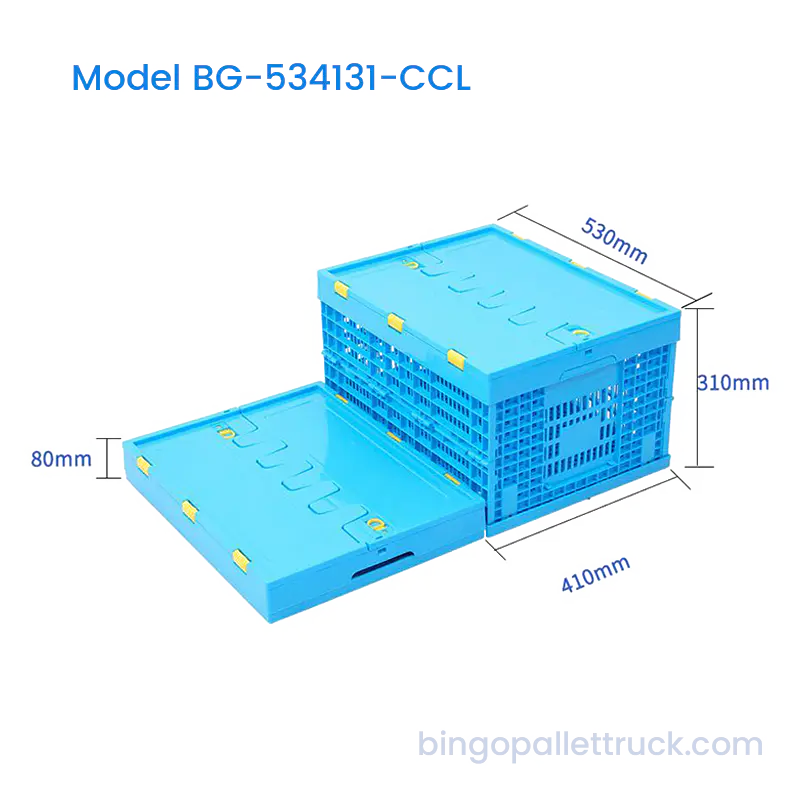
The 53L collapsible plastic crate with lid, model BG-534131-CCL, is designed to address these combined requirements. With external dimensions of 530 × 410 × 310mm, internal dimensions of 495 × 375 × 285mm, and a capacity of 53 liters, it provides practical loading space for food, agricultural products, components, packaged goods, and other materials. When not in use, its collapsible structure reduces the height to only 80mm, helping companies reduce storage requirements and lower the cost of transporting empty containers.
Made from food-grade, impact-resistant polypropylene, the crate combines hygienic protection with the strength required for repetitive commercial use. Its integrated lid helps protect contents from dust, moisture, and contamination, while the stackable design supports better use of vertical warehouse space. At a weight of only 2.63kg, the crate is also manageable for daily handling by warehouse personnel and delivery teams.
This article examines the product’s construction, performance, operational advantages, manufacturing strengths, quality-control approach, and suitability for different industries. It also explains why a modular, repairable, reusable crate can provide a stronger long-term value proposition than disposable packaging or conventional rigid containers.
53L Collapsible Plastic Crate with Lid for Factory Workshops
Product Overview and Core Specifications
The BG-534131-CCL is a large-capacity folding crate developed for storage, distribution, and material-handling applications. Its design combines a rigid base, folding side panels, integrated lid components, locking features, label identification areas, and replaceable structural parts. This combination makes it more than a simple plastic box. It functions as a reusable logistics unit that can support organized product movement across multiple stages of a supply chain.
| Model | BG-534131-CCL |
| Product Type | Collapsible plastic crate with lid |
| Material | Polypropylene, or PP |
| External Dimensions | 530 × 410 × 310mm |
| Internal Dimensions | 495 × 375 × 285mm |
| Capacity | 53 liters |
| Product Weight | 2.63kg |
| Folded Height | 80mm |
| Fold Ratio | 72.6% |
| Primary Applications | Cold chain logistics, food transportation, agricultural handling, factory workshops, warehouses, distribution, and reusable packaging |
The external size provides a useful balance between capacity and handling. At 530mm long and 410mm wide, the crate offers enough room for many commonly handled goods without becoming excessively difficult to move. The 310mm assembled height is suitable for filling and unloading, while the 80mm folded height allows empty units to be consolidated efficiently.
The difference between external and internal dimensions reflects the structural walls, base, lid interfaces, and folding mechanism required to create a durable reusable container. The internal dimensions of 495 × 375 × 285mm provide a usable volume for packaged food, produce, components, tools, and other goods that need protection during movement.
A 53-liter capacity is particularly useful for operations that need more volume than a small tote but do not want the handling burden of a large bulk container. The crate can be used as an intermediate logistics unit between individual packages and palletized loads. It can also be grouped with other crates on pallets, shelving, carts, or warehouse floors.
Food-Safe Polypropylene Construction
The crate is manufactured from PP material described as food-grade, high-density, virgin polypropylene. This material selection is important for applications involving food, agricultural products, and perishable goods. Food-related logistics require containers that can support clean handling and reduce the risk of contamination caused by unsuitable materials, damaged surfaces, or difficult-to-clean designs.
Polypropylene is widely used in reusable logistics containers because it offers a practical combination of low weight, structural rigidity, impact resistance, and chemical stability. Compared with heavier materials, PP helps reduce handling effort and transport weight. Compared with fragile materials, it is better suited to repeated movement, stacking, and warehouse contact.
The use of virgin material also supports production consistency. Recycled material can be appropriate for certain applications, but the use of high-density virgin PP helps manufacturers maintain predictable physical properties and surface quality. For a crate used in demanding daily operations, consistency in dimensions, wall strength, hinge interfaces, and locking parts is essential.
The food-safe construction makes the crate suitable for food transportation and cold chain environments when used under appropriate hygiene and operating procedures. The integrated lid adds another layer of protection by helping prevent dust and external particles from entering the container during storage or transport.
Material selection alone does not guarantee performance. The final result depends on the quality of molding, cooling, assembly, inspection, and handling procedures. For this reason, the manufacturer’s emphasis on controlled production and inspection at each stage is a significant part of the product’s value.
Collapsible Design and Space Efficiency
The defining advantage of this crate is its collapsible structure. Empty return containers often create a hidden logistics cost. A rigid crate occupies nearly the same volume whether it is full or empty, which means delivery vehicles, storage rooms, and return shipments may carry a large amount of unused air. The BG-534131-CCL reduces this inefficiency by folding to a height of only 80mm.
The stated fold ratio is 72.6 percent. This means the collapsed crate uses substantially less vertical space than when assembled. The difference becomes especially valuable when many crates are involved. A warehouse holding dozens or hundreds of empty units can reclaim floor and rack space. A distribution company returning empty crates can consolidate more units into the same vehicle. A factory can keep more containers available without expanding its storage area.
Space efficiency has several practical effects:
First, collapsed crates can be stored in a smaller footprint. This is useful for businesses with limited warehouse capacity, temporary storage areas, or changing inventory levels.
Second, return transportation becomes more efficient. Empty crates can be folded before being sent back to a supplier, distribution center, farm, processing site, or manufacturing location. Reducing empty volume may help lower fuel consumption and transportation expenditure, although the precise savings will depend on vehicle configuration, route length, loading practices, and local freight rates.
Third, the collapsible format supports seasonal operations. Agricultural distributors and food businesses may need large quantities of containers during peak periods but much less capacity during the rest of the year. Foldable crates allow the business to retain reusable assets while reducing their storage burden during quieter periods.
Fourth, the design can improve workplace organization. Folded crates can be grouped in designated areas instead of being left as scattered empty boxes. This helps reduce obstruction in aisles and makes available containers easier to count and distribute.
Compared with conventional rigid plastic boxes, the collapsible format offers a distinct advantage in reverse logistics. Compared with disposable cardboard packaging, it offers a reusable structure that can be folded after use rather than discarded. This can help businesses move toward more organized and durable packaging systems.
Integrated Lid for Protection and Hygiene
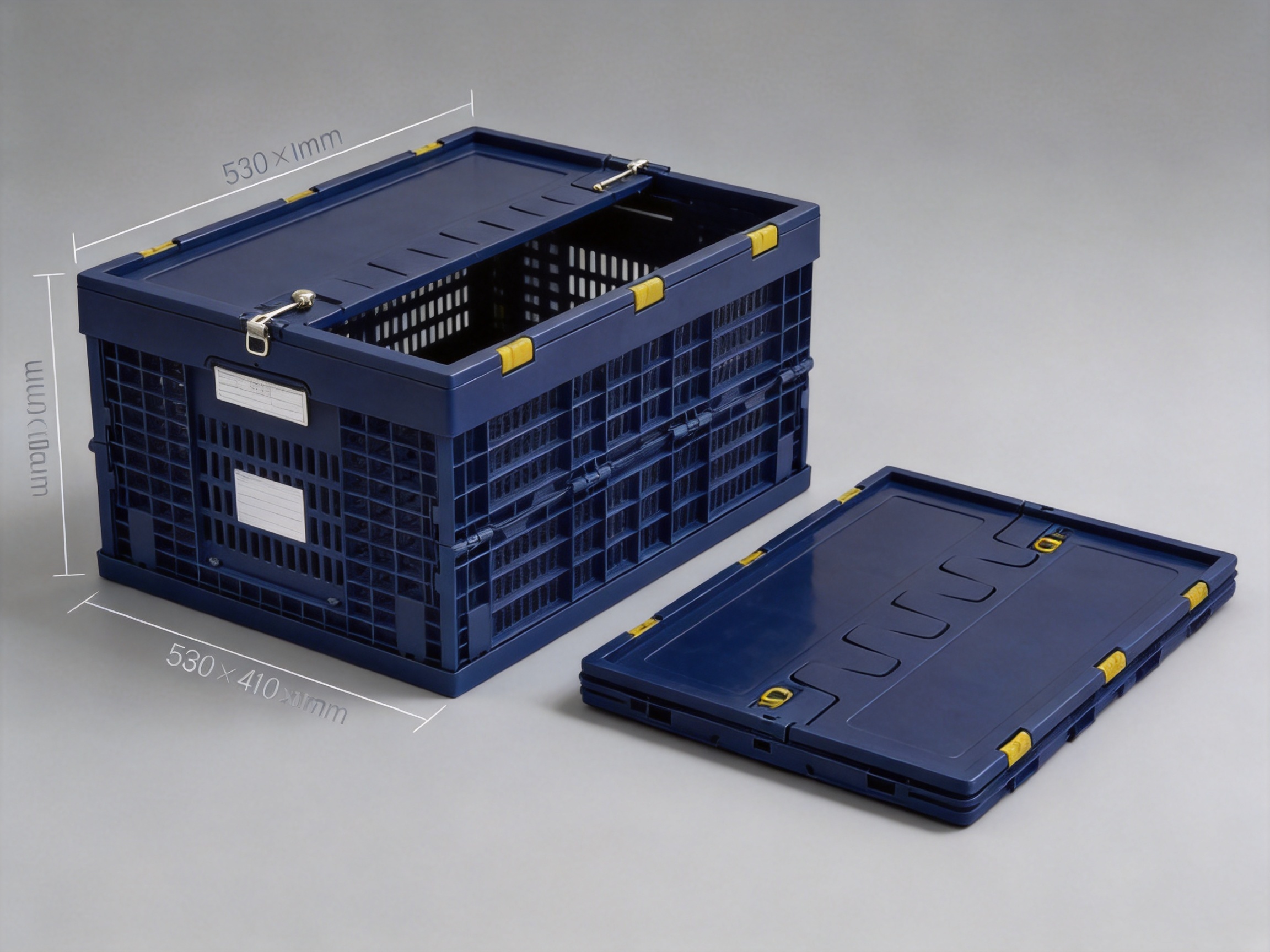
The integrated lid is another important distinction between this model and open-top crates. An open container may be suitable for fast access, but it provides limited protection from dust, moisture, accidental contact, and handling exposure. The attached lid on the BG-534131-CCL helps protect the contents during storage and transportation while keeping the container components together.
For food and agricultural applications, a lid can support more hygienic handling. It helps separate the contents from the external environment and reduces the chance of objects falling into the crate. During movement through a warehouse, loading area, delivery vehicle, or cold storage facility, the lid provides a basic protective barrier.
The lid also improves the practicality of stacking. When a crate is properly closed, the upper surface can provide a more stable interface for another crate or compatible load. Stacking performance should always be evaluated according to the specific load, floor condition, crate orientation, and operating environment, but the integrated lid is an important part of the overall stackable design.
Because the lid is integrated into the crate rather than supplied as a separate loose component, operators do not need to search for matching covers. This reduces the risk of lost lids and helps ensure that each container can be closed when required. It also simplifies return logistics because the crate and lid travel together.
The locking and latch features further support secure closure. A security lock hole allows the crate to be sealed with cable ties or combination locks when additional protection is needed. This feature can be useful for controlled distribution, interdepartmental transfers, high-value goods, and routes where operators want visible evidence if the container has been opened.
Structural Strength for Repeated Industrial Use
Reusable containers must withstand more than a single loading cycle. They may be lifted, stacked, folded, unfolded, transported, placed on pallets, moved through production areas, and handled by different operators. The BG-534131-CCL is designed with impact-resistant PP and a reinforced structural arrangement intended for regular commercial use.
According to the provided product information, load-bearing tests show that the foldable crate can support more than 120kg under high-strength stress. Actual safe loading limits may vary depending on whether the load is static or moving, how weight is distributed, the condition of the crate, stacking height, temperature, and handling method. Nevertheless, the test result indicates that the structure is designed to tolerate significant load pressure.
The crate’s durability is supported by several interconnected components. These include the base, long side panels, short side panels, upper frame, pin shafts, lock pins, latches, and hinged access elements. Each component contributes to the stability and operating life of the assembled container.
The base supports the load and helps distribute pressure across the bottom of the crate. The upper frame contributes to dimensional stability and stacking alignment. The side panels provide containment while allowing the crate to collapse when empty. Pin shaft connections permit controlled movement at the folding points, while latches and lock pins help secure the structure during use.
A well-designed folding mechanism must balance flexibility and rigidity. If the panels are too loose, the crate may be unstable when assembled. If the moving parts are too rigid or poorly aligned, operators may struggle to open and close the unit. The product’s pin shaft and latch fixing designs are intended to create a repeatable operating system that supports both assembly and collapse.
Durability is also an economic advantage. A reusable crate that remains serviceable across many cycles can reduce the need to purchase replacement packaging after every shipment. It can also provide more consistent protection than disposable alternatives that may weaken when exposed to moisture, stacking pressure, or repeated handling.
Modular Construction and Local Replacement
One of the strongest long-term advantages of the design is its modular construction. The product information identifies the long side panel, short side panel, base, hinged access door, pin shaft, lock pin, latch, label card, and upper frame as separate functional elements. This arrangement supports targeted replacement when a component becomes damaged.
In a conventional one-piece container, damage to a major area may require the entire unit to be discarded. That approach increases replacement cost and creates unnecessary material waste. A modular crate offers a different maintenance path: if a side panel, pin, latch, or other replaceable element is damaged, the affected part can be replaced without discarding the complete crate.
This approach is beneficial for large fleet users. A warehouse, factory, food distributor, or logistics company may operate hundreds or thousands of reusable containers. Even a small damage rate can become expensive when every damaged unit must be replaced in full. Local replacement helps the operator preserve the value of the unaffected components.
Modular construction can also reduce downtime. If replacement components are available, a damaged crate may be returned to service more quickly than a completely new unit could be procured. This is particularly useful in operations with established container pools and scheduled distribution cycles.
Repairability also supports sustainability objectives. Extending the useful life of a container reduces the demand for complete replacement products and helps reduce the amount of plastic sent for disposal. Although the environmental result depends on repair practices, product usage, and end-of-life recycling, a replaceable-component strategy is generally more resource-efficient than a disposable design.
The modular concept is especially valuable when combined with strict quality control. Replacement parts must be dimensionally compatible and manufactured to consistent standards. Accurate production of pin holes, latch interfaces, panel edges, and frame connections is therefore essential to ensure that repaired crates continue to function correctly.
Practical Handling Features
Industrial packaging must be easy to use as well as strong. Operators may open and close a crate many times during a shift, often while wearing gloves or working under time pressure. The product’s folding process, latch system, and structured panels are designed to make daily operation straightforward.
The folding process allows an empty crate to be reduced for storage or return transport. When needed, the panels can be raised and secured to restore the full 310mm operating height. A repeatable process helps reduce training requirements and encourages operators to use the containers correctly.
The integrated latch design places the latches within the short panels. This creates a defined closure point and helps hold the crate in its assembled configuration. Pin shaft connections provide controlled articulation between the panels and the main body. Together, these features help transform the flat or folded unit into a stable container.
Label card slots on the short panels support identification and classification. Warehouses and production sites can use labels to identify product type, batch, destination, department, handling instructions, or return status. Clear labeling reduces the need to open containers simply to determine their contents and can improve picking, sorting, and inventory accuracy.
For businesses managing multiple product categories, label card slots are particularly useful. A standardized labeling process can help separate food products, components, finished goods, rejected materials, returns, or work-in-process items. The label can also be changed when the crate is reused for a different product, supporting flexible deployment.
The crate’s 2.63kg weight is another handling benefit. A lighter empty container is easier to move between storage areas and can reduce the effort required when stacking or collapsing units. When filled, total handling weight will depend on the contents, so businesses should establish safe lifting procedures and use mechanical assistance where necessary.
Applications in Cold Chain and Food Logistics
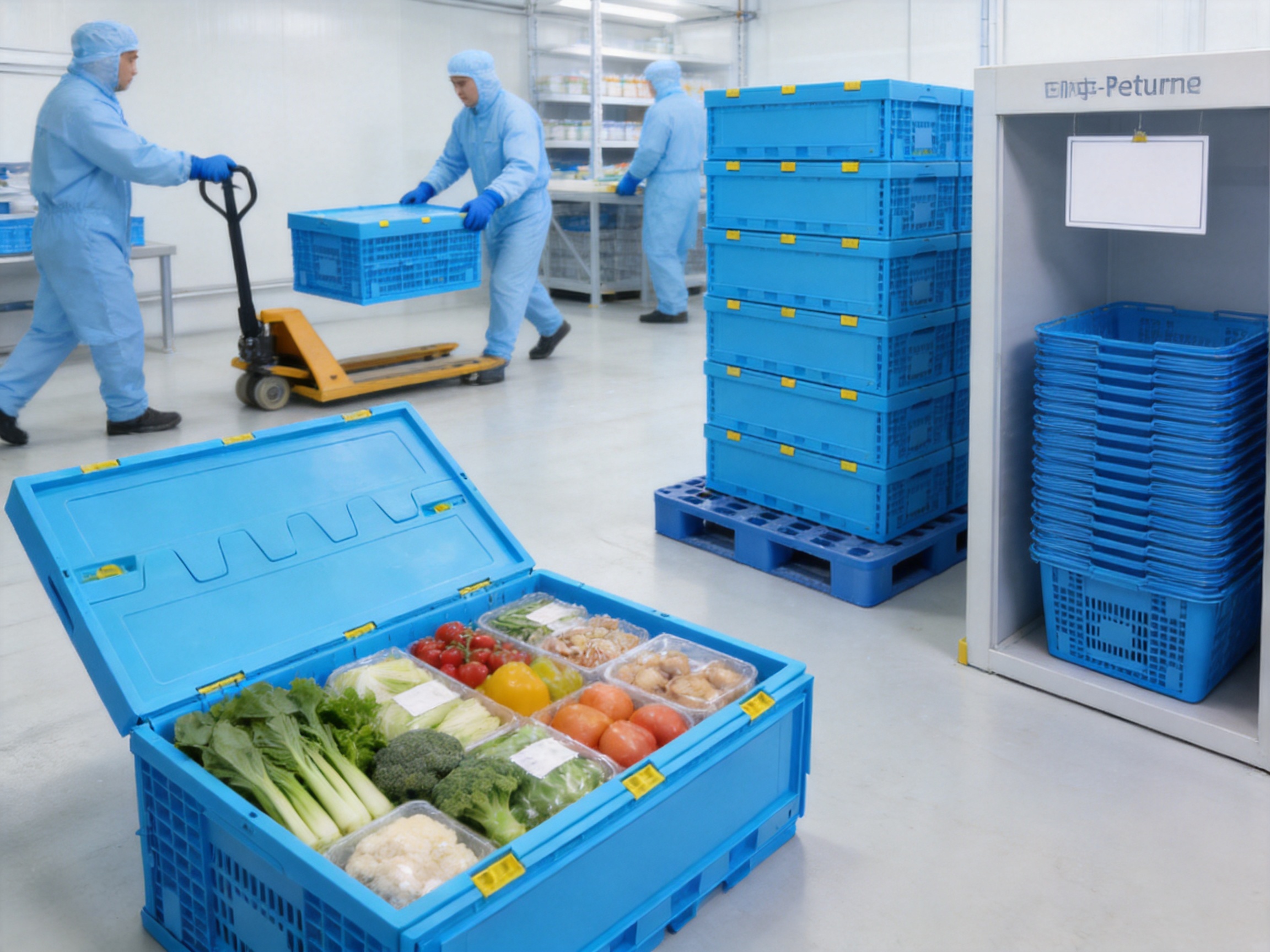
The crate is well suited to cold chain logistics because it combines food-safe material, a protective lid, reusable construction, and folding storage. Cold chain operations often involve repeated movement between suppliers, processing facilities, distribution centers, retail locations, and end customers. A durable reusable container can help create a consistent handling system across these stages.
Potential uses include the transportation of produce, packaged foods, chilled goods, dairy products, bakery items, seafood-related packaging operations, and agricultural products. The specific suitability of the crate for a particular food should be evaluated according to the food-contact requirements, cleaning process, temperature range, and applicable local regulations.
The smooth plastic construction can be easier to clean than porous packaging materials. The lid helps protect the contents during movement, while the folding feature allows empty crates to be returned without occupying the full assembled volume. For businesses that use returnable packaging loops, these characteristics can improve asset circulation.
In agricultural logistics, the crate can support movement from farms or collection points to processing and distribution centers. Its 53L capacity provides room for a useful quantity of products without necessarily requiring a large bulk container. The container can be labeled according to farm, crop, batch, destination, or handling status.
Food logistics operations should establish cleaning, inspection, and segregation procedures. Crates used for food should be cleaned according to the organization’s sanitation program. Damaged units should be removed from service until repaired or assessed. Separate handling rules may be needed when containers are used for raw materials, processed foods, chemicals, or non-food products.
Applications in Factory Workshops and Warehouses
Although the crate is suitable for food logistics, its applications extend to manufacturing and general warehousing. In factory workshops, it can hold components, tools, consumables, maintenance parts, semi-finished goods, and production-line materials. The lid can protect contents from dust and accidental impact, while the label slot supports visual organization.
In a warehouse, the crates can be assigned to picking, replenishment, returns, sorting, order consolidation, and internal transfers. Their stackable format helps use vertical space, and their folding format makes it easier to manage empty containers after goods have been delivered.
The 53L size can support medium-volume order preparation. Workers can place multiple items in one crate while keeping the load contained and identifiable. This may be useful for e-commerce fulfillment, supermarket distribution, spare parts handling, and contract logistics operations.
For workshop environments, the crate can also support 5S and lean organization programs. Dedicated containers can be assigned to particular parts or workstations. Label cards can show stock codes or replenishment information. When the crate is not needed, it can be folded instead of occupying floor space.
Because the crate is reusable and repairable, it may be suitable for closed-loop operations where materials circulate repeatedly between production, storage, and assembly areas. This can help reduce reliance on single-use cartons and create a more standardized internal logistics process.
Advantages Compared with Conventional Packaging Options
Compared with Rigid Plastic Crates
Rigid plastic crates may offer strength and stackability, but they usually occupy their full volume when empty. The collapsible BG-534131-CCL addresses this weakness by folding to 80mm. For companies that frequently return empty containers or operate in space-constrained warehouses, the reduction in empty volume can be a major practical advantage.
The integrated lid and modular parts also add functionality that may not be present in basic rigid open-top crates. At the same time, the crate maintains the benefits associated with reusable plastic, including durability, cleanability, and suitability for repeated handling.
Compared with Cardboard Boxes
Cardboard boxes are lightweight and widely available, but their strength and protection can be affected by moisture, compression, repeated handling, and storage conditions. They are generally designed for limited reuse and may require frequent replacement. The PP crate provides a more durable alternative for operations that need repeated circulation.
The lid, stackable structure, and impact-resistant material can offer better protection in active warehouse environments. The folding feature also allows the reusable crate to be compacted for return transport, which is not possible with many conventional rigid packaging formats.
Compared with Open Plastic Totes
Open totes provide fast access but leave contents exposed. The integrated lid on this model adds protection against dust, moisture, and accidental contact. The security lock hole provides an option for additional closure control, while the label slot supports external identification.
Compared with Disposable Packaging
Disposable packaging creates recurring purchase and disposal requirements. A reusable crate can be deployed repeatedly, repaired when necessary, and folded when idle. Over the entire service life, this may improve cost control and reduce packaging waste, particularly in high-frequency distribution systems.
Manufacturing Process and Production Strengths
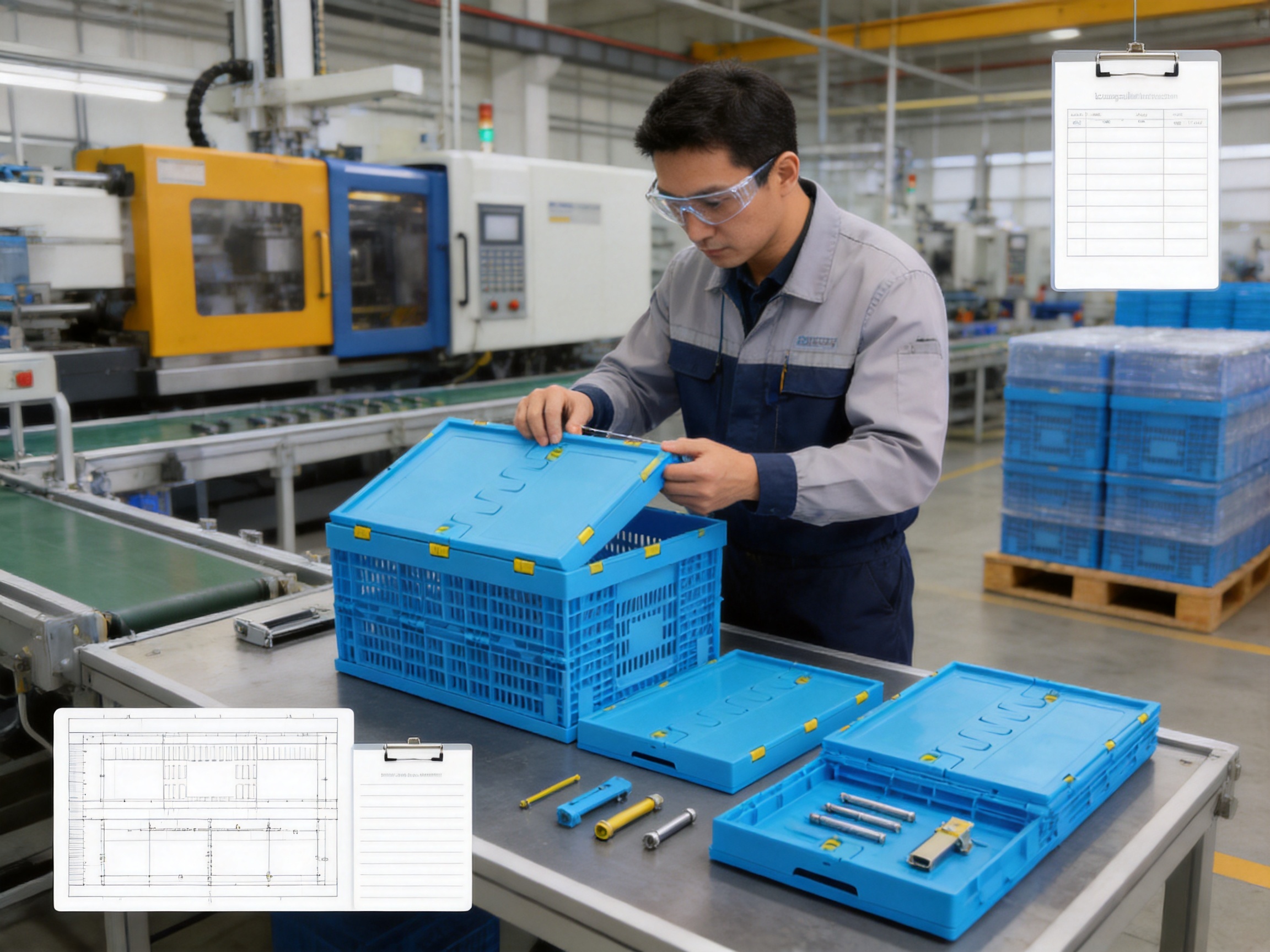
The performance of a reusable logistics crate depends on more than the design drawing. Material quality, molding accuracy, process control, assembly, and inspection must work together. Yancheng Bingo Machinery Equipment Co., Ltd. presents the crate as part of a broader warehousing and logistics equipment supply system and emphasizes standardized production and strict quality control.
The manufacturing process begins with raw material sourcing. The product information specifies high-density PP virgin material for production. Controlling the incoming material helps establish a consistent basis for mechanical strength, dimensional stability, surface appearance, and food-related application requirements.
The next stage involves forming the individual components. The base, panels, frame, lid-related parts, and other structural elements must be produced with accurate dimensions. Folding crates require particular attention to connection points because small dimensional differences can affect panel movement, latch engagement, and final alignment.
After molding, components are inspected for visible defects, dimensional consistency, and functional suitability. Parts that do not meet the required standard should be separated before assembly. This helps prevent problems from being carried into the finished product.
Assembly brings together the pin shafts, lock pins, latches, panels, base, frame, hinged access elements, and label card components. The assembly process must confirm that the crate can be opened, secured, folded, and reopened without abnormal resistance. It must also verify that the lid and locking features operate as intended.
Functional inspections are especially important for a collapsible product. A crate may appear acceptable when fully assembled but still have problems with folding clearance, latch engagement, or panel alignment. Repeated opening and closing checks help identify these issues before shipment.
The company’s stated use of streamlined and standardized processes supports repeatability. Standard operating procedures help ensure that workers follow the same steps for production, assembly, and inspection. This is important for customers who purchase multiple batches and expect consistent interchangeability among units.
The manufacturer also describes inspections at every stage, from raw material sourcing through production. A multi-stage approach is stronger than relying only on a final visual inspection. It can help identify defects earlier, reduce rework, and improve confidence in the final product.
Quality Control and Reliability
Quality control is particularly important for reusable containers because failure during transport can affect both the container and its contents. The manufacturer’s quality approach includes strict standards, inspection during production, and load-bearing testing. These practices are intended to ensure that each crate meets the required performance expectations before delivery.
Important inspection points may include material verification, component dimensions, panel condition, hinge and pin installation, latch operation, lid fit, folded height, assembled height, and overall appearance. The product specifications provide measurable reference values that can be used for quality confirmation.
Load testing helps evaluate structural performance under pressure. The stated test result of more than 120kg under high-strength stress indicates that the design has been evaluated for substantial loading. Users should still follow operating instructions and avoid exceeding suitable working conditions, especially when stacking moving loads or using damaged containers.
Quality control also supports customer confidence in large-scale procurement. A warehouse or manufacturer may require hundreds of units with consistent dimensions so that they can be stacked, stored, labeled, and repaired using standardized procedures. Variation between units can reduce operational efficiency, so production consistency is an important supplier capability.
The company’s broader experience with handling equipment, storage containers, packaging materials, and warehouse racks gives it a product portfolio that covers multiple areas of warehouse operations. This can be useful for customers seeking coordinated material-handling and storage solutions rather than isolated products from unrelated suppliers.
Supplier Capability and One-Stop Logistics Solutions
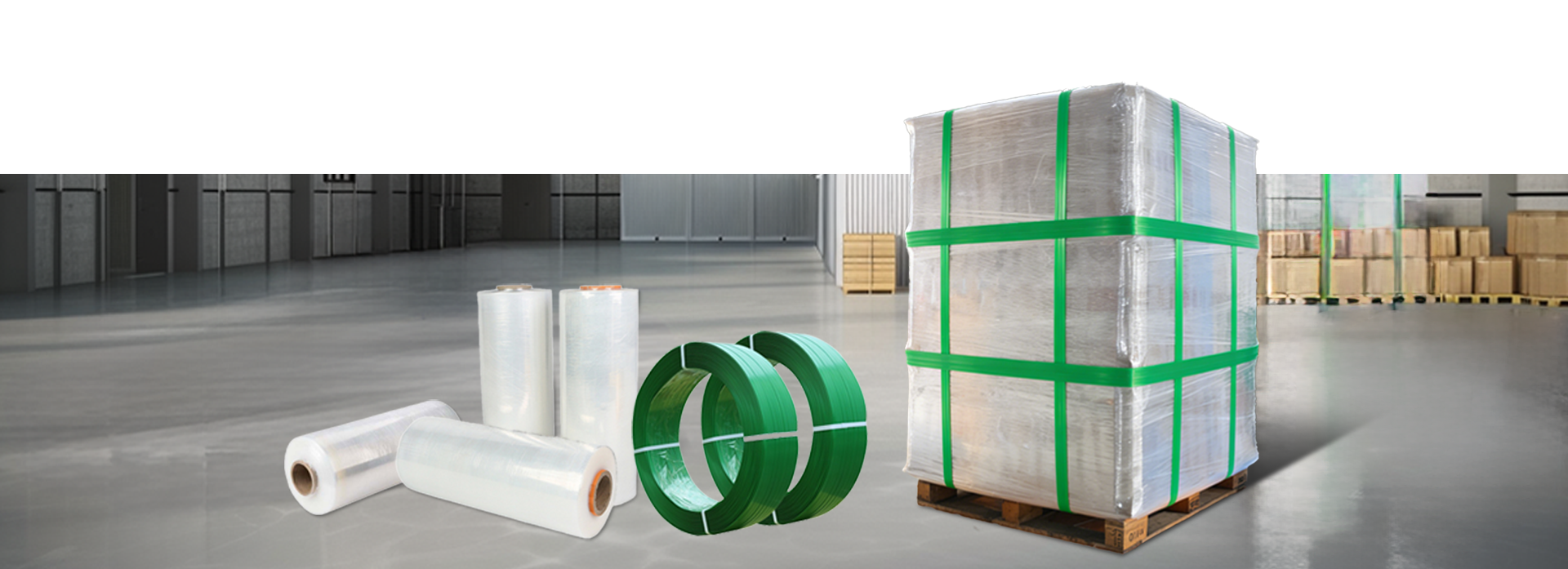
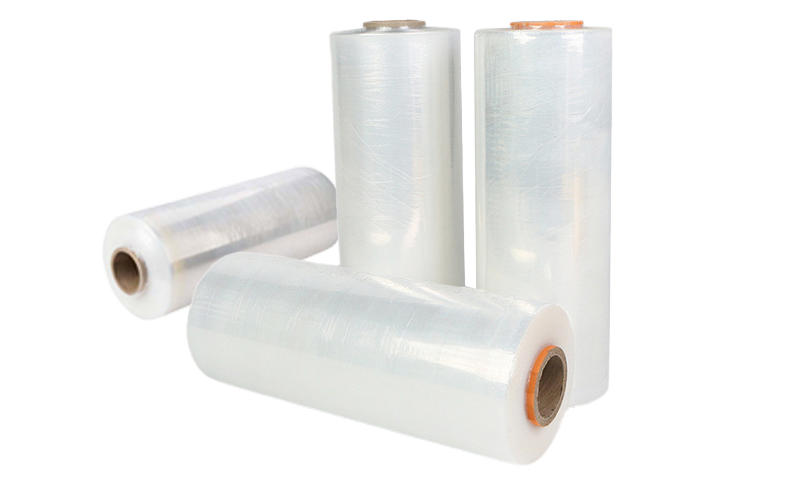
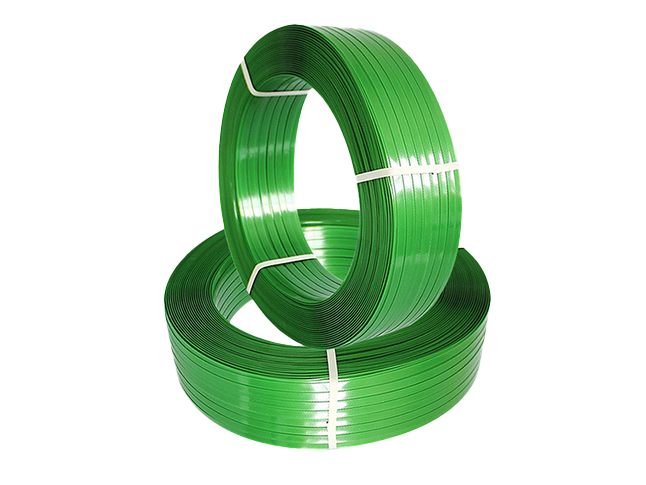
Yancheng Bingo Machinery Equipment Co., Ltd. describes itself as an enterprise specializing in the production, sales, and service of warehousing and logistics equipment. Its product coverage includes manual and electric pallet trucks, stackers, plastic pallets, plastic totes, crates, bulk containers, stretch wrap, packing strapping, and warehouse racking.
This product range can benefit customers that are developing or upgrading a complete logistics system. A collapsible crate may be used together with pallet trucks, stackers, pallets, racking, and packaging materials. Coordinating these products through one supplier can simplify communication, purchasing, and project planning.
For factories and distribution centers, storage containers are only one part of the material-flow system. Containers must be moved, stored, identified, protected, and sometimes integrated with palletized handling. A supplier with experience across these categories may be better positioned to understand how individual products function together.
The company emphasizes cost-effective solutions for manufacturing, e-commerce logistics, warehousing and distribution, and supermarket retail. These sectors have different handling patterns, but all require reliable movement and organization of goods. The 53L collapsible crate can be configured within these workflows as a reusable internal or external transport unit.
Supplier service is also important after delivery. Customers may require product specifications, replacement components, operating guidance, and support with selecting compatible handling equipment. The modular structure of the crate provides a basis for maintenance-oriented service rather than a purely replacement-oriented business model.
Economic Value and Total Cost of Ownership
The purchase price of a container is only one part of its cost. Businesses should consider storage, transport, damage, replacement, labor, cleaning, and disposal over the full service life. The BG-534131-CCL addresses several of these cost categories through its folding structure, reusable PP construction, modular parts, and integrated identification features.
The 80mm folded height can reduce the space required for empty storage. This may allow a business to use existing warehouse capacity more efficiently instead of renting additional space. It may also increase the number of empty crates that can be returned in a single shipment.
The reusable design can reduce the frequency of purchasing disposable packaging. The actual financial benefit depends on how many cycles the crate completes, how it is maintained, and the cost of alternative packaging. However, high-frequency logistics operations are generally the environments where reusable containers can provide the greatest value.
Replaceable components can lower repair costs when localized damage occurs. Rather than removing an entire crate from service, the user may be able to replace the affected panel, pin, latch, or other component. This preserves the value of the remaining parts and can extend the useful life of the container.
The label card slot may also create indirect savings by improving identification and reducing handling errors. Faster sorting, clearer stock separation, and fewer unnecessary container openings can support more efficient workflows. These benefits may be modest for one unit but meaningful across a large fleet.
For a proper purchasing decision, customers should compare the crate’s expected service life, cleaning requirements, repair availability, transport savings, and operating conditions with the total cost of competing packaging systems.
Safety, Maintenance, and Operating Recommendations
Safe use begins with checking each crate before loading. Operators should inspect the base, panels, lid, pin shafts, lock pins, latches, and frame for cracks, deformation, missing components, or abnormal wear. Damaged crates should be removed from active use until repaired or assessed.
Loads should be distributed evenly across the base. Concentrated point loads may create more stress than a uniformly distributed load of the same total weight. Users should also avoid placing loads that extend dangerously beyond the crate’s walls or prevent the lid from closing correctly.
Stacking should be performed on a stable, level surface. Operators should confirm that the crates are properly assembled and that the lids and stacking interfaces are correctly positioned. The allowable stacking height will depend on the load, environment, crate condition, and operational procedure.
For food-related use, cleaning and sanitation should follow the company’s approved procedures. Crates should be cleaned after use where required, dried appropriately, and stored in a manner that prevents recontamination. Food and non-food applications may need to be managed separately.
Folding should be performed according to the intended opening and closing process. Operators should keep hands clear of moving joints and latch areas. Staff training can help prevent damage caused by forcing panels, striking the crate, or attempting to fold it while overloaded.
Where additional security is needed, the lock hole may be used with a suitable cable tie or combination lock. The selected locking method should not interfere with safe handling or create sharp projections.
How to Select the Right Crate Quantity
The required number of crates depends on the operation’s daily throughput, return cycle, cleaning time, storage capacity, and replacement reserve. Businesses should begin by mapping the movement of goods from the point of loading to the point of unloading and return.
For a closed-loop system, the calculation should include crates in use, crates in transit, crates awaiting unloading, crates being cleaned, crates in storage, and a small reserve for maintenance or demand fluctuations. Seasonal businesses may need to plan for peak volumes rather than average volumes.
The 53L capacity should also be compared with the dimensions and weight of the intended products. A crate that is too large may lead to unstable or inefficient loading, while one that is too small may increase handling steps. Internal dimensions of 495 × 375 × 285mm provide the working space that should be used for this evaluation.
Before a full purchase, businesses may conduct a trial involving actual products, workers, pallet patterns, vehicles, racking, cleaning processes, and return routes. A pilot can reveal whether the crate fits the company’s existing workflow and whether additional equipment or procedures are needed.
Why the Product Is Suitable for Modern Logistics
Modern logistics increasingly requires packaging that is reusable, traceable, space-efficient, and compatible with multiple handling environments. The BG-534131-CCL addresses these needs through a combination of capacity, collapsibility, lid protection, modular construction, labeling, and tested structural strength.
Its design is suitable for companies that want to reduce empty-container volume without giving up the protection of a durable plastic crate. The 72.6 percent fold ratio can make a difference in warehouses with limited space and distribution networks with frequent empty returns.
The product also supports a more organized material flow. Label cards make contents easier to identify, the lid protects the load, and the stackable form helps create orderly storage. In factories, this can improve internal movement. In food logistics, it can help create a repeatable returnable-container process. In e-commerce and distribution, it can support picking and order consolidation.
Its modularity is an important competitive advantage. Many containers are treated as consumable assets once damaged. A crate designed for component replacement can provide a more sustainable and cost-conscious approach, especially when supported by a supplier capable of providing related logistics products and service.
Frequently Asked Questions
What is the capacity of the crate?
The crate has a nominal capacity of 53 liters. Its internal dimensions are 495 × 375 × 285mm, which should be used when confirming whether a specific product or package will fit.
What are the external dimensions?
The assembled external dimensions are 530 × 410 × 310mm. These dimensions should be considered when planning pallet layouts, shelving, vehicle loading, and warehouse storage.
How small does the crate become when folded?
The folded height is 80mm. The stated fold ratio is 72.6 percent, allowing empty crates to be stored and transported in a much smaller vertical space than assembled crates.
What material is used?
The crate is made from PP, or polypropylene. The product information describes it as food-grade, impact-resistant, high-density virgin PP material.
Is the crate suitable for food transportation?
It is designed for food transportation, agricultural products, perishables, and cold chain logistics. Users should apply appropriate cleaning, sanitation, temperature, and food-contact procedures for their specific application and local requirements.
Does the crate have a lid?
Yes. It has an integrated lid that helps protect contents from dust, moisture, and external contact. The integrated design also prevents the lid from becoming separated from the crate during normal handling.
Can the crate be locked?
The crate includes a security lock hole that can be used with cable ties or combination locks. This provides an additional option for securing products during transportation or internal transfer.
Can the crate be stacked?
The crate is designed to be stackable when properly assembled and loaded. Stacking height and safe use should be determined according to the load, surface, environment, and the user’s operating procedures.
What load can it support?
Provided information states that load-bearing tests show the foldable crate can support more than 120kg under high-strength stress. Actual operating limits should be evaluated according to load distribution, movement, stacking conditions, temperature, and crate condition.
What happens if one part is damaged?
The modular design allows locally damaged parts to be replaced. Identified components include the long side panel, short side panel, base, hinged access door, pin shaft, lock pin, latch, label card, and upper frame. Availability and compatibility of replacement parts should be confirmed with the supplier.
How much does the crate weigh?
The listed product weight is 2.63kg. The total handling weight will be higher when the crate is filled, so users should consider the contents and follow appropriate manual-handling procedures.
What industries can use this crate?
Potential applications include cold chain logistics, food transportation, agriculture, manufacturing, factory workshops, e-commerce fulfillment, warehouse distribution, supermarket supply, internal material handling, and reusable packaging systems.
How does the crate reduce logistics costs?
Its collapsible structure reduces the volume of empty crates during storage and return transportation. Its reusable construction can also reduce repeated purchases of disposable packaging, while modular repairability can reduce the cost of replacing complete units.
What quality controls are used during manufacturing?
The manufacturer describes the use of high-density virgin PP material, standardized production processes, inspections at different stages, and load-bearing tests. These controls are intended to support consistent product quality and reliable performance.
Conclusion
The 53L collapsible plastic crate with lid is designed for businesses that need a durable, hygienic, and space-efficient reusable container. Its 530 × 410 × 310mm assembled dimensions provide practical capacity, while the 80mm folded height helps reduce the burden of empty storage and reverse logistics. The 2.63kg weight supports everyday handling, and the PP construction provides a balance of strength, impact resistance, and suitability for food-related applications.
The integrated lid improves protection during transport and storage. Latches, lock pins, a security lock hole, and label card slots support secure and organized handling. The modular construction is particularly valuable because it allows damaged parts to be replaced locally instead of requiring disposal of the entire crate.
Compared with rigid containers, the product offers superior empty-space efficiency. Compared with cardboard and disposable packaging, it provides greater reusability and better resistance to repeated industrial handling. Compared with open totes, the integrated lid provides additional protection and security options.
The product is also supported by a manufacturer focused on warehouse logistics equipment, storage containers, packaging materials, and warehouse racking. Its stated use of virgin PP, standardized processes, multi-stage inspections, and load testing demonstrates an emphasis on repeatable manufacturing and long-term customer value.
For factories, warehouses, food distributors, agricultural businesses, and logistics providers, the BG-534131-CCL can serve as a practical building block for a more organized returnable packaging system. By combining capacity, protection, collapsibility, repairability, and supplier expertise, it offers a comprehensive solution for modern material storage and movement.
References
1. Product specification sheet for model BG-534131-CCL, including dimensions, capacity, material, folded height, weight, and fold ratio.
2. Manufacturer-provided product information regarding collapsible design, modular replacement, locking features, label card slots, and load-bearing testing.
3. Manufacturer-provided information concerning food-safe polypropylene construction and applications in cold chain logistics, food transportation, agriculture, and warehousing.
4. Manufacturer-provided quality information concerning virgin PP material, standardized manufacturing processes, and inspections throughout production.
5. General principles of reusable transport packaging, reverse logistics, warehouse organization, and returnable container management.
Product: 53L Collapsible Plastic Crate with Lid for Factory Workshops


Copyright @ Yancheng Bingo Machinery Equipment Co., Ltd. All rights reserved Warehouse Logistics Equipment Manufacturer Pallet Truck Supplier
